
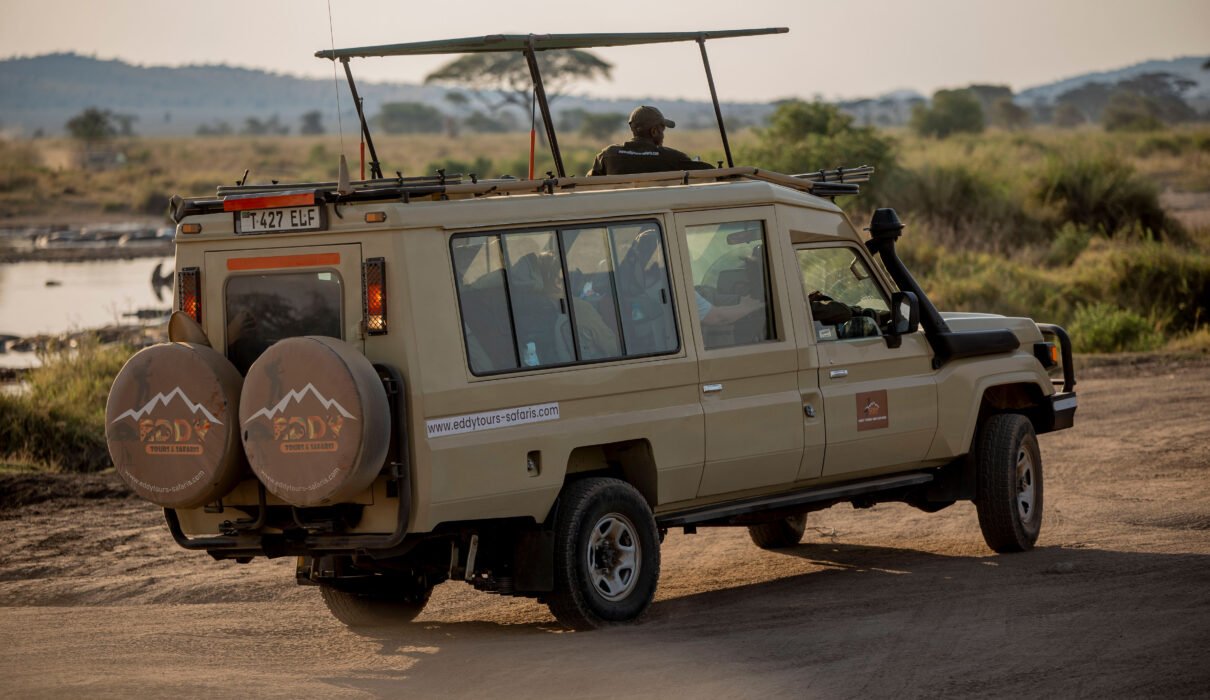
What does Tanzania look like beyond the safari photographs and economic headlines?
For some people, the country brings to mind Serengeti, Kilimanjaro and Zanzibar. Others encounter it through reports about poverty, investment or infrastructure. Each perspective reveals something, but none provides a complete picture.
Tanzania today includes economic growth alongside households facing financial insecurity. It includes major visitor destinations and communities whose livelihoods depend on activities far removed from tourism. Understanding the country requires looking at these experiences together.
For travellers planning with Eddy Tours & Safaris, this article offers context for the places and people encountered along the journey. It explores seven realities that help explain poverty, progress and perception without reducing Tanzania to a slogan.
The economic figures below refer to the years stated. Published data, estimates and forecasts should not be treated as interchangeable.
1. Economic Growth and Household Hardship Can Exist Together
A growing economy does not mean every household experiences the same improvement.
The World Bank’s country overview reports Tanzania’s economic growth at 5.9% in 2025. It projects growth above 6% in 2026, while also noting that poverty reduction has been slow. The 2026 figure is a forecast, rather than a completed annual result. You can consult the World Bank’s Tanzania overview for the wider assessment.
These findings are not contradictory. National output can rise while some households struggle to secure reliable income.
Think about the difference between an economy and a family budget. More construction, investment or business activity may increase total production. A household benefits when those changes translate into work, affordable services or opportunities it can actually access.
That connection may be stronger for some people than others. Someone with relevant skills or an established business may find an opportunity that remains unavailable to a person without capital, transport or training.
For visitors, visible development should encourage curiosity rather than quick conclusions. A new building tells you that something has changed. It does not tell you how widely the benefits are shared.
What this means: Assess progress through both economic indicators and people’s ability to improve their daily lives.
2. Poverty Figures Need Dates, Definitions and Geographical Context
A poverty percentage is useful only when its meaning is clear.
National poverty measures and international poverty lines serve different purposes. They should not be compared casually or presented as if they measure exactly the same thing.
The year matters too. The World Bank’s Tanzania data page lists a 2018 observation for the poverty headcount at the international line of $3.00 per person per day in 2021 purchasing-power-parity terms. That observation should not be described as a newly measured 2026 poverty rate.
Purchasing-power parity is a way of accounting for differences in what money can buy across countries. An international poverty line expressed in those terms is not simply a traveller’s daily cash budget converted into Tanzanian shillings.
When reading a claim, ask:
- Which poverty line is being used?
- What year does the figure describe?
- Is it based on a household survey, an estimate or a projection?
- Does it cover mainland Tanzania, Zanzibar or the whole country?
- Is it being compared with a genuinely comparable figure?
The World Bank’s Tanzania data page provides indicator dates, which are essential for interpreting its numbers.
What this means: A careful explanation is more useful than a dramatic percentage without context.
3. Employment Quality Matters as Much as Having Work
A person can work hard and still face financial insecurity.
Employment discussions often focus on whether someone has a job. Equally important questions concern earnings, stability, working conditions and the ability to plan beyond the next payment.
The World Bank’s February 2026 Tanzania Economic Update identifies a gap between formal job creation and rapid population growth, with substantial reliance on informal employment. Its Tanzania Economic Update page provides the report and its main findings.
Informal employment covers varied circumstances. It should not be used as shorthand for a lack of effort or ability.
Consider an illustrative example: a small trader may have customers and work every day, yet an unexpected illness or equipment repair could interrupt the business. Regular activity does not necessarily provide a financial cushion.
Tourism offers another useful example. Travellers see the guide, driver or hotel employee during their visit, but may know little about the person’s contract, seasonality or opportunities for advancement.
Ask questions respectfully if a conversation develops. Avoid assuming that a worker’s income or circumstances can be judged from their appearance.
What this means: Better livelihoods involve more than increasing the number of people engaged in work.
4. Education Is About Learning and Opportunity, Not Only Enrolment
Getting children into school is important. What they learn, whether they remain in school and how that learning supports their future also matter.
The February 2026 Tanzania Economic Update focuses on basic education. It highlights concerns including learning outcomes, retention, financing and uneven teacher distribution.
For a reader unfamiliar with development reporting, “human capital” can sound abstract. In everyday terms, it concerns the knowledge, skills and health people draw on to participate in society and earn a living.
Reading, numeracy and problem-solving can support many pathways. They matter for running a business, understanding instructions, keeping records and continuing education.
In tourism, learning may support language ability, guiding knowledge, food preparation, administration or digital booking work. These examples show possible connections between education and employment; they do not mean every student should enter tourism.
Visitors should also distinguish curiosity from intrusion. A school is a place of learning, not automatically an attraction. Any visit should have a clear purpose, appropriate permission and arrangements that protect children’s privacy.
What this means: The meaningful question is how education helps people gain skills and choices.
5. Infrastructure Progress Should Be Judged Through Everyday Use
New transport and energy projects are highly visible signs of development. They are often easier to photograph and describe than changes in household wellbeing.
The World Bank’s 2025 Economic Update discusses major infrastructure developments, including the Julius Nyerere Hydropower Project and the first Standard Gauge Railway segment. These belong to the country’s broader economic story, rather than proving that every service challenge has been resolved.
A useful way to assess infrastructure is to ask what it enables.
Does transport make it easier for people to reach jobs or markets? Can a small business use a service reliably and affordably? Are maintenance and access keeping pace with construction?
These are evaluation questions, not claims that every project succeeds or fails in the same way.
Travellers encounter infrastructure through transfers, communications and accommodation. Their experience may reveal something about a particular route or property, but it cannot establish conditions everywhere.
For travel planning, keep the practical question separate from the national headline. A new transport service matters to your journey only if its actual route, schedule and booking arrangements fit your itinerary.
What this means: The value of infrastructure lies in dependable benefits, as well as completed construction.
6. Tourism Can Create Value, but Visitors Should Ask Where It Goes
Tourism connects travellers with a range of businesses and workers. A booking may involve accommodation, transport, guiding, food suppliers and other services.
However, the distribution of that spending depends on the arrangements. You cannot calculate community benefit simply by looking at the advertised price of a safari.
Useful questions include who operates the trip, which services are included and how workers are treated. Local ownership can be relevant, but it should not replace questions about wages, working conditions and reliable payment.
Travellers can make considered choices without assuming responsibility for solving national poverty.
Practical steps include:
- Requesting clear information about crew welfare on a mountain climb.
- Paying agreed prices for services.
- Asking before photographing people.
- Choosing purchases thoughtfully rather than bargaining aggressively over every small amount.
- Checking the purpose and accountability of a project before donating.
If you want to support a community initiative, ask who identified the need and who manages the funds. Avoid assuming that a brief visit provides enough information to choose a solution for someone else.
The Kilimanjaro Responsible Trekking Organization offers one example of a specialist resource for travellers investigating mountain-crew welfare. Its focus is porter working conditions, rather than a general claim about all tourism businesses.
What this means: Responsible travel begins with clear arrangements and respect for the people providing the experience.
7. Headlines and Travel Impressions Are Both Incomplete
A headline selects a subject. A holiday itinerary selects places. Neither can represent every Tanzanian experience.
A report on poverty may correctly describe a serious challenge while saying little about cultural life, professional achievement or individual ambitions. A luxury travel photograph may accurately show an exceptional hotel while revealing little about life outside it.
The problem arises when one perspective is treated as the whole country.
Even helpful programmes need to be understood in context. A World Bank factsheet published in March 2026 explains the third phase of Tanzania’s Productive Social Safety Net programme, designed to support poorer households and strengthen livelihoods. Its PSSN III factsheet describes the programme’s purpose and earlier results.
That is evidence of organised action, not proof that poverty has disappeared. Equally, the existence of hardship does not mean nothing is improving.
Travel can broaden your understanding when you remain open to unfamiliar perspectives. Listen to what people choose to share, recognise the limits of a short visit and avoid using one conversation to make a national generalisation.
What this means: A balanced view makes room for progress, unresolved challenges and people’s own accounts of their lives.
How to Read Stories About Tanzania More Carefully
You do not need specialist economic training to ask better questions.
Start with the publication date, then identify the period the claim describes. A recent article may quote much older data. An annual forecast can also change before the year is complete.
Next, examine the measure. Economic growth, average income, poverty, inequality and employment describe different aspects of development. Improvement in one does not establish the same improvement in all the others.
Use the following checks:
| Claim | Question to ask |
|---|---|
| “The economy is growing” | Which year and measure does this describe? |
| “Poverty has declined” | Which poverty line and comparable periods are used? |
| “More people have jobs” | What kind of work, income and security are involved? |
| “A project will transform the country” | Is this a forecast, a completed project or measured impact? |
| “Tourism helps communities” | What arrangements or evidence support the claim? |
| “This is the real Tanzania” | Whose experience is included, and whose is missing? |
For a current overview, use reputable sources and read beyond a search-result snippet. Where figures differ, check definitions and data periods before deciding that one must be wrong.
What This Means for Your Visit
Understanding Tanzania does not require turning a holiday into a development study.
It can begin with ordinary behaviour: treating service providers respectfully, asking informed questions and allowing the country to be more complex than your expectations.
Be thoughtful about photographs and captions. A person’s home, work or appearance should not become evidence for a sweeping statement about poverty. Ask permission for identifiable portraits and avoid publishing personal details shared privately.
When planning cultural visits, choose activities with a clear purpose and transparent arrangements. Do not assume every encounter labelled “authentic” benefits the people involved.
Travel with curiosity, but remember that residents are not obliged to explain their finances or represent the whole country for you.
Frequently Asked Questions
Is Tanzania a poor country?
Tanzania is classified as a lower-middle-income economy, while many households continue to face poverty and insecurity. Country classification and household wellbeing are different measures.
Is Tanzania making economic progress?
Published sources document economic growth and development activity. How widely that progress improves living standards remains an important question.
Can I use one poverty percentage to describe Tanzania today?
Only with its definition, reference year and coverage clearly stated. An older survey observation should not be presented as a current measurement.
Does visiting help the local economy?
Your spending can support businesses and workers. The extent and distribution of the benefit depend on how services are organised and people are treated.
Should visitors give gifts or donations?
Make informed decisions. Ask about actual needs and accountable delivery arrangements rather than relying on an emotional appeal or brief impression.
Explore Tanzania With Eddy Tours & Safaris
Tanzania today deserves an informed view: one that appreciates its destinations while recognising the lives, work and ambitions beyond them.
To discuss a safari, Kilimanjaro climb or Zanzibar holiday, contact Eddy Tours & Safaris. Share your interests, dates and questions so your proposed journey can be reviewed clearly before booking.
Website: eddytours-safaris.com
Email: eddytoursandsafaris@gmail.com
Sales enquiries: sales@eddytours-safaris.com
Phone and WhatsApp: +255 711 906 664