
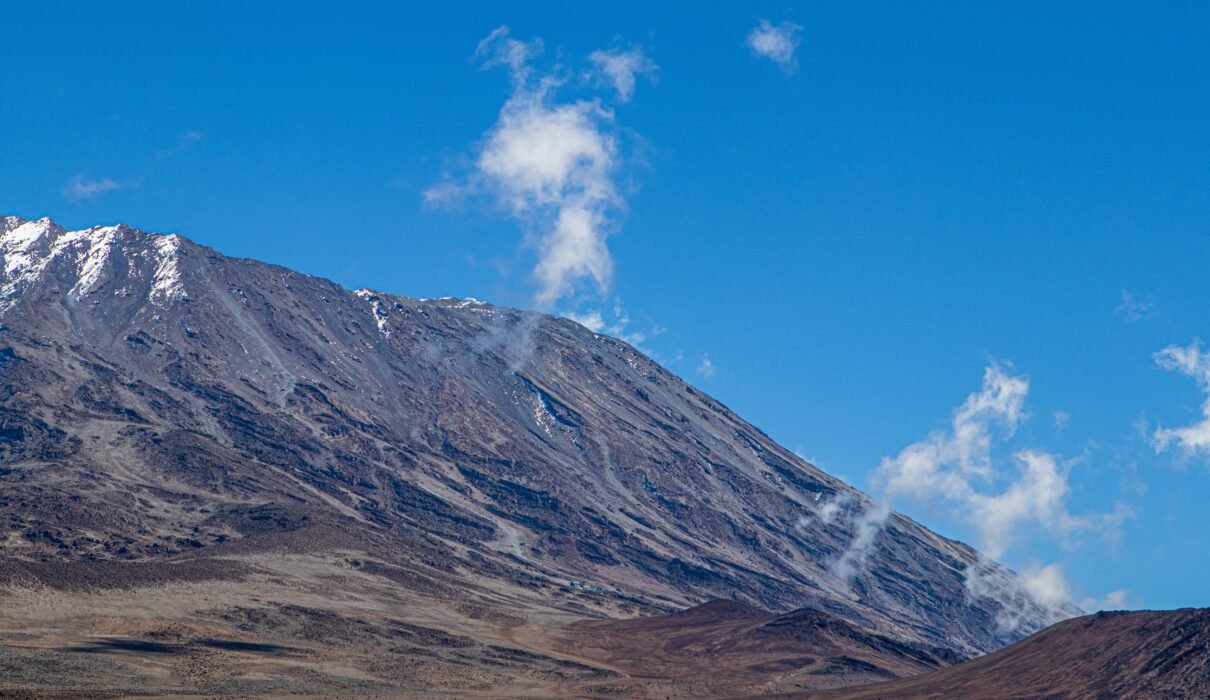
Geological History of Mount Kilimanjaro is one of the most fascinating subjects for travellers who want to understand what really created Africa’s highest mountain beyond beautiful photographs and summit stories. Kilimanjaro is not just a trekking destination. It is a giant natural laboratory that shows how volcanic forces, tectonic movement and long-term erosion shaped the landscape of northern Tanzania and the wider East African region.
This guide explains the origin of the mountain, the volcanic stages that formed its three main cones, and why this giant volcano still attracts scientists from around the world. If you are preparing your journey with a trusted local operator such as Eddy Tours & Safaris, learning about the geology beneath your feet will add real meaning to every step you take on the slopes of Kilimanjaro.
Geological History of Mount Kilimanjaro and the East African Rift system
The foundation of the Geological History of Mount Kilimanjaro is directly connected to the East African Rift, one of the most important tectonic systems on Earth. The slow separation of the African Plate is responsible for deep fractures in the crust that allow magma to rise toward the surface. Detailed geological explanations and tectonic models are provided by the United States Geological Survey and by global crustal research supported through NASA Earth Observatory.
Scientific assessments published by the British Geological Survey and regional geological synthesis developed by the International Atomic Energy Agency show how deep mantle processes drive volcanic activity along rift zones. Kilimanjaro rose where crustal weaknesses allowed repeated magma intrusion, creating a massive volcanic structure that dominates the surrounding plains.
Geological History of Mount Kilimanjaro and the birth of its volcanic cones
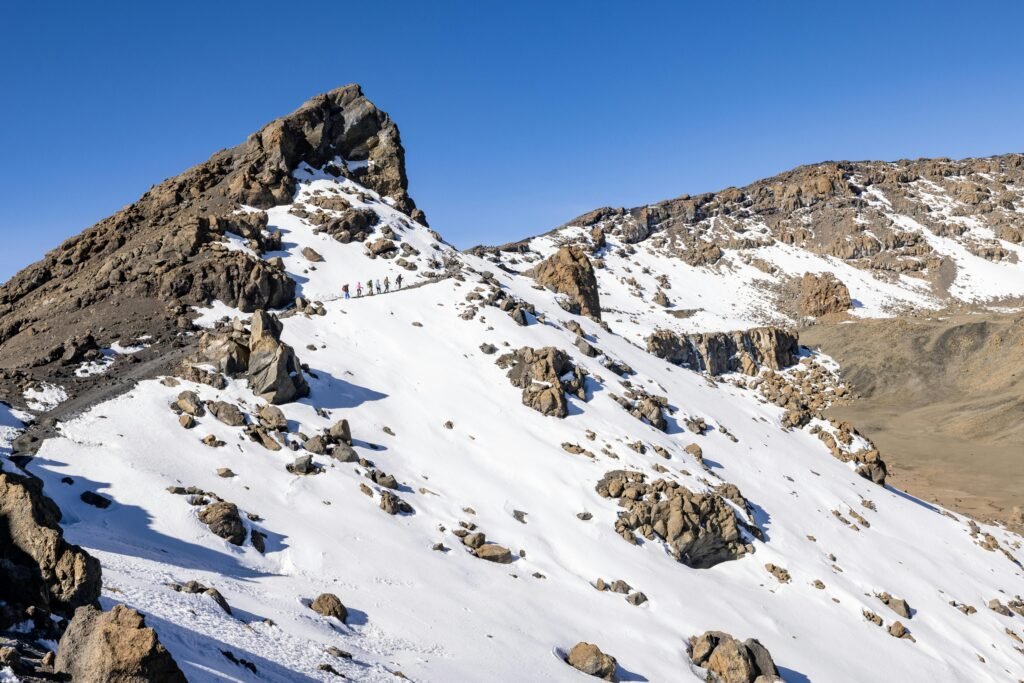
The most distinctive feature within the Geological History of Mount Kilimanjaro is the formation of three major volcanic centres: Shira, Mawenzi and Kibo. Each cone represents a different phase of volcanic growth and collapse. Volcanological studies published through ScienceDirect and peer-reviewed field research shared by Nature Research explain how successive eruptions gradually built these massive landforms.
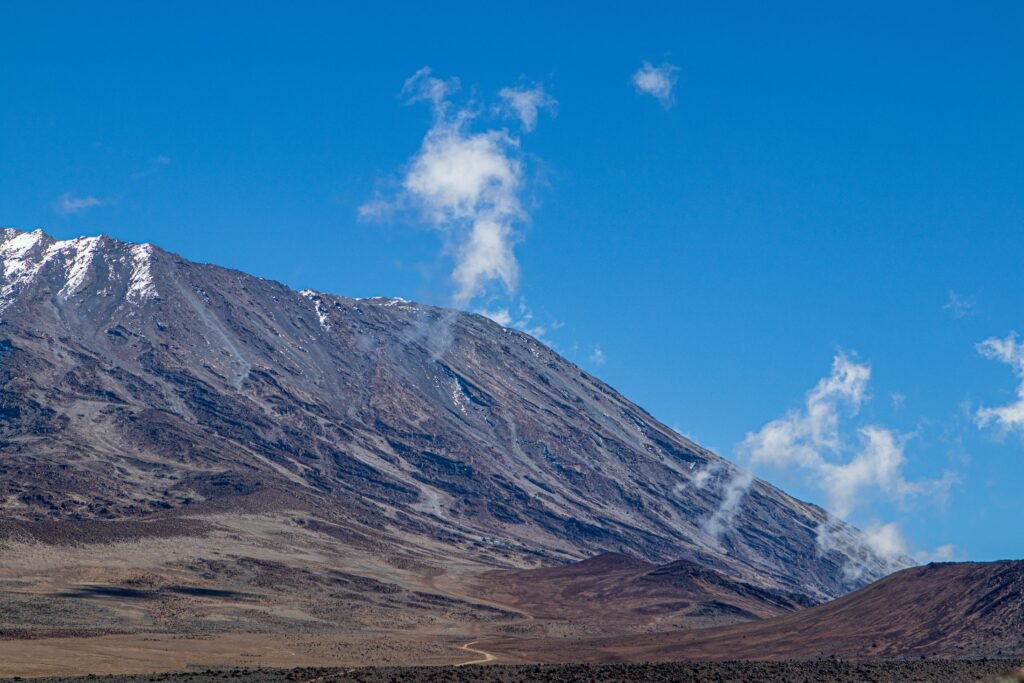
Shira is the oldest and heavily eroded, Mawenzi shows sharp rugged peaks formed by resistant lava and intrusive rocks, while Kibo is the youngest and hosts the summit crater. Global volcanic databases maintained by the Smithsonian Institution Global Volcanism Program classify Kilimanjaro as a dormant volcanic system whose final eruptions shaped the modern profile seen today.
Geological History of Mount Kilimanjaro and magma chemistry
Another important dimension of the Geological History of Mount Kilimanjaro lies in the chemical composition of its volcanic rocks. Petrological studies published through American Geophysical Union journals show that variations in magma chemistry reveal changes in mantle sources and crustal interaction during the mountain’s growth.
Geochemical investigations coordinated by the Geological Society of America and laboratory data presented by the National Institute of Standards and Technology demonstrate how different lava flows record separate volcanic episodes, allowing scientists to reconstruct eruption sequences with remarkable precision.
Geological History of Mount Kilimanjaro and erosion processes
The present shape of Kilimanjaro is not only a result of eruptions. The Geological History of Mount Kilimanjaro is equally defined by erosion, landslides and long-term weathering. Mountain geomorphology research presented by the United Nations Environment Programme highlights how rainfall, temperature variation and wind sculpt high-altitude landscapes.
Landform evolution studies supported by the International Union for Conservation of Nature show that fragile alpine and sub-alpine environments experience accelerated surface degradation when human activity is poorly managed. Understanding erosion patterns helps park authorities and conservation planners protect sensitive geological features around the mountain.
Geological History of Mount Kilimanjaro and glaciers on a volcano
A remarkable part of the Geological History of Mount Kilimanjaro is the presence of glaciers on a tropical volcano. Glaciological research from NASA Climate and global cryosphere studies supported by the Intergovernmental Panel on Climate Change explain how high altitude and atmospheric circulation allowed ice to persist on the summit.
Field measurements coordinated through the National Snow and Ice Data Center and environmental monitoring conducted by the National Oceanic and Atmospheric Administration show how changes in temperature and precipitation directly influence ice retreat. The summit glaciers are now key indicators of regional climate change in East Africa.
Geological History of Mount Kilimanjaro and biological landscapes
The Geological History of Mount Kilimanjaro directly controls the distribution of vegetation zones and wildlife habitats. Soil composition, slope stability and drainage patterns all originate from volcanic deposits. Ecological research coordinated by the World Wide Fund for Nature and regional biodiversity programmes run by the African Wildlife Foundation show how geological diversity supports multiple ecosystems on a single mountain.
Conservation mapping and species-habitat modelling developed by Conservation International and bird habitat assessments published by BirdLife International confirm that volcanic soils and elevation gradients strongly influence plant and animal distribution along Kilimanjaro’s slopes.
Geological History of Mount Kilimanjaro and scientific monitoring
Modern understanding of the Geological History of Mount Kilimanjaro depends on continuous research and monitoring. Seismic studies and volcanic risk models developed by the Global Facility for Disaster Reduction and Recovery help evaluate geological hazards in volcanic regions even when eruption probability is low.
Remote sensing and satellite terrain analysis supported by the European Space Agency allow scientists to detect subtle surface deformation and erosion trends across the mountain. These technologies provide essential data for conservation authorities and disaster preparedness agencies.
Geological History of Mount Kilimanjaro and human use of the mountain
Human interaction with Kilimanjaro is shaped by the Geological History of Mount Kilimanjaro. Trails, camps and infrastructure are planned around stable volcanic terrain and natural drainage corridors. Sustainable land-use guidance developed by the Food and Agriculture Organization shows how soil properties influence agriculture and settlement around volcanic mountains.
Social-environmental research coordinated through Oxfam International and labour standards promoted by the International Labour Organization highlight how sustainable tourism supports livelihoods while reducing pressure on fragile geological zones.
Geological History of Mount Kilimanjaro and responsible tourism
Responsible tourism now plays a vital role in protecting the Geological History of Mount Kilimanjaro. Visitor education programmes promoted by the National Geographic Society and heritage conservation frameworks developed by UNESCO show how protected landscapes can be used for learning without degrading sensitive landforms.
Many travellers choose professionally structured itineraries offered through Kilimanjaro climbing programmes that respect geological features, erosion limits and safety standards while offering expert interpretation of the mountain’s natural history.
Geological History of Mount Kilimanjaro and its meaning for climbers
For modern trekkers, the Geological History of Mount Kilimanjaro turns the climb into a living science lesson. Every lava ridge, crater wall and eroded valley tells a story of deep time, tectonic movement and climate variation. Understanding this background helps climbers walk with more awareness and respect for the mountain.
Visitors who explore the mountain with experienced local teams such as Tanzania travel specialists benefit from practical explanations of volcanic landforms and ecological transitions throughout the journey.
Plan your journey with geological understanding
The Geological History of Mount Kilimanjaro reminds us that this iconic mountain is far more than a summit goal. It is a powerful record of Earth’s internal forces and surface processes, preserved in lava layers, crater rims and glacial scars.
If you would like local guidance and professionally designed itineraries that respect both conservation rules and scientific knowledge, you can speak directly with experts through personal travel and climbing consultation support. A journey that understands the geology beneath your feet becomes deeper, safer and far more memorable.