
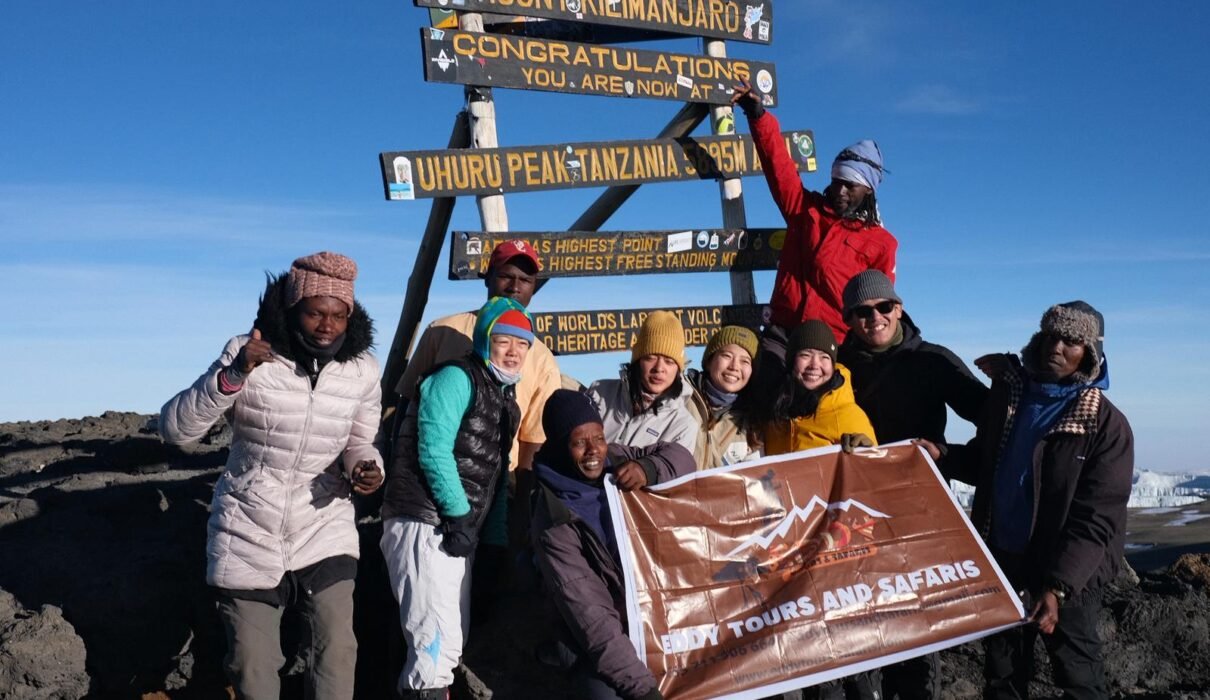
How to Choose the Best Kilimanjaro Route is one of the most important decisions you will make before climbing Africa’s highest mountain, because the route you choose directly affects your health, your safety, your enjoyment of the scenery and your real chance of standing on the summit with strength and confidence. Many climbers focus only on price or the number of days, but experienced mountain professionals know that the structure of the route, the altitude profile and the environmental conditions matter far more than speed.
This guide is written to help you make a calm and informed decision using medical research, conservation science and real field experience. If you are planning your journey with a reliable local company such as Eddy Tours & Safaris, this article will help you understand how to match your personal goals with the most suitable Kilimanjaro route, while respecting your body and the mountain environment.
How to Choose the Best Kilimanjaro Route based on your body and altitude science
Understanding How to Choose the Best Kilimanjaro Route starts with how the human body reacts to altitude. Scientific and clinical research published through the U.S. National Library of Medicine and the PubMed database clearly shows that gradual ascent is the strongest predictor of successful high-altitude adaptation. Routes that gain height slowly give your body more time to increase red blood cell production, adjust breathing patterns and regulate fluid balance.
Medical guidance from the Centers for Disease Control and Prevention and the International Society for Mountain Medicine confirms that routes with longer itineraries and better acclimatisation profiles significantly reduce the risk of altitude illness. When thinking about how to choose the best Kilimanjaro route, your first question should always be whether the route allows your body enough time to adapt safely.
How to Choose the Best Kilimanjaro Route using medical risk and recovery research
Another key part of How to Choose the Best Kilimanjaro Route is understanding medical risk and recovery. High-altitude stress affects sleep, appetite and physical coordination. Clinical studies shared by Johns Hopkins Medicine and the Cleveland Clinic show that poor sleep and dehydration strongly increase fatigue and headache at altitude.
Routes that include proper rest days and shorter daily walking distances help your body recover before summit night. Professional operators apply medical screening and daily health checks based on international safety principles promoted by the World Health Organization. This makes route design a health decision, not just a travel preference.
How to Choose the Best Kilimanjaro Route according to weather and climate patterns
When learning How to Choose the Best Kilimanjaro Route, it is essential to understand how weather interacts with the mountain’s geography. Kilimanjaro crosses several climate zones, and each route is exposed differently to wind, cold and cloud cover. Climate research published by NASA Climate and environmental assessments from the Intergovernmental Panel on Climate Change show that isolated high mountains experience rapid weather shifts and strong solar radiation.
Environmental monitoring coordinated by the United Nations Environment Programme confirms that exposed ridges and alpine desert zones lose heat quickly at night. Routes that offer better shelter, safer camping areas and more flexible timing allow guides to adapt to weather conditions and protect climbers from unnecessary cold stress.
How to Choose the Best Kilimanjaro Route with environmental responsibility in mind
Environmental protection is an important part of How to Choose the Best Kilimanjaro Route. Kilimanjaro lies within fragile ecosystems that are protected under international conservation frameworks. Organisations such as the International Union for Conservation of Nature, World Wide Fund for Nature and the African Wildlife Foundation highlight how visitor pressure, erosion and waste management directly affect mountain biodiversity.
Research supported by Conservation International and the United States Geological Survey shows that concentrated foot traffic on poorly managed routes accelerates soil loss and trail degradation. Choosing routes that are properly regulated and supported by park infrastructure helps protect water sources and sensitive alpine vegetation.
How to Choose the Best Kilimanjaro Route for scenery and learning value
Many people forget that How to Choose the Best Kilimanjaro Route also determines what you see and learn along the way. Educational and environmental interpretation frameworks promoted by the National Geographic Society show that exposure to diverse habitats strengthens environmental awareness and visitor understanding of ecological processes.
Routes that pass through forest, heathland, moorland and alpine desert provide a natural classroom where guides can explain wildlife behaviour, plant adaptation and geological history. Biodiversity organisations such as BirdLife International and conservation science programmes supported by Panthera highlight the importance of habitat diversity for wildlife survival around the mountain.
How to Choose the Best Kilimanjaro Route based on leadership and guide systems
Professional leadership is central to How to Choose the Best Kilimanjaro Route. Research on expedition leadership and risk management published through ScienceDirect and peer-reviewed studies from Nature Research confirm that guide decision-making strongly influences safety and group performance in high-stress environments.
International safety and leadership standards promoted by the International Climbing and Mountaineering Federation and training models developed by the National Outdoor Leadership School emphasize route choice as a leadership responsibility. Routes that allow flexible pacing, alternative camps and early descent options provide guides with better tools to protect climbers.
How to Choose the Best Kilimanjaro Route for emergency response and rescue access
Emergency preparedness is often ignored when people think about How to Choose the Best Kilimanjaro Route. Disaster and emergency coordination principles promoted by the International Federation of Red Cross and Red Crescent Societies show that access points, communication coverage and evacuation corridors are critical in remote terrain.
Risk-reduction frameworks supported by the World Bank Disaster Risk Management programme demonstrate that structured routes with ranger support and defined evacuation paths significantly improve emergency response reliability. This is one of the strongest arguments for selecting professionally managed routes rather than simply choosing the cheapest option.
How to Choose the Best Kilimanjaro Route if you are a first-time high-altitude hiker
For beginners, How to Choose the Best Kilimanjaro Route should focus on safety and learning, not speed. Public health and physiological research from the Harvard T.H. Chan School of Public Health and high-altitude studies published in Frontiers in Physiology show that previous altitude experience is helpful but not essential when acclimatisation and supervision are properly designed.
First-time climbers benefit most from routes that offer longer schedules, steady elevation gain and experienced supervision. Many visitors rely on carefully planned itineraries available through Kilimanjaro climbing programs that are structured to support both safety and learning.
How to Choose the Best Kilimanjaro Route with ethics and porter welfare in mind
Ethical responsibility forms an important part of How to Choose the Best Kilimanjaro Route. Labour standards and fair employment principles promoted by the International Labour Organization and social development programmes supported by Oxfam International show that good working conditions improve team health, morale and safety.
Routes that are well supported logistically allow porters and guides to work reasonable distances, manage loads safely and maintain proper nutrition. Healthy and respected crews are more attentive to client well-being and environmental protection.
How to Choose the Best Kilimanjaro Route through scientific and conservation collaboration
Scientific collaboration also shapes How to Choose the Best Kilimanjaro Route. Long-term environmental monitoring and biodiversity research depend on controlled access to sensitive mountain zones. Conservation and ecological studies published by the Wildlife Conservation Society and global research networks supported by UNESCO highlight the importance of well-regulated visitation.
Field research logistics and data collection often follow academic and operational guidance supported by United Nations Academic Impact and university research programmes such as those coordinated by Harvard University research initiatives. Routes that align with these conservation and research priorities help protect Kilimanjaro for future generations.
How to Choose the Best Kilimanjaro Route with honest local planning support
In real practice, How to Choose the Best Kilimanjaro Route becomes easier when you receive advice from professionals who work on the mountain every week. Local experts understand current trail conditions, water availability, campsite pressure and ranger regulations better than distant booking agents.
You can review balanced and professionally structured options through local travel and safari specialists who combine wildlife, culture and mountain logistics under one responsible planning system.
How to Choose the Best Kilimanjaro Route and turn planning into a confident decision
So, what does How to Choose the Best Kilimanjaro Route truly mean in practice? It means choosing health over shortcuts, knowledge over marketing promises, and responsibility over rushed schedules. The best route is not the fastest route. It is the route that respects your body, supports your guides and porters, protects fragile ecosystems and allows enough time for learning, recovery and enjoyment.
If you would like personalised advice based on your fitness level, travel goals and preferred comfort level, you can speak directly with experienced local planners through professional Kilimanjaro consultation support. Making the right route choice is the strongest foundation for a safe, meaningful and successful climb.