
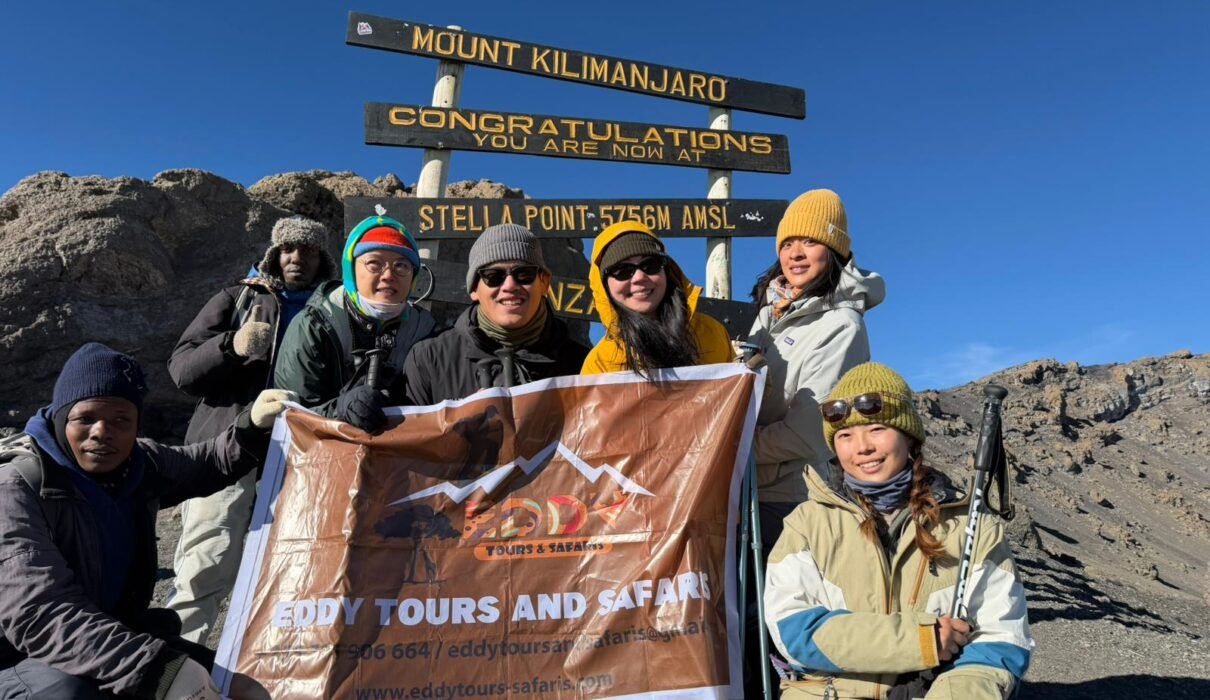
Marangu Route: The Classic “Coca-Cola” Route is the best-known and most historic trekking trail on Mount Kilimanjaro, and it remains the only route that offers permanent mountain huts instead of tents for overnight stays. For many first-time climbers, this route represents comfort, tradition and a direct path to Africa’s highest mountain summit, but its popularity also creates important safety, environmental and planning questions that every climber should clearly understand before making a final booking.
This detailed guide explains what truly makes the Marangu Route unique, how it earned its famous nickname, how science and conservation research view this trail today, and how responsible trekking can protect the mountain for future generations. If you are planning your climb with a reliable local company such as Eddy Tours & Safaris, this article will help you decide whether this classic route truly fits your personal goals and physical preparation.
Marangu Route: The Classic “Coca-Cola” Route and its historical background
The story of Marangu Route: The Classic “Coca-Cola” Route begins with early access paths developed on the southeastern side of Mount Kilimanjaro, long before modern trekking tourism existed. This trail followed natural ridges and forest corridors that were already used by local communities and early explorers. Historical geographic documentation and volcanic landscape studies published through United States Geological Survey show that the southeastern slopes offered relatively stable terrain compared to other parts of the mountain.
Over time, the trail became the first officially developed hiking route, complete with constructed huts and controlled access points. Research articles available through ScienceDirect and academic publications distributed by Nature Research describe how early mountain infrastructure strongly influenced modern tourism patterns across high-altitude protected areas worldwide, including Kilimanjaro.
Marangu Route: The Classic “Coca-Cola” Route and the origin of its nickname
Many climbers are curious about why Marangu Route: The Classic “Coca-Cola” Route carries such a distinctive name. The nickname comes from the early days when refreshments and basic supplies were more commonly available at the huts compared to other routes. This reputation for relative comfort made the route appear easier and more accessible, especially to first-time visitors who preferred sheltered accommodation.
However, modern mountain medicine and trekking research published through the U.S. National Library of Medicine and indexed in PubMed clearly show that comfort does not reduce altitude risk. The human body reacts to elevation in the same way on every route, regardless of hut accommodation.
Marangu Route: The Classic “Coca-Cola” Route and its geographical structure
From a physical landscape perspective, Marangu Route: The Classic “Coca-Cola” Route climbs steadily through multiple ecological zones, beginning in dense montane forest and gradually rising into heath, moorland and alpine desert. Geomorphological and volcanic studies published by the United States Geological Survey explain how Mount Kilimanjaro’s stratovolcanic structure shapes the slope gradients that define this route.
Environmental monitoring projects coordinated through International Union for Conservation of Nature confirm that these transition zones are among the most sensitive ecosystems on the mountain. The Marangu corridor therefore plays a major role in conservation planning because it channels a large share of visitor traffic through fragile forest and high-altitude vegetation areas.
Marangu Route: The Classic “Coca-Cola” Route and altitude adaptation science
Understanding altitude is central to evaluating Marangu Route: The Classic “Coca-Cola” Route. Medical guidance published by the Centers for Disease Control and Prevention and the International Society for Mountain Medicine explains that rapid elevation gain without sufficient acclimatization significantly increases the risk of acute mountain sickness.
Clinical research supported by Johns Hopkins Medicine and reviewed in medical literature indexed on PubMed confirms that steady ascent profiles and extra adaptation days dramatically improve physical performance and safety at high elevation. Because this route follows the same trail up and down, it is especially important to plan realistic pacing rather than focusing only on speed or budget.
Marangu Route: The Classic “Coca-Cola” Route and climate exposure
Climate conditions strongly influence the experience of Marangu Route: The Classic “Coca-Cola” Route. High-altitude climate research published by NASA Climate and global assessments released by the Intergovernmental Panel on Climate Change demonstrate how isolated tropical mountains are highly sensitive to temperature and wind fluctuations.
Environmental studies coordinated through the United Nations Environment Programme highlight that alpine desert zones along this route experience increasing dehydration stress and rapid weather changes, which directly affect walking efficiency, hydration management and thermal comfort during the summit phase.
Marangu Route: The Classic “Coca-Cola” Route and environmental protection
Environmental responsibility is now a major part of how Marangu Route: The Classic “Coca-Cola” Route is managed. Conservation organisations such as the World Wide Fund for Nature, the African Wildlife Foundation and Conservation International consistently show that concentrated tourism corridors require strict waste control and visitor flow regulation.
Land-use monitoring data produced by the United States Geological Survey and conservation education programs supported by the National Geographic Society confirm that erosion, vegetation damage and water contamination increase rapidly when trekking routes are not professionally managed.
Marangu Route: The Classic “Coca-Cola” Route and wildlife and forest conservation
The lower sections of Marangu Route: The Classic “Coca-Cola” Route pass through biologically rich montane forest zones that support bird species, primates and unique plant communities. Biodiversity assessments coordinated by BirdLife International and carnivore research programs led by Panthera show how forest corridors on large mountains remain important refuge systems for many species.
Conservation monitoring supported by the Wildlife Conservation Society demonstrates that controlled visitor behaviour, noise reduction and strict trail use are essential to limit disturbance in these habitats.
Marangu Route: The Classic “Coca-Cola” Route and safety management
Professional safety systems are essential along Marangu Route: The Classic “Coca-Cola” Route. Emergency preparedness frameworks developed by the International Federation of Red Cross and Red Crescent Societies and public health guidance published by the World Health Organization stress the importance of trained staff, clear evacuation protocols and effective communication devices in remote terrain.
Risk reduction models promoted by the World Bank Disaster Risk Management programme highlight how structured access routes such as Marangu allow faster response times compared with more remote mountain environments.
Marangu Route: The Classic “Coca-Cola” Route and porter welfare
Ethical labour practice is an increasingly important part of how Marangu Route: The Classic “Coca-Cola” Route operates today. Social protection frameworks promoted by the International Labour Organization and community support initiatives led by Oxfam International demonstrate that fair employment and safe working conditions improve both operational quality and staff well-being.
Healthy and motivated mountain crews provide better logistical coordination, safety awareness and communication throughout the trek.
Marangu Route: The Classic “Coca-Cola” Route and scientific observation value
High-altitude research continues to benefit from controlled access along Marangu Route: The Classic “Coca-Cola” Route. Ecological monitoring and climate modelling projects published through Frontiers in Environmental Science and environmental field studies supported by the Food and Agriculture Organization use mountain corridors to assess vegetation shifts and water availability trends.
Academic collaboration supported by research networks such as Harvard University research initiatives and global education frameworks promoted by the United Nations Academic Impact reinforce the importance of preserving mountain access for both science and public learning.
Marangu Route: The Classic “Coca-Cola” Route for first-time climbers
For beginners, Marangu Route: The Classic “Coca-Cola” Route remains attractive because of its hut accommodation and well-established logistics. Public health research from the Harvard T.H. Chan School of Public Health and physiological studies published in Frontiers in Physiology confirm that previous altitude experience is not required when acclimatization is properly managed.
What matters most is realistic pacing, honest self-reporting of symptoms and professional guidance throughout the ascent.
Marangu Route: The Classic “Coca-Cola” Route and professional local planning
Many climbers who choose Marangu Route: The Classic “Coca-Cola” Route prefer working directly with experienced Tanzanian operators who understand daily mountain conditions. Professionally designed itineraries such as those available through Kilimanjaro climbing programs combine acclimatization science, safety systems and environmental responsibility.
Travelers who wish to combine their climb with wildlife experiences can also explore structured options through Tanzania safari specialists who coordinate responsible travel across multiple protected areas.
Plan your Marangu Route experience with confidence
Choosing Marangu Route: The Classic “Coca-Cola” Route means choosing history, comfort and tradition, but it also means accepting the responsibility that comes with trekking on one of Africa’s most sensitive and heavily visited mountain corridors.
If you would like honest advice about route choice, acclimatization planning and ethical trekking practice, you can speak directly with local professionals through personal climbing consultation support. A well-planned Marangu experience becomes not only a summit attempt, but a meaningful journey that respects science, people and the mountain itself.