
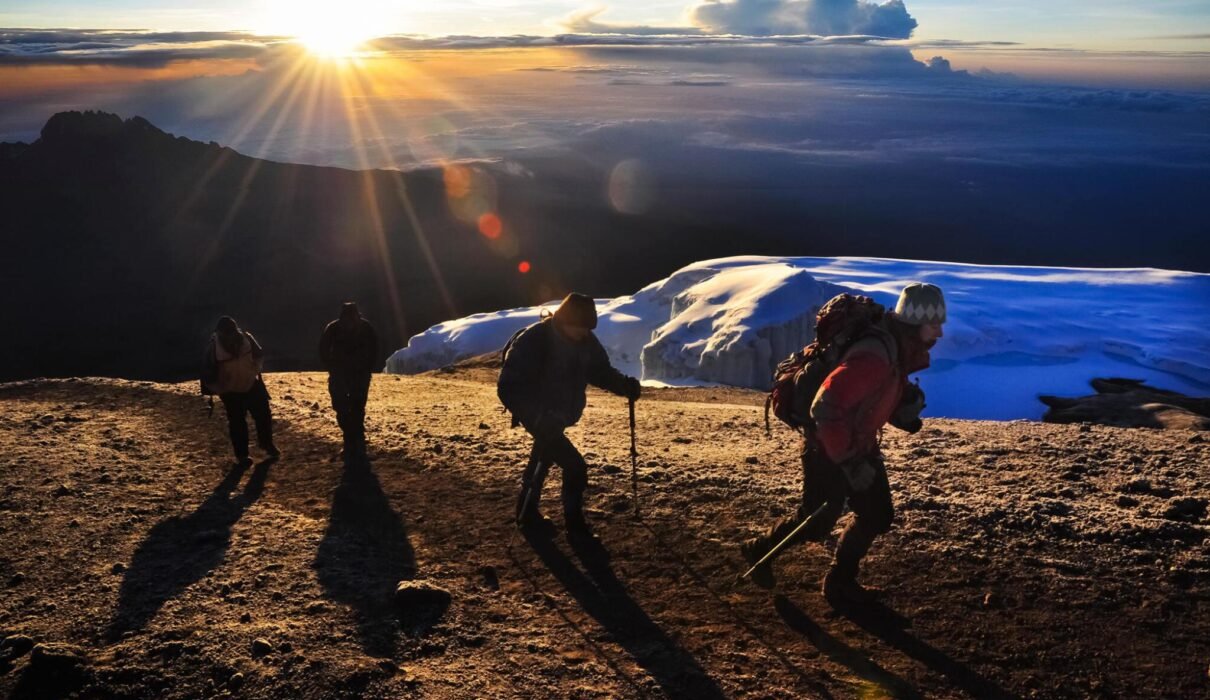
Complete 5 Days Marangu Route Kilimanjaro is one of the shortest established routes to the summit of Mount Kilimanjaro. It is a popular choice among travelers who have limited time in Tanzania and prefer staying in mountain huts rather than camping in tents.
Known as the Coca-Cola Route, Marangu approaches Kilimanjaro from the southeastern side of the mountain. The trail begins at Marangu Gate and passes through beautiful rainforest, open moorland, and rocky high-altitude landscapes before reaching Kibo Hut, where climbers prepare for their final ascent to Uhuru Peak.
At 5,895 meters above sea level, Uhuru Peak is the highest point in Africa. Reaching the summit is a memorable achievement, but it requires good preparation, patience, and the ability to walk for several hours at high altitude.
The five-day itinerary follows a direct schedule without a separate acclimatization day. Although it is shorter and usually costs less than the six-day version, the faster ascent gives climbers less time to adjust to altitude. For most travelers, the six-day Marangu Route or a longer Kilimanjaro itinerary is a better choice.
At Eddy Tours and Safaris, we help travelers plan Kilimanjaro climbing trips according to their available time, experience, and preferred travel dates. Whether you are planning a private climb or looking for a joining group in 2027 or 2028, our team can help you discuss suitable options.
This guide explains the complete five-day Marangu Route itinerary, daily walking distances, accommodation, estimated prices, preparation, and important information to know before booking.
5 Days Marangu Route Kilimanjaro Climbing Overview
| Tour information | Details |
|---|---|
| Tour name | 5 Days Marangu Route Kilimanjaro Climbing |
| Destination | Mount Kilimanjaro, Tanzania |
| Duration | 5 days and 4 nights |
| Starting point | Marangu Gate |
| Ending point | Marangu Gate |
| Starting elevation | Approximately 1,860 meters |
| Highest point | Uhuru Peak, 5,895 meters |
| Accommodation | Shared mountain huts |
| Mountain huts | Mandara, Horombo and Kibo |
| Total walking distance | Approximately 70 kilometers |
| Difficulty | Challenging |
| Acclimatization day | Not included |
| Best climbing seasons | January–March and June–October |
| Travel period | 2027/2028 |
| Tour type | Private or joining group, subject to availability |
Walking times, distances, and elevations are approximate. They can vary depending on weather, trail conditions, and the group’s pace.
Why Choose the 5 Days Marangu Route?
The Marangu Route is different from most other Kilimanjaro climbing routes because it uses permanent mountain huts for overnight accommodation.
While routes such as Machame, Lemosho, and Rongai generally require climbers to sleep in tents, Marangu provides shared sleeping rooms at Mandara Hut, Horombo Hut, and Kibo Hut.
This makes the route attractive to travelers who prefer having a roof over their heads, especially during cold mountain nights.
Another advantage is that the trail is well established. The lower sections have relatively gradual slopes, although the final climb from Kibo Hut to the summit is steep and demanding.
The route also passes through several beautiful landscapes. You begin in the rainforest, continue through open moorland, cross the high-altitude Saddle, and eventually reach the rocky summit area.
However, the biggest disadvantage of the five-day itinerary is the limited time for acclimatization.
Climbers ascend from Marangu Gate to Kibo Hut in just three days before attempting the summit. This increases the risk of altitude sickness compared with a slower itinerary.
If your travel schedule allows, we recommend considering the six-day Marangu Route because it includes an additional acclimatization day at Horombo Hut.
Complete 5 Days Marangu Route Kilimanjaro Climbing Itinerary
The following itinerary covers five days on Mount Kilimanjaro, starting and ending at Marangu Gate. Hotel accommodation before and after the climb can be arranged separately or included in your confirmed package.
Day 1: Moshi to Marangu Gate – Hike to Mandara Hut
Starting elevation: 1,860 meters
Ending elevation: 2,720 meters
Hiking distance: Approximately 8 kilometers
Walking time: 4–5 hours
Habitat: Rainforest
Your Kilimanjaro adventure begins in Moshi, a town located near the southern slopes of Mount Kilimanjaro.
After breakfast at your hotel, you meet your mountain guide and the rest of the climbing team. Your guide checks your equipment and explains the day’s activities, walking pace, and safety arrangements.
You then drive to Marangu Gate, the starting point of the Marangu Route.
The journey takes you through local villages, banana plantations, coffee farms, and green countryside. Depending on traffic and your hotel location, the drive usually takes around one hour.
When you arrive at the gate, your guide completes the national park registration procedures. Meanwhile, the porters organize the food, equipment, and luggage needed for the expedition.
After registration, you begin walking through Kilimanjaro’s rainforest.
The trail is surrounded by tall trees, ferns, and thick vegetation. The forest is often cool and humid, and the path can become muddy after rainfall.
You may see monkeys or hear different birds along the trail, although wildlife sightings are never guaranteed.
Your guide will encourage you to walk slowly and take regular breaks. There is no need to rush, especially because your body is beginning to adjust to the increasing altitude.
After approximately four to five hours, you reach Mandara Hut.
The hut is located at around 2,720 meters and provides basic shared accommodation.
If you arrive early and feel comfortable, your guide may suggest a short walk toward Maundi Crater, where you can enjoy views of the surrounding area when the weather is clear.
You return to Mandara Hut for dinner and your first night on the mountain.
Accommodation: Mandara Hut
Meals: Lunch and dinner
Day 2: Mandara Hut to Horombo Hut
Starting elevation: 2,720 meters
Ending elevation: 3,720 meters
Hiking distance: Approximately 11–12 kilometers
Walking time: 6–8 hours
Habitat: Moorland
After breakfast, you leave Mandara Hut and continue climbing toward Horombo Hut.
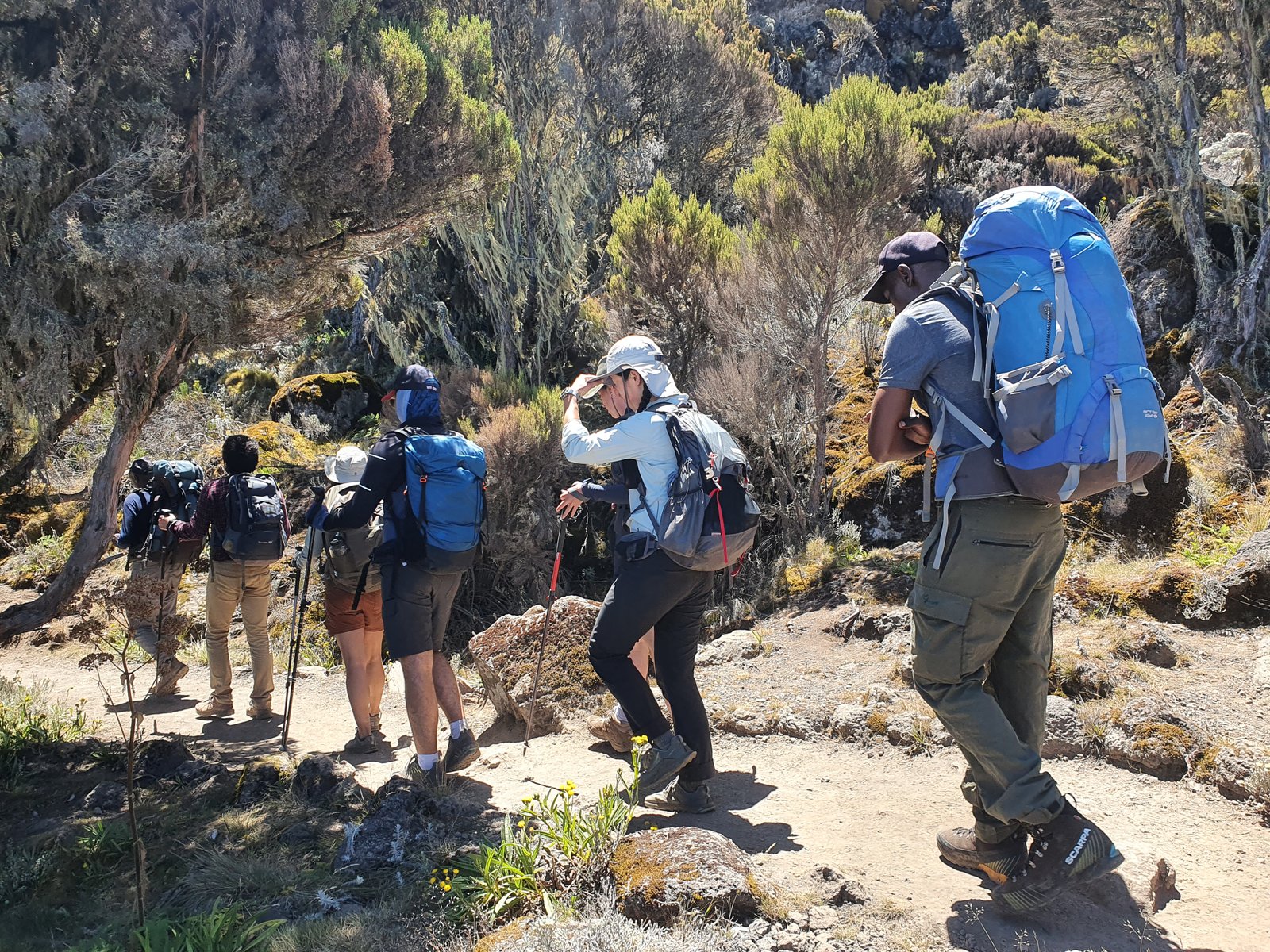
During the first part of the walk, the trail passes through the upper sections of the forest. As you gain altitude, the trees gradually become smaller and the landscape opens into moorland.
This change in scenery is one of the most interesting parts of the Marangu Route.
You begin seeing mountain grasses, shrubs, giant groundsels, and other plants that grow at higher elevations.
On a clear day, you can enjoy beautiful views of Mawenzi and Kibo, the two main peaks visible from this part of Kilimanjaro.
Mawenzi has steep, rocky peaks, while Kibo is the large volcanic cone where Uhuru Peak is located.
The trail continues uphill across open slopes.
Although the path is not technically difficult, the increasing altitude may make walking more tiring than on the first day.
Your guide will encourage a comfortable pace and check how you are feeling.
It is important to report headaches, nausea, dizziness, or unusual tiredness rather than trying to ignore them.
After approximately six to eight hours, you arrive at Horombo Hut.
Horombo Hut is located at about 3,720 meters and is one of the main accommodation points on the Marangu Route.
The area offers impressive views of the upper mountain when the weather is clear.
After arriving, you settle into your shared accommodation and enjoy a warm meal.
Your guide will explain the following day’s walk to Kibo Hut and remind you to rest before moving to a higher altitude.
Accommodation: Horombo Hut
Meals: Breakfast, lunch and dinner
Day 3: Horombo Hut to Kibo Hut
Starting elevation: 3,720 meters
Ending elevation: Approximately 4,700 meters
Hiking distance: Approximately 10–11 kilometers
Walking time: 5–7 hours
Habitat: Alpine desert
Today, you continue from Horombo Hut toward Kibo Hut, the final overnight stop before the summit attempt.
After breakfast, you leave the moorland behind and begin walking through a much drier landscape.
The trail gradually climbs toward the Saddle, a wide area of high-altitude land between Mawenzi and Kibo.
This section is very different from the rainforest you experienced on the first day.
There are few plants, the ground is rocky, and the landscape becomes increasingly open.
When the weather is clear, you can see Mawenzi rising on one side and Kibo ahead of you.
The trail is generally well marked, but the altitude makes the walk demanding.
You may notice that you need more time to catch your breath, even when walking slowly.
Your guide will encourage regular breaks and monitor the group’s condition.
After approximately five to seven hours, you arrive at Kibo Hut, located at around 4,700 meters above sea level.
Kibo Hut provides basic shared accommodation in a cold and exposed part of the mountain.
After arriving, you have a meal and prepare your equipment for the summit attempt.
Your guide will explain the route toward Gilman’s Point and Uhuru Peak, including the expected departure time and safety procedures.
You should prepare your warm jacket, gloves, hat, headlamp, drinking water, and snacks before going to bed.
The summit attempt normally begins around midnight, so you will have only a few hours to rest.
Accommodation: Kibo Hut
Meals: Breakfast, lunch and dinner
Day 4: Kibo Hut to Uhuru Peak – Descend to Horombo Hut
Starting elevation: Approximately 4,700 meters
Summit elevation: 5,895 meters
Ending elevation: 3,720 meters
Hiking distance: Approximately 20–22 kilometers
Walking time: 12–16 hours
Habitat: Summit zone and alpine desert
Day four is the most challenging day of your Kilimanjaro climb.
You normally wake late at night and prepare for the final ascent to Uhuru Peak.
After a light meal or warm drink, you put on your warmest clothing and begin walking with your mountain guide.
The trail climbs steeply over loose volcanic rocks and scree.
Because you are walking in darkness, your headlamp is essential. The temperature may be well below freezing, and strong winds can make conditions even colder.
Your guide will maintain a very slow pace.
At this altitude, even a few steps can feel difficult, so it is important to conserve your energy and follow the guide’s instructions.
As you climb higher, you may pass Hans Meyer Cave before reaching the steeper sections below the crater rim.
After several hours of climbing, you reach Gilman’s Point at approximately 5,685 meters.
Gilman’s Point is located on the crater rim and is an important milestone on the Marangu Route.
However, it is not the highest point on Kilimanjaro.
If you are feeling well and conditions are safe, you continue along the crater rim toward Stella Point and Uhuru Peak.
The final section may involve snow, ice, and strong winds depending on the weather.
Eventually, you reach Uhuru Peak, the highest point in Africa at 5,895 meters.
For many climbers, this is the moment they have been working toward for months or even years.
When visibility is good, you can enjoy views of the crater and the remaining glaciers.
After taking photographs, you begin descending toward Kibo Hut.
You normally stop at Kibo Hut for a short rest and a meal before continuing downhill to Horombo Hut.
Although descending is faster than climbing, the long walk can be tiring, especially after the summit attempt.
You arrive at Horombo Hut for dinner and overnight rest.
Accommodation: Horombo Hut
Meals: Breakfast, lunch and dinner
Day 5: Horombo Hut to Marangu Gate – Return to Moshi
Starting elevation: 3,720 meters
Ending elevation: 1,860 meters
Hiking distance: Approximately 19–20 kilometers
Walking time: 5–7 hours
Habitat: Moorland and rainforest
After breakfast at Horombo Hut, you begin your final descent toward Marangu Gate.
The trail follows the same general route used during the ascent.
You walk through open moorland before reaching the forest zone.
As you descend, the air becomes warmer and the vegetation becomes thicker.
You pass Mandara Hut along the way and continue through the rainforest.
The trail can be muddy or slippery after rain, so you should continue walking carefully.
Although the final day is less demanding than summit day, your legs may still be tired from the previous day’s long descent.
After several hours, you arrive at Marangu Gate.
Your guide completes the national park exit procedures, and climbers who reached the relevant summit points may receive official climbing certificates.
You then meet your driver and return to Moshi.
At your hotel, you can enjoy a shower, change into comfortable clothes, and rest after five days on Mount Kilimanjaro.
If you have more time in Tanzania, you may choose to continue your holiday with a wildlife safari or a Zanzibar beach trip.
Meals: Breakfast and lunch
End of the 5 Days Marangu Route Kilimanjaro Climbing Itinerary.
5 Days Marangu Route Itinerary Summary
| Day | Hiking route | Overnight |
|---|---|---|
| Day 1 | Marangu Gate to Mandara Hut | Mandara Hut |
| Day 2 | Mandara Hut to Horombo Hut | Horombo Hut |
| Day 3 | Horombo Hut to Kibo Hut | Kibo Hut |
| Day 4 | Kibo Hut to Uhuru Peak, descend to Horombo | Horombo Hut |
| Day 5 | Horombo Hut to Marangu Gate | Return to Moshi |
5 Days Marangu Route Kilimanjaro Prices for 2027/2028
The cost of climbing Kilimanjaro through the five-day Marangu Route depends on the number of climbers, the type of expedition, park fees, mountain crew arrangements, and services included.
Private climbs are organized for your booking party, while joining groups bring together travelers who follow the same itinerary.
Estimated Private Climbing Prices
| Number of climbers | Estimated price per person |
|---|---|
| 1 person | $1,950–$2,450 |
| 2 people | $1,650–$2,100 |
| 3 people | $1,550–$2,000 |
| 4 people | $1,450–$1,900 |
| 5 people | $1,400–$1,850 |
| 6 or more | $1,350–$1,800 |
Estimated Joining Group Price
A five-day Marangu joining-group climb may cost approximately $1,350–$1,900 per person, depending on the number of climbers and services included.
The final price for 2027 or 2028 should be confirmed through an official quotation.
Why Do Kilimanjaro Climbing Prices Vary?
Kilimanjaro climbing prices are influenced by national park entry fees, hut accommodation charges, mountain crew wages, food, transport, and other operating expenses.
The number of climbers also affects the total cost because some expenses can be shared between participants.
When comparing quotations, check what is included and whether the operator provides suitable equipment, professional guides, and proper safety arrangements.
Choosing the cheapest package without reviewing these details may result in unexpected expenses or poor service.
What Is Included in the 5 Days Marangu Route Package?
A typical professionally organized Marangu climbing package may include:
- Kilimanjaro National Park entry fees.
- Mountain hut accommodation fees.
- Licensed mountain guides.
- Porters and mountain cooking crew.
- Meals during the five-day climb.
- Drinking water prepared according to the operator’s procedures.
- Shared accommodation at Mandara, Horombo, and Kibo huts.
- Transport from Moshi to Marangu Gate and back.
- Pre-climb briefing and equipment checks.
- Mountain safety monitoring.
The exact inclusions will be listed in your confirmed Eddy Tours and Safaris quotation.
What Is Not Included?
The following expenses are commonly excluded unless otherwise stated:
- International flights.
- Tanzania visa fees.
- Personal travel insurance.
- Personal trekking equipment.
- Sleeping bag rental or purchase.
- Tips for mountain guides, porters, and cooks.
- Extra hotel nights.
- Personal expenses.
- Optional safari or Zanzibar extensions.
Travelers should make sure their insurance covers high-altitude trekking and emergency evacuation.
Marangu Route Accommodation: Where Will You Sleep?
The Marangu Route uses permanent mountain huts rather than camping tents.
The accommodation is basic and shared, but it provides an indoor sleeping area that many climbers prefer.
Mandara Hut
Mandara Hut is located at approximately 2,720 meters in the rainforest zone.
It is the first overnight stop and provides shared sleeping accommodation and communal facilities.
Horombo Hut
Horombo Hut is located at approximately 3,720 meters in the moorland zone.
On the five-day itinerary, climbers stay here on the second night and return after the summit attempt.
Kibo Hut
Kibo Hut is located at approximately 4,700 meters in the alpine desert zone.
It is the final overnight stop before the summit attempt.
Temperatures can be very cold, and climbers need suitable sleeping bags and warm clothing.
Is the 5 Days Marangu Route Difficult?
Yes. The five-day Marangu Route is a demanding high-altitude trek.
Although some sections have relatively gradual slopes, the final ascent to Uhuru Peak is steep and physically exhausting.
The main challenge is the altitude.
Climbers reach Kibo Hut at approximately 4,700 meters on the third day and attempt the summit only a few hours later.
This gives the body very little time to adjust to the reduced oxygen levels.
Even physically fit travelers can develop altitude sickness.
For this reason, the five-day Marangu Route is not the preferred option for most first-time high-altitude climbers.
5 Days vs 6 Days Marangu Route: Which Should You Choose?
| Feature | 5 Days Marangu | 6 Days Marangu |
|---|---|---|
| Total duration | 5 days | 6 days |
| Mountain nights | 4 | 5 |
| Extra acclimatization day | No | Yes |
| Zebra Rocks hike | Usually not included | Included |
| Summit attempt | Day 4 | Day 5 |
| Accommodation | Mountain huts | Mountain huts |
| Time to adjust to altitude | Limited | More |
| Overall schedule | Faster | More gradual |
| Preferred for most climbers | No | Yes |
The six-day itinerary is generally a better choice because it provides an extra acclimatization day at Horombo Hut.
However, even six days is a relatively short Kilimanjaro expedition. Travelers with more time may benefit from considering longer routes.
Best Time to Climb the Marangu Route in 2027/2028
Mount Kilimanjaro can be climbed throughout the year, but some months generally provide more favorable weather conditions.
January through early March and June through October are popular climbing periods.
January and February often have relatively favorable conditions, while June through October is the main dry season.
April and May are commonly associated with the long rainy season, and November may bring additional rainfall.
Even during the dry season, the mountain can experience strong winds, freezing temperatures, rain, and snow.
Travelers should prepare for changing conditions regardless of the month.
What Should You Pack for the 5 Days Marangu Route?
Although Marangu provides mountain huts, you still need proper trekking equipment.
The temperature changes significantly as you climb higher, so your clothing must be suitable for both warm rainforest conditions and freezing summit temperatures.
Important equipment includes:
- Waterproof hiking boots.
- Thermal base layers.
- Warm fleece or insulated jacket.
- Waterproof jacket and trousers.
- Warm summit jacket.
- Insulated gloves.
- Warm hat.
- Trekking poles.
- Headlamp with spare batteries.
- Sunglasses and sunscreen.
- Sleeping bag suitable for freezing conditions.
- Comfortable daypack.
- Reusable water bottles.
- Personal medication and basic hygiene items.
Your tour operator should provide a complete packing list before departure.
Altitude Sickness and Safety on the Marangu Route
Altitude sickness is one of the most important risks when climbing Mount Kilimanjaro.
As you climb higher, the air pressure decreases and your body receives less oxygen.
Common symptoms include headaches, nausea, dizziness, unusual tiredness, and difficulty sleeping.
If you experience these symptoms, inform your mountain guide immediately.
Severe symptoms such as confusion, difficulty walking normally, or breathlessness at rest require urgent medical attention and may require immediate descent.
The five-day itinerary provides very limited time for acclimatization.
Climbers should never continue ascending with worsening symptoms simply because they want to reach the summit.
A responsible climbing expedition should include trained guides, appropriate health monitoring, and a clear emergency plan.
Can Beginners Climb the 5 Days Marangu Route?
Some physically prepared beginners may be capable of completing the five-day Marangu Route, but it is not the best option for most people with no previous high-altitude experience.
The short schedule increases the risk of altitude-related problems.
If you are climbing Kilimanjaro for the first time, consider the six-day Marangu Route or a longer itinerary that provides additional acclimatization time.
Your route choice should be based on your health, previous experience, and available time rather than price alone.
Can You Combine the Marangu Route with a Tanzania Safari?
Yes. Many travelers combine their Kilimanjaro climb with a wildlife safari in northern Tanzania.
After completing the mountain expedition, you can visit Serengeti National Park, Ngorongoro Crater, Tarangire National Park, or Lake Manyara National Park.
A three- to five-day safari can provide opportunities to see elephants, lions, giraffes, zebras, buffaloes, and other wildlife.
It is advisable to allow some recovery time after the climb before beginning a long safari journey.
Can You Visit Zanzibar After Climbing Kilimanjaro?
Yes. Zanzibar is a popular destination for travelers who want to relax after a Kilimanjaro expedition.
The island offers beautiful beaches, comfortable resorts, historical attractions, and opportunities for snorkeling and other coastal activities.
A Zanzibar holiday can be a relaxing way to finish your Tanzania trip.
Frequently Asked Questions About the 5 Days Marangu Route
How many days does the Marangu Route take?
The Marangu Route is commonly completed in five or six days. The six-day version includes an extra acclimatization day.
Is the five-day Marangu Route enough to reach Uhuru Peak?
Some climbers reach Uhuru Peak on the five-day itinerary, but the short schedule provides limited acclimatization time. Reaching the summit is never guaranteed.
Is the Marangu Route easier than Machame?
Marangu has relatively gradual lower trails and uses mountain huts, but the summit attempt remains difficult. A shorter Marangu itinerary can also present greater altitude-related challenges than a longer Machame itinerary.
How much does the five-day Marangu Route cost?
Illustrative prices may range from approximately $1,350 to $2,450 per person, depending on group size and inclusions. Actual prices require a confirmed quotation.
Do climbers sleep in tents on Marangu?
No. The standard Marangu Route uses permanent mountain huts.
Where does the Marangu Route start?
The route starts at Marangu Gate on the southeastern side of Mount Kilimanjaro.
Where does the Marangu Route finish?
The route finishes at Marangu Gate, following the same general trail used during the ascent.
What is the highest point on the Marangu Route?
Uhuru Peak, at 5,895 meters above sea level.
What is the hardest day on the five-day Marangu Route?
Day four is generally the hardest because climbers attempt the summit from Kibo Hut before descending to Horombo Hut.
Is the Marangu Route suitable for solo travelers?
Yes. Solo travelers may book a private expedition or join a suitable group departure, subject to availability.
What is the best month to climb Marangu?
January, February, and the main dry-season months from June through October are generally popular choices.
Can I climb Marangu without a guide?
No. Kilimanjaro climbing requires arrangements through licensed mountain guiding services.
Can I combine Marangu with a Serengeti safari?
Yes. A Kilimanjaro climb can be combined with a wildlife safari to Serengeti, Ngorongoro, Tarangire, and other destinations.
Final Thoughts: Is the 5 Days Marangu Route Worth It?
The five-day Marangu Route offers a direct way to experience Mount Kilimanjaro through an established trail with permanent mountain hut accommodation.
During the climb, you pass through rainforest, moorland, alpine desert, and the cold summit environment.
The route provides beautiful scenery and an opportunity to attempt Uhuru Peak, the highest point in Africa.
However, the five-day itinerary is demanding because it provides very little time for acclimatization.
For most travelers, the six-day Marangu Route or a longer Kilimanjaro itinerary is a more sensible choice.
If you decide to climb in five days, make sure you are properly prepared, understand the altitude risks, and choose a professional mountain team that prioritizes safety.
Book Your 5 Days Marangu Route Kilimanjaro Climb with Eddy Tours and Safaris
Are you planning to climb Mount Kilimanjaro through the Marangu Route in 2027 or 2028?
Eddy Tours and Safaris can help you discuss available climbing dates, private or joining-group arrangements, equipment requirements, and the services included in your expedition.
Contact our team with your preferred travel dates, number of climbers, and previous hiking experience.
Website: www.eddytours-safaris.com
Contact page: Plan Your Kilimanjaro Climb
Email: sales@eddytours-safaris.com
WhatsApp: +255 711 906 664
Request your personalized five-day Marangu Route quotation and plan your Kilimanjaro adventure with Eddy Tours and Safaris.