
Meaning and Origin of the Name “Kilimanjaro” is one of the most interesting and emotional questions for travellers who come to Tanzania, because the name of this mountain is not just a label on a map, but a reflection of language, history, belief, and the long relationship between local communities and the land surrounding Africa’s highest peak.
When visitors hear the word Kilimanjaro for the first time, it often sounds mysterious and powerful. Many people assume the meaning is simple and fixed, yet research, oral traditions, and historical records show that the name has several interpretations, shaped by different languages and cultural viewpoints that developed around the mountain over many generations.
Meaning and Origin of the Name “Kilimanjaro” and early linguistic roots
The most widely discussed explanations connect the name to languages spoken by communities living around the mountain, especially the Chagga and Swahili-speaking groups. Linguistic and cultural research supported by institutions such as The British Museum and long-term African studies documented by SOAS University of London show that many place names in East Africa evolved through interaction between indigenous languages and later regional trade languages such as Swahili.
Several scholars suggest that the first part of the name, “Kili”, may be linked to words describing a mountain or elevated place, while the second part, “Njaro” or “Jaro”, is often associated with ideas of brightness, whiteness, or something remarkable seen from a distance. Historical and linguistic documentation collected by JSTOR and digital African language archives hosted by Endangered Languages Archive show that variations of these terms appear in different dialects spoken around the Kilimanjaro region.
Meaning and Origin of the Name “Kilimanjaro” in Chagga oral tradition
Among the Chagga people, who have lived on the fertile slopes of the mountain for centuries, the mountain has always carried spiritual and cultural meaning. Cultural heritage research supported by UNESCO highlights how oral traditions play a central role in preserving indigenous interpretations of place names and landscapes. According to many local accounts, the mountain was not simply named for geography, but for its visible and symbolic presence in daily life.
Anthropological research published through AnthroSource and African ethnographic collections maintained by Smithsonian National Museum of Natural History show that the mountain was often associated with rain, fertility, and protection. For farming communities, the snow-capped summit and cloud cover were interpreted as signs of water and life, which may explain why words linked to brightness, whiteness, or shining appearance appear in local explanations of the name.
Meaning and Origin of the Name “Kilimanjaro” and Swahili influence
As long-distance trade expanded along the East African coast and inland routes, Swahili became an important regional language. Historical studies supported by The Metropolitan Museum of Art and East African history research shared by The British Library show how Swahili words gradually blended with inland languages and local place names.
Some interpretations link “Kilimanjaro” to a combination of Swahili and local expressions, where the name may have been reshaped to match pronunciation patterns familiar to traders, missionaries, and early explorers. Linguistic fieldwork archived by Glottolog and African language classification projects hosted by Ethnologue confirm that multiple spelling and pronunciation forms existed before standard mapping practices fixed the modern version of the name.
Meaning and Origin of the Name “Kilimanjaro” and early European records
The first written references to the mountain in European sources appear in travel and missionary records. Historical mapping and exploration documents preserved by The National Archives of the United Kingdom and academic historical geography research available through The Royal Society Publishing show that early visitors often recorded the name using local pronunciation, which varied between communities.
Because of this, different spellings and meanings were reported in early texts, sometimes causing confusion that still exists today. This explains why no single explanation has been accepted as absolutely final by modern scholars.
Meaning and Origin of the Name “Kilimanjaro” and the natural environment
The physical character of the mountain itself plays an important role in how people describe and name it. Environmental and geographical studies coordinated by United Nations Environment Programme and ecosystem assessments by the International Union for Conservation of Nature show that Kilimanjaro’s unique ecological zones, from forest to alpine desert, strongly influence how communities perceive the mountain.
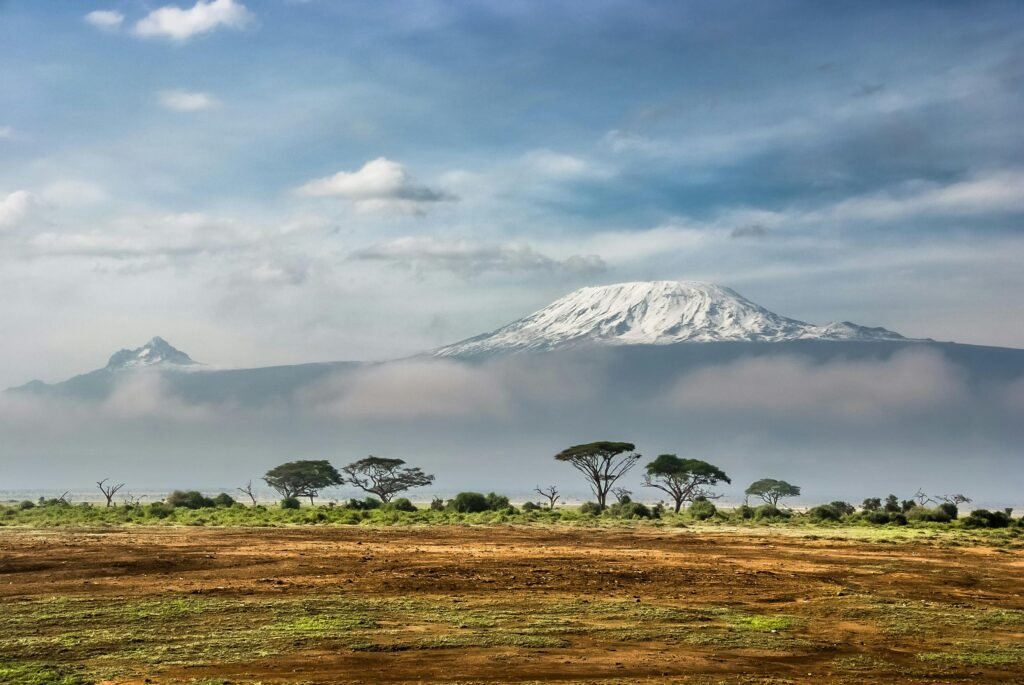
Glacier and mountain climate research shared by the National Snow and Ice Data Center and atmospheric studies coordinated by the World Meteorological Organization confirm that the bright summit and cloud systems are visible across very long distances. This visible contrast between white summit and dark forest is often cited by researchers as a possible reason why words related to brightness or shining appearance became linked with the mountain’s name.
Meaning and Origin of the Name “Kilimanjaro” and cultural identity today
For people living around the mountain today, the name still carries meaning far beyond tourism. Social development and cultural identity research supported by the UN Department of Economic and Social Affairs shows that traditional place names remain important for preserving heritage and community identity. Academic cultural studies published through ScienceDirect also show that naming landscapes strengthens people’s connection to conservation and land stewardship.
Community-based tourism projects that respect cultural heritage are increasingly recognised by organisations such as Conservation International and The Nature Conservancy as important tools for protecting both nature and local traditions around protected landscapes.
Meaning and Origin of the Name “Kilimanjaro” and responsible travel experience
Understanding the story behind the mountain’s name adds depth to every visit. Travellers who explore Kilimanjaro with cultural sensitivity gain a stronger appreciation for the people who have protected these landscapes long before national parks existed. Visitors who plan their journeys through Eddy Tours and Safaris are introduced to local guides who share cultural stories, farming traditions and environmental knowledge linked to the mountain.
Many guests also choose custom cultural and hiking programmes through local Kilimanjaro travel services, which allow travellers to combine nature walks, village visits and conservation education in one experience.
Meaning and Origin of the Name “Kilimanjaro” and conservation awareness
Today, the name Kilimanjaro is closely linked to environmental protection. Mountain ecosystem conservation strategies promoted by the World Wide Fund for Nature and biodiversity protection initiatives coordinated by the Global Biodiversity Information Facility support research and conservation work in and around the mountain ecosystem. Forest and land-use research by the Center for International Forestry Research further helps protect the forest belt that supports both local communities and wildlife.
Visitors who include cultural interpretation and conservation learning in their itinerary through responsible Kilimanjaro experiences directly support community projects and environmental education programmes.
Meaning and Origin of the Name “Kilimanjaro” and why it still matters to travellers
The story behind the mountain’s name reminds visitors that Kilimanjaro is not only a destination for adventure, but a living cultural landscape shaped by language, belief and environment. Choosing travel experiences through trusted local tour specialists helps protect both the natural environment and the cultural stories that give the mountain its true identity.
In simple words, the meaning and origin of the name Kilimanjaro reflect how people have seen this mountain for centuries – as a powerful, shining presence, deeply connected to life, land and community. Understanding this story makes every journey to the mountain richer, more respectful and far more memorable.