
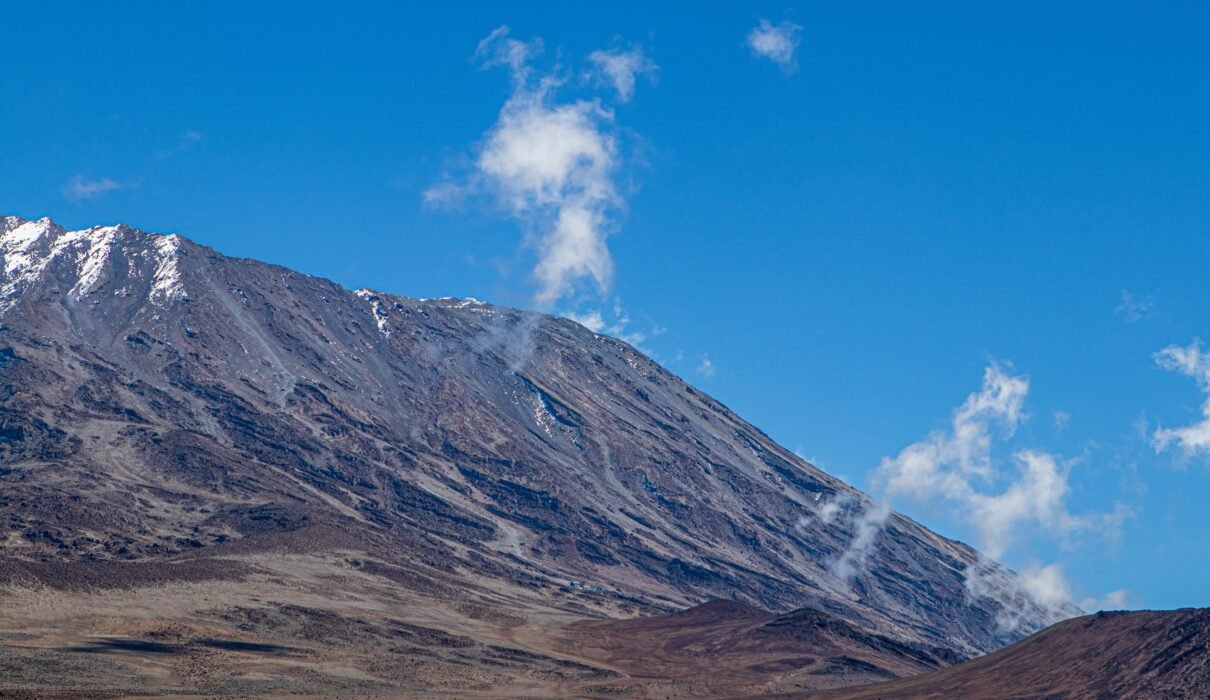
The History of Mawenzi Peak is one of the most fascinating and least told stories on Mount Kilimanjaro, because this sharp and dramatic summit carries a deeper scientific and cultural legacy than many travelers ever realize. While most visitors focus on reaching Uhuru Peak, Mawenzi stands quietly beside it, shaped by fire, erosion, and centuries of local meaning, forming what many scientists describe as one of East Africa’s most striking volcanic remnants.
This story of Mawenzi is not only about rock and altitude. It is about ancient geological forces, the survival of rare alpine ecosystems, and the long relationship between local communities and the mountain. If you explore Kilimanjaro with a responsible local company such as Eddy Tours & Safaris, understanding this hidden peak adds depth to every step you take on the mountain.
The History of Mawenzi Peak and the birth of Kilimanjaro’s volcanic system
To understand The History of Mawenzi Peak, we must first understand how the entire Kilimanjaro massif was formed. Geological research published by the United States Geological Survey explains that Kilimanjaro developed from repeated volcanic eruptions driven by deep tectonic forces linked to the East African Rift. Mawenzi represents one of the oldest and most heavily eroded volcanic cones in the mountain group.
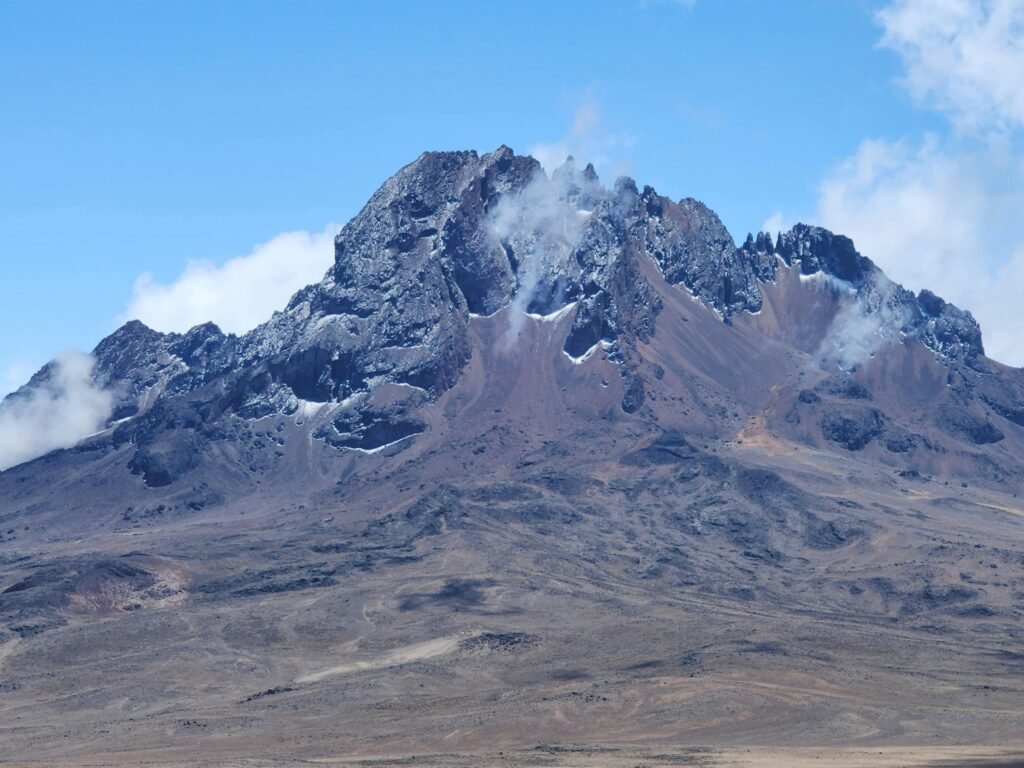
Studies shared through the British Geological Survey and academic summaries available on ScienceDirect confirm that Mawenzi’s jagged ridges were created when volcanic activity stopped and long-term erosion slowly removed softer materials. What remains today is a hard, resistant volcanic core that gives Mawenzi its dramatic spires and knife-like ridgelines.
The History of Mawenzi Peak and the shaping of a broken mountain
When scientists describe The History of Mawenzi Peak, they often refer to it as a collapsed and deeply eroded stratovolcano. Research published in international earth science journals and distributed via PubMed explains that long-term exposure to wind, temperature change, rainfall and gravity has slowly broken the original volcanic structure apart.
Environmental geomorphology studies supported by the National Geographic Society show that high mountain erosion creates unique landforms that are not only visually impressive but also extremely fragile. Mawenzi’s sharp towers, steep gullies and unstable rock faces are clear evidence of how time reshapes even the most powerful volcanic mountains.
The History of Mawenzi Peak and ancient climate influence
Another important layer of The History of Mawenzi Peak is the role of ancient climate cycles. Climate reconstruction projects supported by NASA Climate and high-altitude climate modelling coordinated by the Intergovernmental Panel on Climate Change show that repeated cold and warm phases dramatically influenced erosion and vegetation patterns on Kilimanjaro.
These climate shifts created freeze–thaw processes that fractured Mawenzi’s rock faces and opened deep cracks that are still visible today. Research shared through the Nature Research platform explains how mountain environments preserve long records of climate change inside their rock layers and soil deposits.
The History of Mawenzi Peak and its unique alpine ecosystems
The biological side of The History of Mawenzi Peak is just as remarkable as its geology. Conservation organisations such as the International Union for Conservation of Nature and the Conservation International confirm that Kilimanjaro’s high-altitude zones host rare plant communities found almost nowhere else on Earth.
Ecological monitoring coordinated by the United Nations Environment Programme and species distribution research supported by BirdLife International demonstrate how these alpine habitats survive under extreme cold, intense sunlight and low oxygen levels. Mawenzi’s slopes provide small protected micro-habitats where specialised plants can persist despite harsh conditions.
The History of Mawenzi Peak and wildlife movement on Kilimanjaro
Although large mammals rarely reach high elevations, The History of Mawenzi Peak is still connected to broader wildlife movement patterns on Kilimanjaro. Landscape connectivity research promoted by the African Wildlife Foundation and long-term ecosystem monitoring by the World Wide Fund for Nature show that mountain forests below Mawenzi act as important corridors for wildlife and water systems.
Studies coordinated by the Wildlife Conservation Society explain how protection of highland ecosystems helps stabilize lowland habitats and supports entire conservation networks far beyond the mountain itself.
The History of Mawenzi Peak and local cultural meaning
For local communities, The History of Mawenzi Peak goes far beyond science. Social and cultural research supported by UNESCO shows that mountains often hold deep spiritual and symbolic meaning in many societies. Mawenzi has long been regarded as a powerful and respected presence within the wider Kilimanjaro landscape.
Anthropological studies published through JSTOR and regional heritage research supported by Harvard University research programmes confirm that oral traditions, sacred stories and place names preserve important historical memory connected to the mountain.
The History of Mawenzi Peak and early scientific exploration
European scientific interest in The History of Mawenzi Peak began when early explorers and geologists documented the unusual volcanic structure of Kilimanjaro. Archival research and scientific expedition records preserved through the Royal Geographical Society reveal how Mawenzi attracted attention because of its dramatic contrast to the smoother dome of Kibo.
Modern geological mapping projects coordinated by the Geological Society of London continue to use Mawenzi as a key reference point for understanding volcanic evolution in East Africa.
The History of Mawenzi Peak and conservation management today
Today, The History of Mawenzi Peak is closely tied to conservation planning and protected area management. Biodiversity protection frameworks developed by the Intergovernmental Science-Policy Platform on Biodiversity and Ecosystem Services and global land monitoring supported by the Food and Agriculture Organization help guide how fragile mountain environments should be managed.
Protected mountain ecosystems are also monitored through satellite analysis and terrain assessment conducted by institutions such as the European Space Agency, allowing conservation planners to track vegetation change, erosion patterns and climate impacts around Mawenzi.
The History of Mawenzi Peak and the risks of human pressure
Another important chapter in The History of Mawenzi Peak concerns growing tourism pressure. Sustainable tourism studies published by the OECD Environment Directorate and environmental governance research supported by Transparency International warn that poor management can accelerate environmental degradation in sensitive mountain zones.
Responsible operators follow strict trail use, waste control and visitor education practices. This is why travelers who choose experienced local teams such as Kilimanjaro climbing specialists directly contribute to reducing unnecessary environmental stress on Mawenzi and the surrounding alpine zone.
The History of Mawenzi Peak and the modern trekking experience
For many travelers, The History of Mawenzi Peak becomes personal when they stand on nearby ridges and look across its dramatic spires. Responsible tourism organizations emphasize that learning the story of a place improves visitor behaviour and respect for fragile environments.
Travelers who include educational interpretation in their journey often gain far more than a simple hiking experience. Carefully designed programs offered through Tanzania travel and safari programs allow visitors to combine wildlife experiences with deeper understanding of mountain landscapes and conservation challenges.
The History of Mawenzi Peak and why it remains Tanzania’s hidden gem
Despite standing beside Africa’s most famous summit, The History of Mawenzi Peak remains largely unknown to the wider public. Its rugged terrain makes technical climbing difficult, and its fragile ecosystems demand careful protection rather than heavy visitation.
This limited access has quietly preserved Mawenzi’s wild character. Unlike busier trekking corridors, the Mawenzi zone still offers a powerful sense of isolation and geological drama that reflects the true ancient identity of Kilimanjaro.
The History of Mawenzi Peak and planning a responsible visit
Learning The History of Mawenzi Peak helps travelers make better and more responsible decisions when visiting Kilimanjaro. Ethical planning means choosing routes that respect environmental limits, listening to local expertise and supporting conservation-based operations.
If you wish to explore Kilimanjaro in a way that respects its hidden landscapes and cultural meaning, you can speak directly with local specialists through professional local consultation support. A well-planned journey allows you to appreciate Mawenzi not simply as a background mountain, but as one of Tanzania’s most powerful and meaningful natural symbols.