
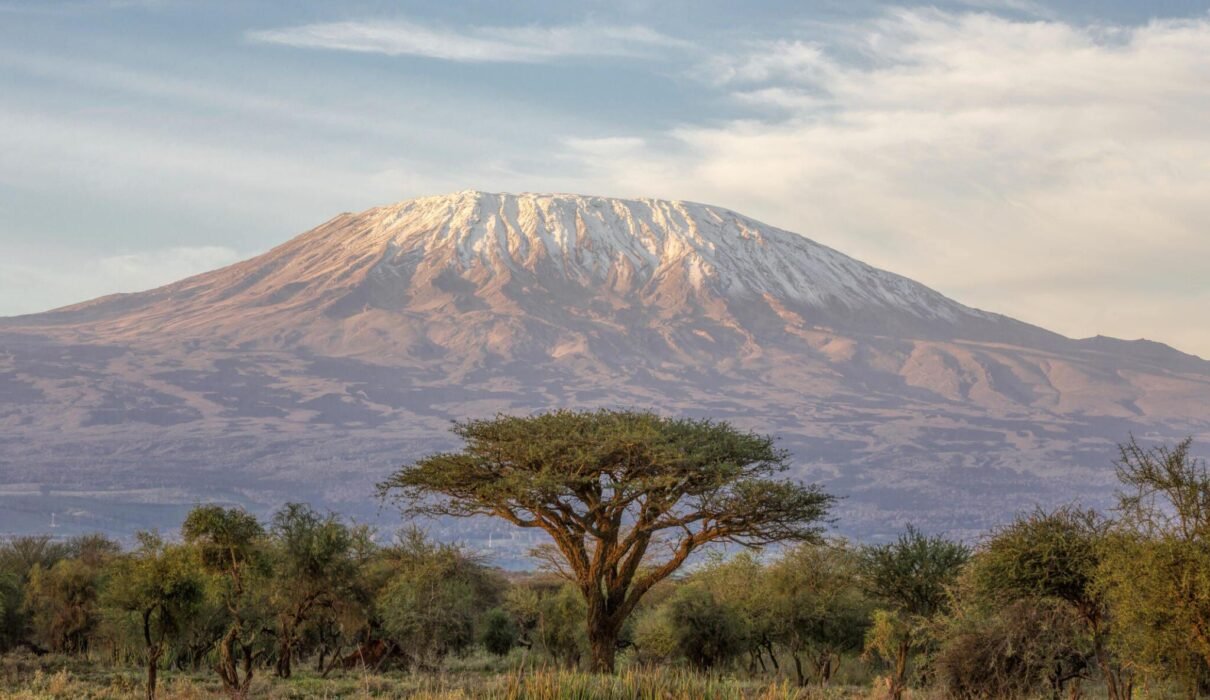
Mount Kilimanjaro is located in northeastern Tanzania, East Africa, near the border between Tanzania and Kenya. Rising to 5,895 meters (19,341 feet) above sea level, it is the highest mountain in Africa and the world’s tallest free-standing mountain above its surrounding landscape.
The mountain stands in Tanzania’s Kilimanjaro Region, north of the town of Moshi and east of Arusha. Its enormous volcanic slopes rise above cultivated farmland, tropical forests, and the plains of northern Tanzania, creating one of the most recognizable landscapes on the African continent.
For many international travelers, Kilimanjaro is the main reason for visiting Tanzania. Some come to climb to Uhuru Peak, while others want to photograph the mountain, explore the surrounding villages, or combine a trekking expedition with a wildlife safari.
One of the most common questions among first-time visitors is whether Kilimanjaro belongs to Tanzania or Kenya. The answer is straightforward: Mount Kilimanjaro is entirely within Tanzania, although it can be seen from several locations across the border in Kenya.
This guide explains exactly where Kilimanjaro is located, how to reach it, which towns are closest to the mountain, where climbing routes begin, and what travelers should know before planning their visit.
At Eddy Tours & Safaris, we help visitors plan Kilimanjaro climbing expeditions, northern Tanzania safaris, and personalized travel experiences.
Where Exactly Is Mount Kilimanjaro?
Mount Kilimanjaro is situated in the Kilimanjaro Region of northern Tanzania, close to the international border with Kenya.
The mountain is part of the Eastern Rift region of Africa, although it is a separate volcanic massif rather than a peak within a long mountain range.
Its approximate geographical coordinates are:
Latitude: 3.067° South
Longitude: 37.367° East
These coordinates place the mountain just south of the equator.
Despite its tropical geographical position, the upper slopes are cold enough to support snow and glaciers.
Kilimanjaro is particularly remarkable because it rises independently above the surrounding plains.
Unlike mountain summits that form part of extensive ranges, Kilimanjaro stands as a massive volcanic mountain with three principal volcanic cones.
Mount Kilimanjaro Location Facts
| Geographical information | Details |
|---|---|
| Mountain | Mount Kilimanjaro |
| Country | Tanzania |
| Continent | Africa |
| Region | Kilimanjaro Region |
| Nearest major town | Moshi |
| Nearby major city | Arusha |
| International border | Tanzania–Kenya |
| Highest summit | Uhuru Peak |
| Elevation | 5,895 meters / 19,341 feet |
| Mountain type | Volcanic massif |
| Main volcanic cones | Kibo, Mawenzi and Shira |
| Protected area | Kilimanjaro National Park |
| Main international airport | Kilimanjaro International Airport (JRO) |
| UNESCO World Heritage designation | 1987 |
Kilimanjaro’s geographical location makes it accessible to travelers visiting northern Tanzania, particularly those combining a mountain expedition with a safari.
Is Mount Kilimanjaro in Tanzania or Kenya?
Mount Kilimanjaro is in Tanzania, not Kenya.
This question arises frequently because the mountain can be photographed from Kenya, particularly from the Amboseli National Park area.
Some of the world’s best-known photographs of elephants walking across open plains with Kilimanjaro in the background were taken in Kenya.
As a result, travelers sometimes assume the mountain is located within Kenyan territory.
However, the mountain itself, including Uhuru Peak and the established summit trekking routes, is situated in Tanzania.
Visitors planning to climb Kilimanjaro must arrange their expedition through Tanzania.
They normally enter the country through Kilimanjaro International Airport or another Tanzanian entry point before traveling to their hotel and mountain starting gate.
Can You See Kilimanjaro from Kenya?
Yes. On clear days, Mount Kilimanjaro can be seen from parts of southern Kenya.
Amboseli National Park is particularly famous for views of the mountain rising behind wildlife and open savannah.
However, visibility depends on cloud cover, weather conditions, and the time of day.
Seeing Kilimanjaro from Kenya is very different from climbing it.
To begin a standard summit expedition, travelers need to travel to Tanzania and enter Kilimanjaro National Park through an authorized route.
How High Is Mount Kilimanjaro?
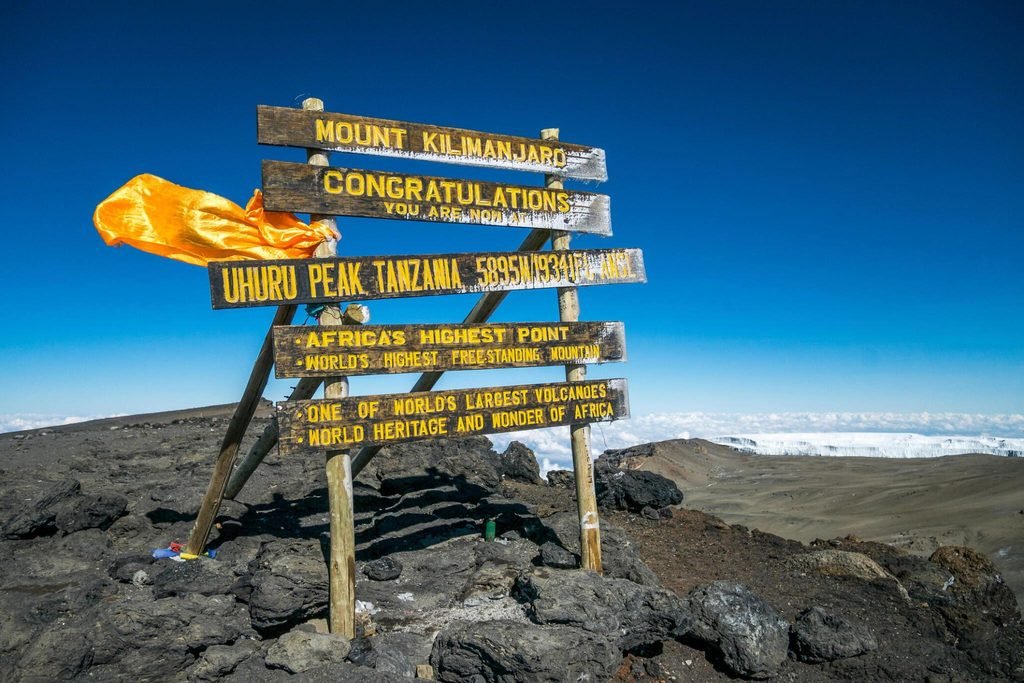
Mount Kilimanjaro reaches an elevation of 5,895 meters (19,341 feet) at Uhuru Peak.
This makes it the highest mountain in Africa.
It is also one of the Seven Summits, the highest mountains on each continent.
Kilimanjaro is famous for its impressive height above the surrounding landscape.
Because it is not part of a large continuous mountain range, its volcanic slopes appear to rise almost independently from the plains below.
The mountain’s great elevation creates dramatic environmental changes between its lower slopes and summit.
At the base, visitors may experience warm tropical conditions, while near Uhuru Peak temperatures can fall well below freezing.
Is Kilimanjaro Taller Than Mount Kenya?
Yes.
Mount Kenya, located in central Kenya, is Africa’s second-highest mountain, reaching approximately 5,199 meters at Batian Peak.
Kilimanjaro is approximately 696 meters higher.
Both mountains are important East African landmarks, but they offer different climbing experiences.
Kilimanjaro’s standard trekking routes do not normally require technical rock-climbing skills, while reaching Mount Kenya’s highest summit involves technical climbing.
The Three Volcanic Peaks of Mount Kilimanjaro
Kilimanjaro is not a single volcanic cone.
It is a large volcanic massif formed by three main volcanic centers: Kibo, Mawenzi, and Shira.
Kibo – Home of Uhuru Peak
Kibo is the highest of Kilimanjaro’s three volcanic cones.
Its summit reaches 5,895 meters at Uhuru Peak.
Kibo is the principal destination for climbers attempting to reach the Roof of Africa.
The summit area includes a volcanic crater, exposed rock, and remaining glaciers.
Kibo is generally classified as dormant rather than extinct.
Mawenzi – The Rugged Eastern Peak
Mawenzi stands east of Kibo and reaches approximately 5,149 meters.
It has a dramatic, jagged appearance that distinguishes it from Kibo’s broader summit.
Mawenzi’s highest sections involve technical climbing and are not part of ordinary Kilimanjaro trekking itineraries.
Climbers following routes such as Rongai and Marangu may enjoy impressive views of Mawenzi during their expeditions.
Shira – The Ancient Western Volcanic Center
Shira is the oldest of Kilimanjaro’s three principal volcanic centers.
Much of its original volcanic structure collapsed, leaving the broad Shira Plateau.
The plateau forms an important part of the Lemosho and Shira trekking approaches.
Its open landscapes and views toward Kibo make it one of the most scenic areas on the mountain.
Where Is Kilimanjaro National Park Located?
Kilimanjaro National Park protects the mountain’s upper slopes and important surrounding forest habitats.
It is situated in the Kilimanjaro Region of Tanzania, with park administration based near Marangu.
The national park was established in 1973 and later recognized as a UNESCO World Heritage Site in 1987.
The protected landscape includes mountain forests, heathland, moorland, alpine desert, and the high-altitude summit environment.
Visitors entering the park must follow the relevant regulations.
Summit expeditions are organized through licensed guiding arrangements, and independent unguided climbing is not permitted.
For official information about park regulations and visitor arrangements, consult Tanzania National Parks.
For additional background on the mountain’s international conservation significance, visit the UNESCO Kilimanjaro National Park World Heritage listing.
Which Town Is Closest to Mount Kilimanjaro?
Moshi is the main town most closely associated with Mount Kilimanjaro climbing.
Located south of the mountain, Moshi serves as an important center for trekking operators, hotels, equipment services, and transport arrangements.
Many climbers spend one or two nights in Moshi before beginning their expedition.
The town is surrounded by agricultural communities and is known for its connection to coffee growing, local markets, and mountain tourism.
Why Stay in Moshi Before Climbing Kilimanjaro?
Moshi is a convenient base for several reasons.
It provides relatively easy access to major climbing entrances such as Machame Gate and Marangu Gate.
Travelers can attend a pre-climb briefing, check their equipment, meet their mountain guide, and rest before beginning the trek.
There are also opportunities to explore nearby attractions if your schedule allows.
Visitors who arrive several days before their climb may consider local cultural experiences, coffee tours, or waterfalls around the Kilimanjaro foothills.
How Far Is Kilimanjaro from Arusha?
Arusha is another important travel base for Kilimanjaro visitors.
It is located west of Mount Kilimanjaro and serves as a major center for Tanzania’s northern safari circuit.
The road journey between Arusha and Moshi is approximately 80 kilometers, depending on the exact starting and finishing locations.
The transfer to a Kilimanjaro trailhead takes additional time and varies according to the chosen climbing route.
Arusha is particularly convenient for travelers planning to combine Kilimanjaro with a safari to Tarangire, Ngorongoro, or Serengeti.
Many visitors begin their Tanzania holiday in Arusha, complete a wildlife safari, and then travel toward Kilimanjaro.
Others climb first and enjoy a safari afterward.
Both arrangements are possible.
How Do You Get to Mount Kilimanjaro?
The most convenient way for many international travelers to reach Mount Kilimanjaro is by flying into Kilimanjaro International Airport.
Step 1: Fly to Kilimanjaro International Airport
Kilimanjaro International Airport, commonly known as JRO, serves the northern Tanzania region.
It is located between Moshi and Arusha.
International travelers may reach the airport through connecting flights from major international aviation hubs.
Flight routes and schedules vary, so travelers should check current connections before booking.
Step 2: Transfer to Moshi or Arusha
After arriving at the airport, most climbers travel by road to their hotel.
The journey to Moshi generally takes around 45–60 minutes, while Arusha may take approximately 60–90 minutes, depending on traffic and the hotel location.
These are planning estimates rather than guaranteed transfer times.
Step 3: Attend Your Pre-Climb Briefing
Before beginning the expedition, travelers normally meet their climbing guide or tour operator.
The briefing covers the planned route, equipment, luggage arrangements, safety procedures, and departure time.
This is also an opportunity to ask questions about altitude, mountain accommodation, and the daily trekking schedule.
Step 4: Travel to the Kilimanjaro Starting Gate
On the first day of the climb, your team transfers you to the appropriate national park entrance.
The starting gate depends on the route selected.
After registration and preparation, the trekking expedition begins.
At Eddy Tours & Safaris, we can help you plan your Kilimanjaro travel arrangements around your preferred route and arrival schedule.
Where Do Kilimanjaro Climbing Routes Begin?
Mount Kilimanjaro has several established trekking routes approaching from different directions.
Each route offers a different combination of scenery, duration, difficulty, and accommodation.
| Climbing route | Starting point | General approach | Common duration |
|---|---|---|---|
| Machame | Machame Gate | Southwest | 6–7 days |
| Marangu | Marangu Gate | Southeast | 5–6 days |
| Lemosho | Londorossi Gate and western trailhead | West | 7–8 days |
| Rongai | Nalemuru/Rongai trailhead | North | 6–7 days |
| Northern Circuit | Western Lemosho approach | West and north | 8–9 days |
| Umbwe | Umbwe Gate | South | Varies by itinerary |
| Shira | Londorossi Gate and higher western trailhead | West | 7–8 days |
Machame Route
The Machame Route begins on Kilimanjaro’s southwestern slopes.
It is known for varied scenery, the Shira Plateau, Lava Tower, and Barranco Wall.
The seven-day Machame itinerary is a popular choice for climbers who want additional acclimatization time compared with the six-day version.
Marangu Route
The Marangu Route begins on the southeastern side of the mountain.
It is the only standard Kilimanjaro summit route with permanent sleeping huts throughout the trek.
The six-day Marangu itinerary includes an additional acclimatization day at Horombo Hut.
Lemosho Route
Lemosho approaches Kilimanjaro from the west.
It begins with a rainforest walk before crossing the Shira Plateau and joining the southern circuit.
The eight-day itinerary is often recommended for travelers who prefer a more gradual ascent.
Rongai Route
Rongai begins near the Tanzania–Kenya border on the northern side of Kilimanjaro.
Its northern approach is generally quieter than some of the popular southern routes.
Northern Circuit Route
The Northern Circuit begins from the western side before traveling around Kilimanjaro’s northern slopes.
It is one of the longest established trekking itineraries and offers additional opportunities for gradual acclimatization.
Umbwe Route
Umbwe begins on the southern side of the mountain.
It follows a steep, direct approach and is generally more demanding during the early stages.
For many first-time climbers, a longer and more gradual route is preferable.
If you are unsure which route is suitable, contact Eddy Tours & Safaris for Kilimanjaro route advice.
What Is the Climate Like on Mount Kilimanjaro?
Kilimanjaro’s enormous elevation creates several distinct ecological and climatic zones.
Climbers experience significant changes in vegetation, temperature, and weather as they ascend.
Lower Slopes and Cultivated Areas
The lower slopes are relatively warm and support farming communities.
Coffee, bananas, and other crops are grown in suitable areas around the mountain.
Montane Rainforest
The rainforest zone is generally humid and receives substantial rainfall.
It supports dense vegetation, birds, monkeys, and other wildlife.
Heath and Moorland
Above the forest, the landscape becomes more open.
Trekkers may encounter giant lobelias, groundsels, heather, and rocky hillsides.
Alpine Desert
At higher elevations, vegetation becomes sparse.
The terrain is dominated by volcanic rock, gravel, and exposed slopes.
Temperatures vary significantly between day and night.
Summit Zone
Near Uhuru Peak, conditions can be extremely cold.
Snow, ice, strong winds, and freezing temperatures are possible.
The weather can change rapidly, making suitable equipment and responsible guiding essential.
Why Is There Snow on Kilimanjaro When It Is Near the Equator?
Kilimanjaro is located only a few degrees south of the equator, where lowland temperatures are generally warm.
However, temperature decreases with increasing elevation.
At nearly 5,900 meters, the summit is high enough to experience freezing conditions despite the mountain’s tropical latitude.
This explains why snow and glaciers can occur on Kilimanjaro.
The mountain’s glaciers have declined considerably over time, and their future is a subject of scientific research.
Travelers should not assume that the summit is covered in deep snow throughout the year.
The amount of visible snow varies according to recent weather and seasonal conditions.
What Is the Best Time to Visit Mount Kilimanjaro?
Kilimanjaro can be visited throughout the year, although weather conditions vary by season.
For climbing expeditions, travelers often prefer the relatively drier periods.
| Period | General conditions |
|---|---|
| January–February | Often favorable trekking conditions, with cold summit temperatures |
| March | Transitional period with increasing rainfall possible |
| April–May | Usually wetter, with muddy lower trails and possible snow higher up |
| June–October | Generally drier and popular for climbing |
| November–December | Variable conditions during the short-rain period |
The best month depends on your priorities.
Travelers who want relatively dry trekking conditions may prefer January, February, or June through October.
Those visiting during wetter periods should be prepared for rain, cloud cover, and potentially difficult trails.
Mountain weather cannot be predicted reliably from the season alone.
Is Mount Kilimanjaro Difficult to Climb?
Kilimanjaro is a demanding high-altitude trek.
Its standard routes do not normally require technical rock-climbing skills, but reaching Uhuru Peak involves significant physical effort.
The greatest challenge for many climbers is the altitude.
As you ascend, atmospheric pressure decreases, reducing the amount of oxygen available with each breath.
Altitude illness can affect anyone, including physically fit travelers.
Symptoms may include headaches, nausea, dizziness, unusual fatigue, and loss of appetite.
More serious conditions can develop and require urgent medical attention.
Choosing an itinerary with enough acclimatization time, walking at a suitable pace, and reporting symptoms to your guide are important parts of safe climbing.
For detailed medical information, consult the CDC guidance on high-altitude travel and altitude illness.
How Many Days Do You Need to Climb Kilimanjaro?
Most standard Kilimanjaro summit expeditions take between five and nine days, depending on the route.
Longer itineraries generally provide additional time for altitude acclimatization.
For many travelers, seven- or eight-day routes offer a more gradual schedule than shorter alternatives.
However, longer itineraries cannot guarantee summit success.
The right duration depends on your experience, health, fitness, travel schedule, and chosen route.
What Wildlife Lives Around Mount Kilimanjaro?
Kilimanjaro National Park protects a variety of mountain habitats.
Wildlife found in its forest environments includes different monkey species, forest antelope, birds, and other mammals.
Larger animals may also occur in suitable habitats, although they are not commonly seen by most summit trekkers.
Wildlife sightings depend on location, habitat, time of day, and animal behavior.
Kilimanjaro is primarily a mountain trekking destination rather than a conventional big-game safari park.
Travelers interested in seeing elephants, lions, giraffes, zebras, and other large African wildlife may prefer to combine their climb with a safari in northern Tanzania.
What Can You Do Near Mount Kilimanjaro Without Climbing?
You do not need to reach Uhuru Peak to enjoy the Kilimanjaro region.
There are several activities for travelers who prefer shorter excursions or cultural experiences.
Explore Moshi Town
Moshi offers a relaxed introduction to northern Tanzania.
Visitors can explore local markets, restaurants, and the surrounding countryside.
Visit Materuni Waterfalls
Materuni is a village on the southern slopes of Kilimanjaro.
The area is known for its waterfall, coffee-growing traditions, and beautiful green landscapes.
A guided excursion may include a walk to the waterfall and a local coffee experience.
Enjoy a Coffee Tour
Coffee cultivation is an important part of the Kilimanjaro region’s agricultural heritage.
Visitors can learn about coffee growing, processing, roasting, and preparation through suitable community-based tours.
Visit Marangu
Marangu is one of the best-known villages on Kilimanjaro’s southeastern slopes.
It is associated with the Marangu climbing route and offers opportunities to learn about local Chagga culture and history.
Explore Chemka Hot Springs
Chemka, also known as Kikuletwa Hot Springs, is a popular swimming destination in the wider Kilimanjaro region.
Its clear spring-fed water provides a different experience from mountain trekking.
Although often called hot springs, the water is generally pleasantly warm rather than geothermal hot.
These activities can be arranged before or after a Kilimanjaro expedition, depending on your schedule.
Can You Combine Kilimanjaro with a Tanzania Safari?
Yes. Mount Kilimanjaro is located within the broader northern Tanzania tourism region, making it convenient to combine a mountain expedition with a wildlife safari.
Many travelers spend several days climbing before visiting Tanzania’s national parks.
Tarangire National Park
Tarangire is known for its large elephant populations, baobab trees, and seasonal wildlife concentrations.
It is an excellent option for travelers interested in a shorter safari extension.
Ngorongoro Crater
Ngorongoro offers opportunities to observe wildlife within a remarkable volcanic caldera.
The crater floor supports a variety of animals, including lions, buffalo, elephants, and the endangered black rhinoceros.
Serengeti National Park
The Serengeti is famous for its vast plains, big cats, and the seasonal Great Wildebeest Migration.
A multi-day safari provides time to explore different parts of the ecosystem.
Zanzibar Beach Holiday
After a demanding mountain expedition, some travelers prefer to relax on Zanzibar’s Indian Ocean beaches.
A combined Kilimanjaro and Zanzibar itinerary can include mountain trekking, cultural experiences, and coastal relaxation.
For assistance planning a combined holiday, request a customized Tanzania itinerary from Eddy Tours & Safaris.
Frequently Asked Questions About Mount Kilimanjaro’s Location
1. Where is Mount Kilimanjaro located in Africa?
Mount Kilimanjaro is located in northeastern Tanzania, East Africa, close to the border with Kenya.
2. Is Mount Kilimanjaro in Kenya or Tanzania?
Mount Kilimanjaro is entirely within Tanzania. It is visible from parts of Kenya, but the summit and established climbing routes are in Tanzania.
3. What is the nearest town to Kilimanjaro?
Moshi is the main town most closely associated with Kilimanjaro tourism and climbing expeditions.
4. How high is Mount Kilimanjaro?
Kilimanjaro reaches 5,895 meters, or 19,341 feet, above sea level at Uhuru Peak.
5. Is Kilimanjaro the highest mountain in Africa?
Yes. Kilimanjaro is the highest mountain on the African continent.
6. Which airport is best for visiting Kilimanjaro?
Kilimanjaro International Airport (JRO) is generally the most convenient international airport for travelers visiting the mountain.
7. Can you see Kilimanjaro from Nairobi?
Kilimanjaro is far from Nairobi and is not normally visible from the city. Travelers seeking views from Kenya usually visit locations farther south, such as Amboseli.
8. Is Kilimanjaro an active volcano?
Kilimanjaro is a volcanic massif. Kibo and Mawenzi are generally classified as dormant, while Shira is extinct.
9. Does Kilimanjaro have snow?
Yes. Snow can occur near the summit, and remaining glaciers are present, although their extent has decreased considerably.
10. Is Kilimanjaro close to the equator?
Yes. The mountain lies approximately three degrees south of the equator.
11. How many days does it take to climb Kilimanjaro?
Most standard trekking itineraries take approximately five to nine days, depending on the route.
12. Can beginners climb Kilimanjaro?
Physically prepared beginners can attempt established trekking routes with professional guides. However, altitude illness and demanding summit conditions are important considerations.
13. Do you need a guide to climb Kilimanjaro?
Yes. Standard Kilimanjaro climbs must be organized through licensed guiding arrangements.
14. What is the best route for climbing Kilimanjaro?
The best route depends on your experience, preferred accommodation, available time, and acclimatization needs. Machame, Lemosho, Marangu, Rongai, and Northern Circuit all offer different advantages.
15. Can I visit Kilimanjaro without climbing to the summit?
Yes. Visitors can enjoy shorter excursions, cultural experiences, waterfalls, coffee tours, and views of the mountain without attempting a summit expedition.
Plan Your Kilimanjaro Adventure with Eddy Tours & Safaris
Mount Kilimanjaro is more than the highest mountain in Africa. It is one of Tanzania’s most important natural landmarks and a destination that attracts travelers from around the world.
Located in northeastern Tanzania near Moshi and the Kenyan border, the mountain offers extraordinary landscapes, varied ecosystems, and the opportunity to undertake a challenging high-altitude expedition.
Whether you want to climb the scenic Machame Route, explore the western slopes through Lemosho, experience the hut-based Marangu Route, or combine your climb with a Serengeti safari, careful planning will help you make the most of your visit.
At Eddy Tours & Safaris, we help travelers organize Kilimanjaro climbing expeditions and customized Tanzania holidays.
Tell us your preferred travel dates, number of travelers, climbing route, and any additional destinations you would like to visit.
Plan Your Kilimanjaro Climb with Eddy Tours & Safaris
For direct assistance, speak with our team on WhatsApp or email our reservations team.
You can also explore Tanzania travel experiences with Eddy Tours & Safaris.
Your journey to Mount Kilimanjaro begins in Tanzania, where Africa’s highest mountain rises above the beautiful landscapes of East Africa.