
When people think about a safari in Serengeti National Park, the first animals that usually come to mind are lions, elephants, leopards, and the huge herds of wildebeest moving across the plains. However, there is another group of animals that makes the Serengeti equally interesting: the antelopes. From the tiny dik-dik hiding among bushes to the powerful eland walking across open grassland, these animals are an important part of the park’s wildlife.
Serengeti National Park is one of Tanzania’s most famous wildlife destinations, covering approximately 14,763 square kilometres of grasslands, woodlands, rivers, valleys, and rocky hills. These different habitats provide food and shelter for a wide range of animals, including several species of antelope. Some are easy to see during a game drive, while others require patience, a knowledgeable safari guide, and a little luck.
Antelopes come in different sizes, colours, and shapes. Some have long, curved horns, while others have short, straight horns or distinctive markings on their faces. Certain species prefer open grasslands, where they can spot predators from a distance, while others live in thick vegetation or rocky areas where they can hide quickly when threatened.
For visitors planning a Tanzania safari, learning to recognize these animals can make a game drive much more interesting. Instead of seeing every brown animal as simply an antelope, you will begin to notice the differences between an impala, a topi, a hartebeest, or a gazelle. You may also understand why some animals gather in large groups while others prefer living alone or in pairs.
At Eddy Tours & Safaris, we help travelers explore Tanzania’s national parks and discover the wildlife that makes each destination special. This guide introduces the main antelope species found in the Serengeti, explains how to identify them, and shares practical tips for seeing them during a safari.
What Are Antelopes?
Antelopes are hoofed mammals belonging to the Bovidae family, which also includes cattle, goats, and sheep. The word antelope is a general name rather than a single scientific group, and it covers many different animals with varied body shapes, habitats, and feeding habits. Most antelopes are plant eaters, feeding on grasses, leaves, shoots, or a combination of different vegetation types.
One of the easiest ways to recognize an antelope is by looking at its horns, although not every individual has them. In some species, such as impalas and many gazelles, males have more prominent horns than females. In others, including elands and topis, both sexes may have horns. Unlike the antlers of deer, antelope horns generally remain attached throughout life and continue growing.
Antelopes are also important prey animals. Lions, leopards, cheetahs, hyenas, and other predators depend on different antelope species for food. Their presence helps maintain the natural balance of the Serengeti ecosystem, where the relationship between predators, herbivores, grasslands, and seasonal rainfall shapes wildlife movements throughout the year.
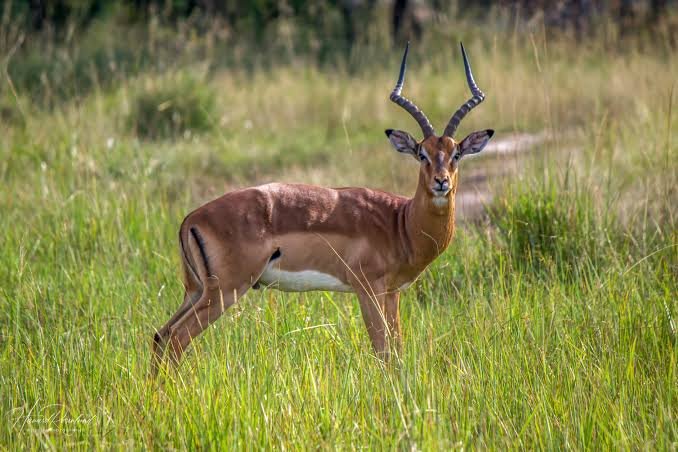
1. Impala: The Graceful Antelope of the Serengeti
The impala is one of the most recognizable antelopes in East Africa and is frequently seen in the Serengeti’s woodland and savannah areas. It has a reddish-brown coat, a lighter belly, and distinctive black markings on the back legs and tail. Male impalas have long, curved horns shaped somewhat like a lyre, while females do not have horns.
Impalas are particularly well known for their ability to jump. When threatened, they can make impressive leaps and change direction quickly to escape predators. Their speed and agility are important because they are hunted by lions, leopards, cheetahs, wild dogs, and other carnivores. Watching a herd react to danger can be one of the most interesting moments of a safari.
These antelopes often live in groups, although the size and structure of the herd can change depending on the breeding season. Females and young animals may gather together, while adult males establish territories or form bachelor groups. During the breeding season, males compete for access to females and may be seen chasing rivals or displaying their horns.
Impalas are commonly associated with wooded grasslands and areas where they can find both grass and leafy vegetation. During a Serengeti safari, look for them around woodland edges and suitable habitats in the central and western areas of the park.
How to identify an impala: Look for a slender reddish-brown body, white underparts, black markings near the tail, and long curved horns on males.
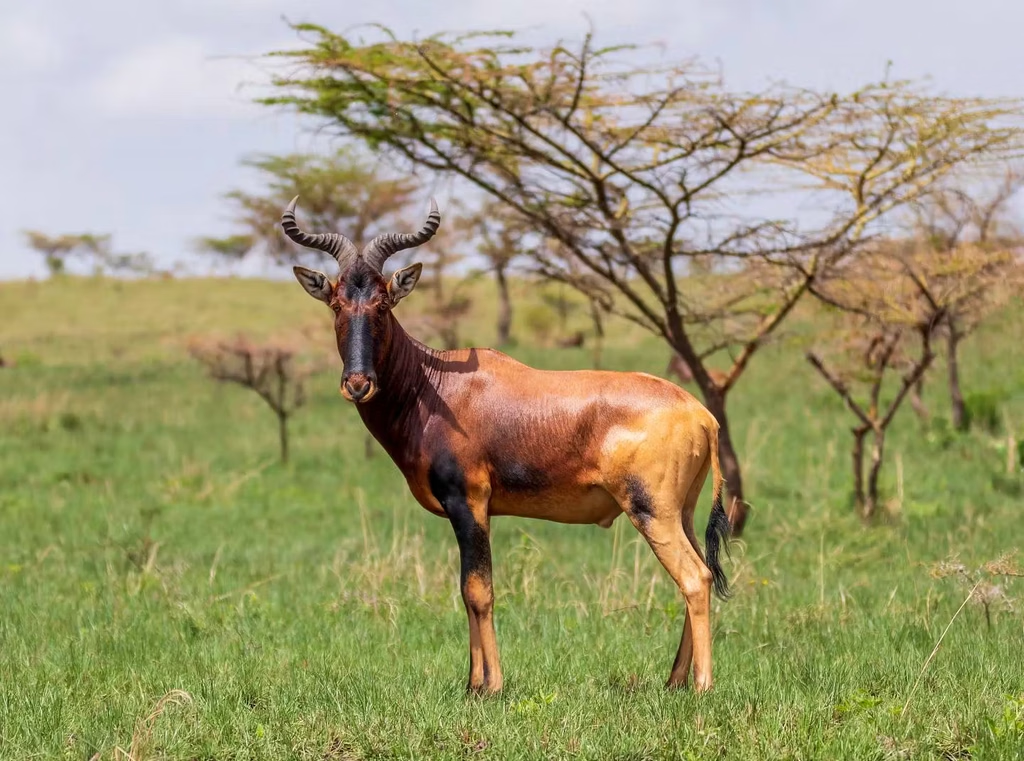
2. Topi: The Alert Antelope of the Open Plains
The topi is a distinctive antelope commonly associated with the open grasslands of the Serengeti. It has a dark reddish-brown body, darker patches around the upper legs and shoulders, and a long, narrow face. Both males and females have horns, which curve upward and slightly backward.
One of the most interesting behaviours of topis is their habit of standing on termite mounds or other raised ground. This gives them a better view of the surrounding grassland and helps them detect approaching predators. During a game drive, you may see a topi standing almost motionless on a mound while other animals graze nearby.
Topis are social animals and may be found in groups ranging from a few individuals to larger gatherings. Their distribution can change with the availability of fresh grass and water. They are also strong runners and can move quickly across open terrain when threatened.
Topis are particularly interesting to photograph because of their unusual body colouring and alert posture. Their darker markings make them easy to distinguish from many other antelopes, especially when viewed in good daylight.
How to identify a topi: Look for a reddish-brown body, dark patches on the shoulders and upper legs, a long face, and upward-curving horns.
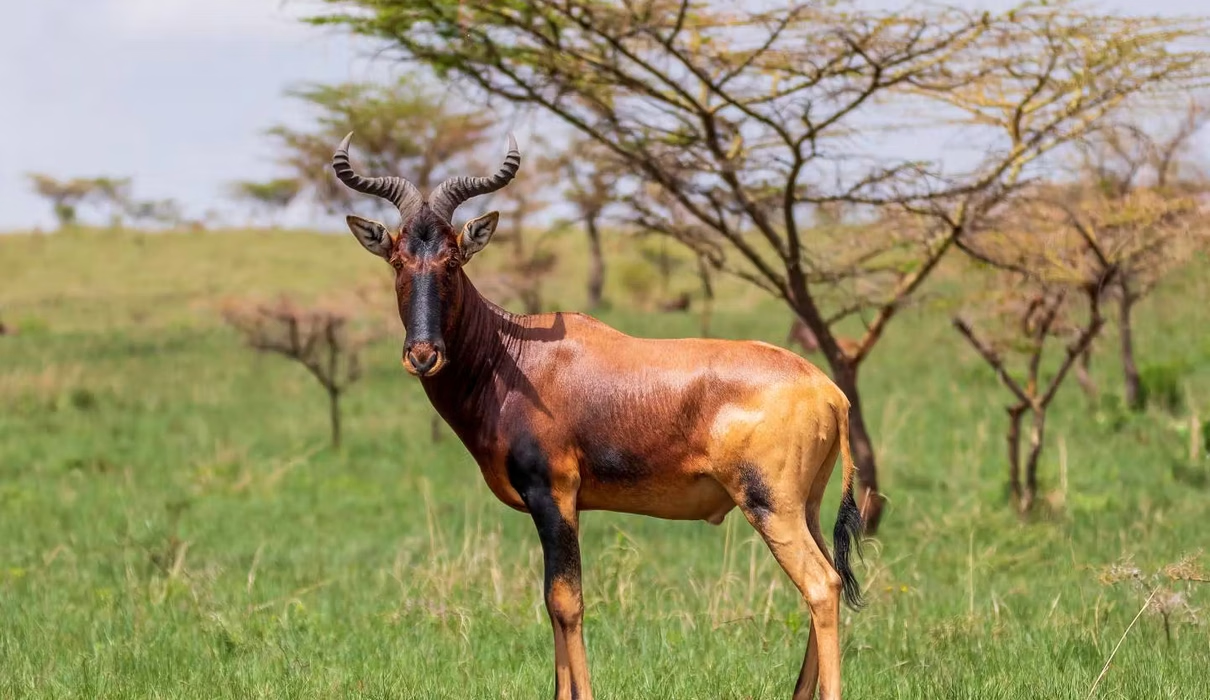
3. Coke’s Hartebeest: The Long-Faced Grassland Antelope
Coke’s hartebeest, also known locally as the kongoni, is another important antelope found in the Serengeti. It is a large, strongly built animal with long legs, a narrow face, and distinctive horns. Its body is generally yellowish-brown to reddish-brown, helping it blend into the grassland environment.
The hartebeest has an unusual appearance compared with many other antelopes. Its shoulders are relatively high, its back slopes toward the hindquarters, and its long face gives it a distinctive profile. Although it may look awkward when standing still, it is a capable runner and can move quickly when escaping danger.
Hartebeests are mainly grazers and prefer grassland habitats where they can feed on different grasses. They may be seen alone, in small groups, or in larger gatherings depending on the season and local conditions. Like other open-country antelopes, they rely heavily on their eyesight and speed to detect and escape predators.
During a Serengeti game drive, hartebeests are worth watching carefully because visitors sometimes confuse them with topis. Their longer faces, body shape, and horn structure are useful features for telling the two animals apart.
How to identify a hartebeest: Look for a long narrow face, high shoulders, a sloping back, and horns with a distinctive curved shape.
4. Common Eland: The Largest Antelope in the Serengeti
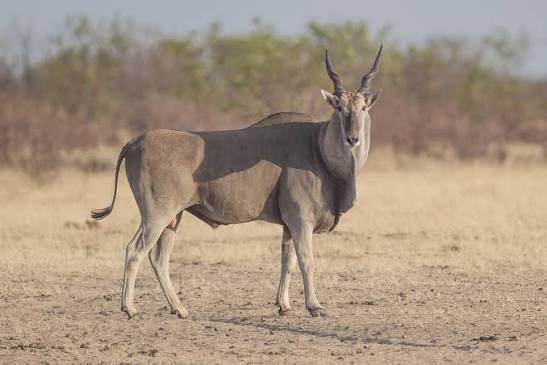
The common eland is the largest living antelope species and one of the most impressive herbivores visitors may encounter in the Serengeti. Adult males can be extremely heavy, with broad bodies, thick necks, and a noticeable dewlap hanging beneath the throat. Both males and females have horns, although males are generally larger and more heavily built.
Despite their size, elands are surprisingly agile animals. They can move quickly when threatened and are capable of jumping obstacles that might seem difficult for such a large animal. Their behaviour is often calm and cautious, and they may begin moving away from approaching vehicles before visitors get close enough for photographs.
Elands feed on a mixture of grasses, leaves, and other vegetation, allowing them to use different habitats depending on food availability. They may be found in open grasslands, lightly wooded areas, and other suitable environments throughout the wider Serengeti ecosystem. Herd sizes vary, and some groups may contain several adults and young animals.
Seeing an eland is particularly rewarding because its size can be surprising. From a distance, it may resemble a large domestic cow, but its spiral horns, body markings, and powerful build make it unmistakable once you have a clear view.
How to identify an eland: Look for a very large, heavy body, spiral horns, a loose fold of skin beneath the neck, and sometimes faint vertical stripes along the sides.
5. Thomson’s Gazelle: The Small Antelope of the Serengeti Plains
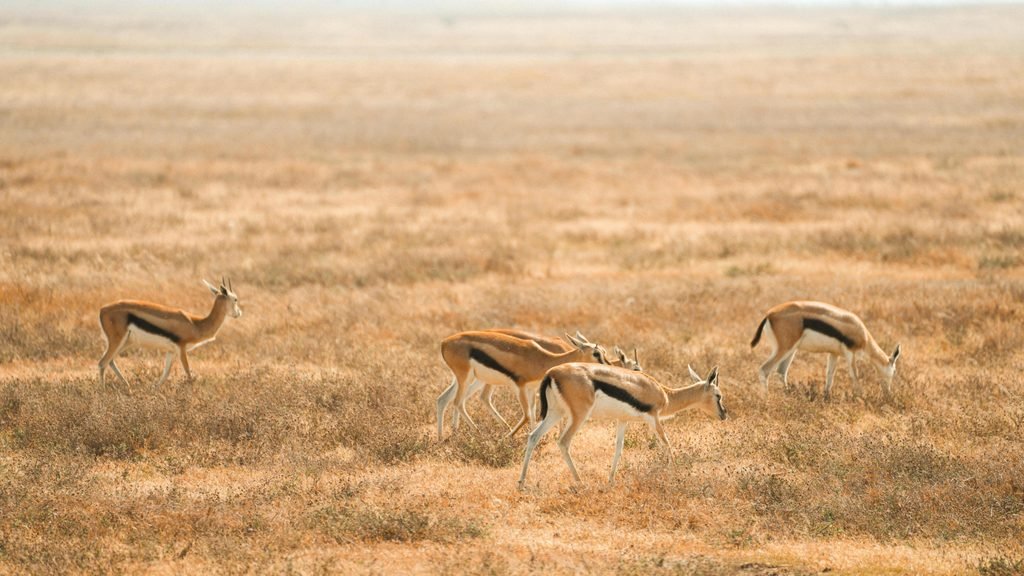
Thomson’s gazelle is one of the best-known small antelopes of the Serengeti and an important part of the grassland ecosystem. It has a light brown upper body, white belly, and a distinctive dark stripe running along each side. Both males and females can have horns, although the horns of males are generally longer and more developed.
These gazelles are commonly seen on open plains where short grass provides suitable feeding conditions. Their relatively small size and quick movements make them easy to recognize, especially when they gather in groups. They are also among the animals most closely associated with the Serengeti’s famous grassland scenery.
Thomson’s gazelles are important prey for several predators, particularly cheetahs. Their speed and ability to change direction rapidly help them escape danger, although young and weaker animals remain vulnerable. During a game drive, visitors may observe gazelles grazing peacefully one moment and suddenly running when a predator approaches.
They also form part of the wider seasonal wildlife movements of the Serengeti ecosystem. Although their movements do not always follow exactly the same pattern as wildebeest, they respond to changes in rainfall, grass growth, and food availability.
How to identify Thomson’s gazelle: Look for a small, slender body with a clear black stripe along each side and a white belly.
6. Grant’s Gazelle: The Elegant Antelope of Open Grasslands
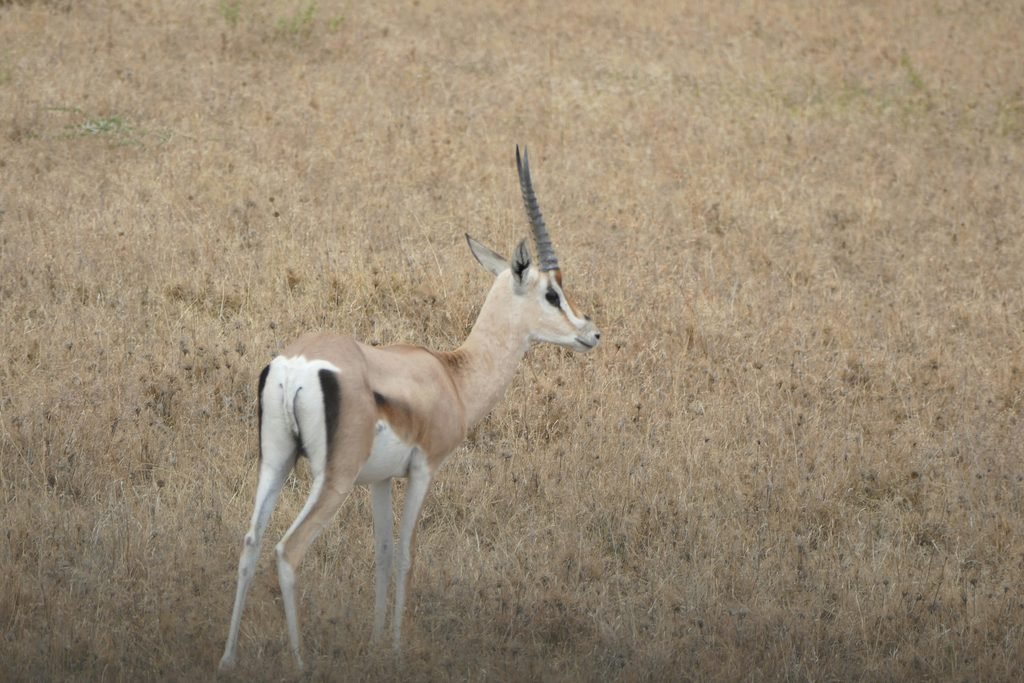
Grant’s gazelle is larger than Thomson’s gazelle and has a more lightly coloured body. It is commonly found in open grasslands and dry savannah environments, where it feeds on grasses, leaves, and other vegetation. Its long legs and graceful appearance make it one of the most attractive antelopes to observe during a safari.
One of the easiest ways to distinguish Grant’s gazelle from Thomson’s gazelle is by examining the markings along its sides. Grant’s gazelle usually lacks the strong black side stripe that makes Thomson’s gazelle so recognizable. It also has a larger white rump patch and a generally taller, more robust appearance.
Grant’s gazelles can survive in relatively dry environments and are able to obtain some of their water requirements from the vegetation they eat. This helps them use habitats where surface water may not always be readily available. Their feeding habits also allow them to take advantage of different plant types as seasonal conditions change.
During a Serengeti safari, you may see Grant’s gazelles standing in small groups or moving across open plains. Their alert behaviour and elegant horns make them excellent subjects for wildlife photography.
How to identify Grant’s gazelle: Look for a relatively large gazelle with a pale body, long horns, a broad white rump area, and no strong black side stripe.
7. Kirk’s Dik-Dik: One of the Smallest Antelopes
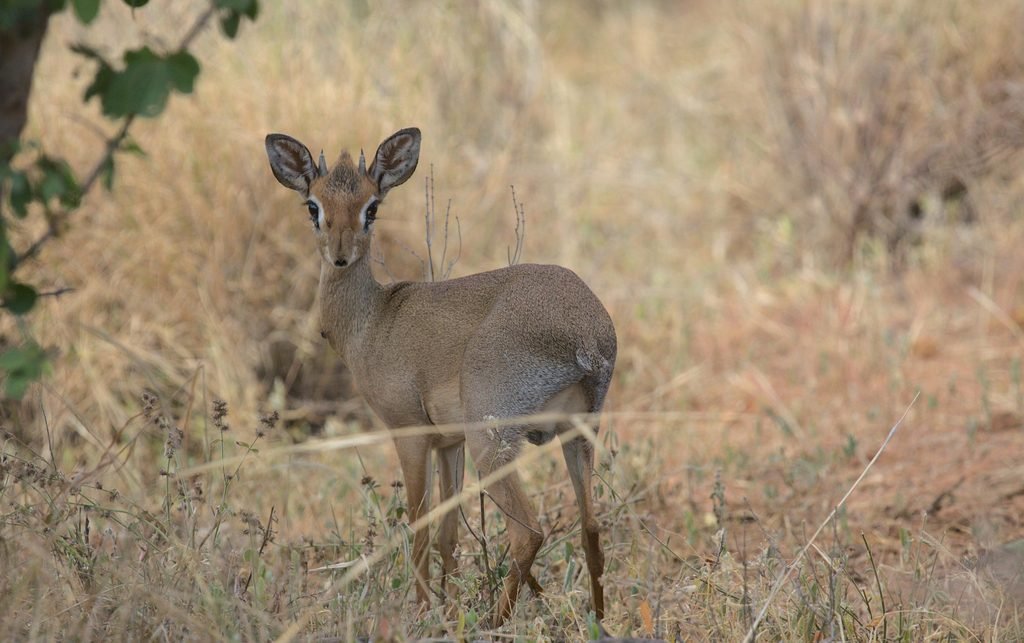
Kirk’s dik-dik is one of the smallest antelopes visitors may encounter in the Serengeti. These tiny animals are usually found in bushy or wooded habitats, where thick vegetation provides protection from predators. Their small size makes them easy to miss, especially when they remain still among shrubs.
A dik-dik has a small, delicate body, large eyes, a pointed snout, and relatively long legs for its size. Males have short horns that may be partly hidden by the hair on the forehead, while females do not have horns. Their unusual nose helps distinguish them from other small antelopes.
Dik-diks often live in pairs and maintain territories. Unlike the larger antelopes that gather in herds, these animals usually rely on dense vegetation and quick movements to avoid danger. When disturbed, they may disappear into nearby bushes before visitors have time to take a photograph.
Spotting a dik-dik can be especially satisfying because it requires careful observation. Ask your safari guide to watch the edges of bushes and woodland tracks, particularly in areas where the vegetation provides suitable cover.
How to identify a dik-dik: Look for a very small antelope with large eyes, a pointed nose, slender legs, and a habit of staying close to bushes.
8. Klipspringer: The Antelope That Lives Among Rocks
The klipspringer is a small antelope specially adapted to rocky environments. Its name is commonly translated as “rock jumper,” which describes its remarkable ability to move across steep and uneven rock surfaces. In the Serengeti, klipspringers are associated with kopjes, the rocky outcrops that rise above the surrounding grasslands.
Unlike antelopes that depend mainly on speed across open plains, klipspringers use their agility and specialized hooves to navigate rocky terrain. Their hooves have a distinctive shape that helps them maintain balance on narrow surfaces. Watching one move across a steep rock face can be fascinating because it appears remarkably confident in places where larger animals would struggle.
Klipspringers are relatively small and have a thick, speckled coat that helps them blend into rocky surroundings. They are often seen alone or in pairs and may remain motionless when they detect possible danger. Their camouflage makes them difficult to notice unless they move or stand against the skyline.
During a Serengeti safari, look carefully at rocky kopjes, particularly where small animals may be resting or feeding among the stones. These rocky formations are also important habitats for lions, hyraxes, reptiles, and various bird species.
How to identify a klipspringer: Look for a small, compact antelope standing on rocks, with a speckled coat and short, pointed horns on males.
9. Bushbuck: The Secretive Antelope of Wooded Areas
The bushbuck is a medium-sized antelope that prefers areas with dense vegetation, including riverine woodland, thickets, and forest edges. Unlike topis or hartebeests, which are often visible on open plains, bushbucks are more difficult to observe because they spend much of their time close to cover.
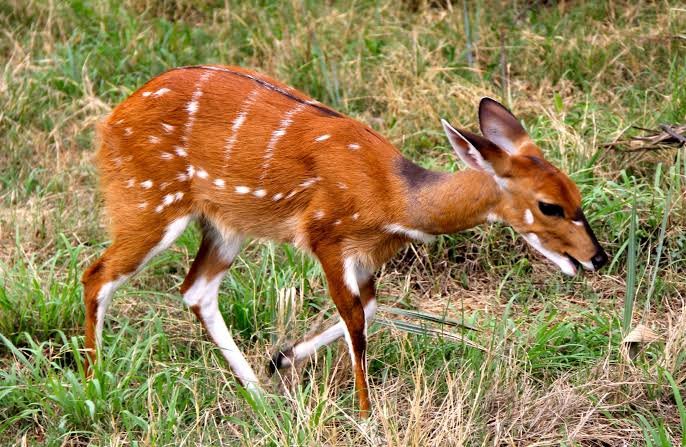
Bushbucks have a reddish-brown or darker brown coat, sometimes marked with white spots or stripes. Males are generally darker and have spiral horns, while females are smaller and lack horns. Their colouring varies, making them interesting animals to identify during a game drive.
These antelopes are usually solitary or found in small family groups. They feed on leaves, shoots, fruits, and other vegetation, and their preference for sheltered habitats helps protect them from predators. When threatened, a bushbuck may move quickly into thick vegetation rather than attempting to outrun danger across open ground.
Visitors may have an opportunity to see bushbucks near suitable riverine habitats and wooded areas of the Serengeti. Because they are naturally cautious, patience and quiet observation can improve the chances of a sighting.
How to identify a bushbuck: Look for a medium-sized antelope in dense vegetation, with white body markings and spiral horns on males.
10. Defassa Waterbuck: The Antelope Found Near Water
The Defassa waterbuck is a large antelope associated with grasslands and woodlands near rivers, wetlands, and other water sources. It has a shaggy greyish-brown coat, a strong body, and long ringed horns on males. Its appearance is quite different from the more slender antelopes found on open plains.
Waterbucks often remain relatively close to water because they depend on regular access to drinking sources and suitable grazing areas. Their preference for wetter habitats means visitors are more likely to encounter them near rivers and areas with permanent or seasonal water.
The Defassa waterbuck can be distinguished from the common waterbuck by its rump markings. Instead of a clearly defined white ring around the tail, the Defassa form generally has a broad pale or whitish rump patch. This feature is useful for identifying the animal when viewed from behind.
During a Serengeti game drive, look for waterbucks in suitable river valleys and woodland habitats. They may be seen grazing, resting in small groups, or standing alert while watching their surroundings.
How to identify a waterbuck: Look for a large, shaggy antelope with ringed horns on males and a pale rump patch.
11. Bohor Reedbuck: The Shy Antelope of Wet Grasslands
The Bohor reedbuck is a medium-sized antelope that prefers grasslands with relatively tall vegetation, particularly in areas associated with wetlands, river valleys, and seasonal drainage lines. Its coat is usually yellowish-brown, helping it blend into dry or green grass depending on the season.
Reedbucks are generally shy animals and may remain hidden in tall grass until they are disturbed. When alarmed, they often move quickly away and may use a distinctive bounding movement. Males have horns that curve forward near the tips, while females lack horns.
These antelopes are not as conspicuous as impalas or topis, and visitors may need patience to see them clearly. They are usually found alone, in pairs, or in small groups rather than the large herds associated with open grassland species.
During a safari, reedbucks are most likely to be encountered in suitable wet grassland habitats. Their preference for cover means sightings may be brief, but careful observation can reveal their distinctive shape and behaviour.
How to identify a reedbuck: Look for a medium-sized, pale brown antelope in tall grass, with forward-curving horns on males.
12. Oribi: The Small Antelope of Open Grasslands
The oribi is a small, slender antelope that prefers open grasslands with enough vegetation to provide some cover. It has a yellowish-brown coat, white underparts, a relatively long neck, and short straight horns on males. Its delicate appearance can make it easy to confuse with other small antelopes when viewed from a distance.
Oribis are generally cautious and rely on their alertness to detect danger. They may stand still while observing their surroundings before suddenly running when threatened. Their small size and preference for suitable grassland habitats mean they can be overlooked during game drives focused mainly on larger animals.
Although oribis are part of the Serengeti’s antelope diversity, they are less frequently encountered than impalas, topis, or gazelles. Seeing one can therefore be a special experience for travelers interested in identifying a wider range of wildlife.
How to identify an oribi: Look for a small, slender antelope with a long neck, pale brown coat, and short straight horns on males.
13. Other Rarely Seen Antelopes of the Serengeti
In addition to the more familiar species, the wider Serengeti ecosystem supports several antelopes that are difficult to encounter during ordinary game drives. These include roan antelope, greater kudu, steenbok, and other species associated with particular habitats. Their presence contributes to the park’s wildlife diversity, but visitors should not expect to see every species during a short safari.
The roan antelope is a large, strongly built animal with distinctive facial markings and long curved horns. It is associated with suitable grassland and woodland habitats but is rarely encountered in the Serengeti. Greater kudu are recognized by their large ears, body stripes, and impressive spiral horns on males, while steenbok are small, solitary antelopes that often remain close to grass or low vegetation.
Some wildlife references also mention lesser kudu and fringe-eared oryx within parts of the wider Serengeti region. These are not animals that visitors should assume they will encounter on a standard central Serengeti itinerary. Their distribution is limited, and sightings depend on the particular area visited and local wildlife conditions.
For travelers who are especially interested in rare antelopes, it is worth discussing this with a knowledgeable safari guide before departure. A specialized wildlife itinerary can place greater emphasis on suitable habitats, although sightings remain unpredictable.
Quick Identification Guide to Serengeti Antelopes
| Antelope | Main identifying feature | Typical habitat | General sighting outlook |
|---|---|---|---|
| Impala | Reddish coat and curved horns on males | Woodlands and savannah | Common |
| Topi | Dark shoulder patches and long face | Open grasslands | Common |
| Coke’s hartebeest | Long face and sloping back | Grasslands | Regular |
| Common eland | Very large body and spiral horns | Grasslands and woodland | Regular, locally variable |
| Thomson’s gazelle | Black stripe along each side | Short-grass plains | Common |
| Grant’s gazelle | Larger gazelle with pale rump | Open plains | Common |
| Kirk’s dik-dik | Tiny body and pointed snout | Bushland | Regular but easily missed |
| Klipspringer | Small body and rocky habitat | Kopjes | Localized |
| Bushbuck | White markings and secretive behaviour | Riverine woodland | Less conspicuous |
| Defassa waterbuck | Shaggy coat and pale rump patch | Near water | Localized |
| Bohor reedbuck | Pale coat and tall-grass habitat | Wet grassland | Less frequently seen |
| Oribi | Small body and short straight horns | Open grassland | Less frequently seen |
| Roan antelope | Large body and striking face markings | Suitable woodland and grassland | Rare |
These sighting descriptions are general guides rather than guarantees. Wildlife distribution varies with season, habitat, and the areas included in your safari.
The Role of Antelopes in the Serengeti Ecosystem
Antelopes are essential to the Serengeti because they help connect the grasslands and vegetation with the park’s large predator populations. Different species feed on different types of plants, which helps distribute grazing and browsing pressure across the landscape. Some species mainly eat grass, while others prefer leaves, shoots, or a mixture of vegetation.
These feeding differences allow several antelope species to share the same general area without depending entirely on the same food. For example, a topi may graze in open grassland while a bushbuck feeds on leaves in nearby woodland. Elands can use both grazing and browsing opportunities, allowing them to respond to changing seasonal conditions.
Antelopes also provide food for predators such as lions, leopards, cheetahs, and hyenas. The size and behaviour of each species influence which predators are most likely to hunt them. Smaller gazelles are particularly important prey for cheetahs, while larger antelopes may be hunted by lions or groups of hyenas.
By supporting predator populations and influencing vegetation, antelopes play an important role in the natural functioning of the Serengeti ecosystem.
Are Wildebeest and Gazelles Also Antelopes?
Yes. Wildebeest and gazelles are generally included within the broad group commonly called antelopes, although many safari guides discuss them separately because of their importance to the Great Migration. Wildebeest belong to the same wider family as other antelopes and are closely related to hartebeests and topis.
Gazelles are also antelopes, and the Serengeti is particularly well known for its populations of Thomson’s and Grant’s gazelles. Their smaller size and distinctive body markings make them easy to distinguish from the much larger wildebeest.
Zebras, however, are not antelopes. They belong to the horse family and are more closely related to horses and donkeys. Although zebras often travel alongside wildebeest during seasonal movements, they are part of a different animal family.
Where Can You See Antelopes in Serengeti National Park?
The Serengeti contains several different habitats, and each supports its own combination of wildlife. The central Serengeti, particularly the Seronera area, is known for its mixture of grasslands, riverine vegetation, and woodland. These habitats provide opportunities to see impalas, topis, hartebeests, gazelles, and other antelopes while also searching for lions, leopards, and cheetahs.
The southern and eastern plains are especially associated with open-country animals, including gazelles, wildebeest, topis, and other grazing species. During the greener months, fresh grass can attract large numbers of herbivores to suitable areas. However, the exact distribution changes with rainfall and food availability, so animals may not remain in the same place throughout the year.
Rocky kopjes provide suitable habitats for klipspringers, while river valleys and wooded areas may offer opportunities to observe bushbucks, waterbucks, and impalas. Some of the rarer antelopes occur in more restricted habitats and are much harder to find during a standard safari.
If your main interest is wildlife photography or identifying different antelope species, consider allowing several days in the park rather than attempting to see everything in a single afternoon. A longer itinerary gives your guide more flexibility to explore different habitats and spend time observing animals.
Best Time to See Antelopes in the Serengeti
Antelopes can be seen in the Serengeti throughout the year, but their distribution and visibility change with seasonal conditions. During the wetter months, many areas become greener, and fresh vegetation attracts grazing animals to the plains. This period can be particularly interesting for observing gazelles, wildebeest, and other herbivores feeding in open grassland.
The drier months, generally from June to October, can also provide excellent wildlife viewing because shorter vegetation may make some animals easier to spot. Water availability becomes increasingly important during dry conditions, and certain species may spend more time near rivers or other reliable sources.
Early morning and late afternoon are often productive times for observing antelopes because temperatures are generally cooler and many animals are actively feeding. These periods can also provide attractive natural light for photography.
There is no single month when every antelope species is easiest to see. The best time depends on the particular species, the habitats included in your itinerary, and local weather conditions.
Wildlife Photography Tips for Serengeti Antelopes
Photographing antelopes can be surprisingly rewarding because their behaviour is often more varied than visitors initially expect. A topi standing on a termite mound, a male impala displaying its horns, or a dik-dik peering out from behind a bush can produce memorable photographs. Instead of concentrating only on large predators, take time to observe how antelopes move, feed, interact, and respond to their surroundings.
A camera with a telephoto lens is useful because many antelopes are naturally cautious and may move away if a vehicle approaches too closely. A focal length of approximately 200–400 mm can be practical for many wildlife situations, although the ideal equipment depends on the distance and lighting conditions. For smaller animals such as dik-diks or klipspringers, patience and careful framing can be more important than having the longest lens.
Try to photograph animals at eye level when possible, while remaining inside the safari vehicle and following park rules. Early morning and late afternoon light can bring out the natural colours of their coats, while a simple background can help make their horns and facial markings stand out.
Always give wildlife enough space and avoid asking your guide to chase animals or disturb their natural behaviour. The best wildlife photographs often come from allowing animals to behave normally.
Frequently Asked Questions About Serengeti Antelopes
1. How many antelope species are found in the Serengeti?
The Serengeti supports numerous antelope species, although the exact total depends on the taxonomic classification and whether the wider ecosystem is included.
2. What is the most common antelope in the Serengeti?
Impalas, topis, and gazelles are among the antelopes visitors frequently encounter, depending on the habitat.
3. What is the largest antelope in the Serengeti?
The common eland is the largest antelope species.
4. What is the smallest antelope in the Serengeti?
Kirk’s dik-dik is among the smallest antelopes found in the area.
5. Are wildebeest antelopes?
Yes. Wildebeest belong to the Bovidae family and are commonly grouped with antelopes.
6. Are zebras antelopes?
No. Zebras belong to the horse family, Equidae.
7. Are Thomson’s gazelles antelopes?
Yes. Thomson’s gazelles are small antelopes found on the Serengeti plains.
8. What is the difference between Thomson’s and Grant’s gazelles?
Thomson’s gazelles are generally smaller and have a clear dark stripe along their sides, while Grant’s gazelles are larger and lack the same strong stripe.
9. Which antelope stands on termite mounds?
Topis are well known for standing on termite mounds to watch their surroundings.
10. Which antelope lives among rocks?
Klipspringers are specially adapted to rocky habitats such as kopjes.
11. Which antelope is commonly found near water?
Defassa waterbucks are often associated with river valleys and other areas near water.
12. Are impalas easy to see in the Serengeti?
Impalas are regularly encountered in suitable woodland and savannah habitats.
13. Do female antelopes have horns?
It depends on the species. Female elands and topis may have horns, while female impalas do not.
14. What do antelopes eat?
Different species eat grasses, leaves, shoots, fruits, and other plant material.
15. What animals hunt antelopes in the Serengeti?
Lions, leopards, cheetahs, hyenas, and other predators hunt different antelope species.
16. Are antelopes part of the Great Migration?
Yes. Wildebeest and gazelles are among the antelope groups involved in seasonal movements across the ecosystem.
17. Can I see antelopes during the dry season?
Yes. Antelopes remain present throughout the year, although their distribution may change.
18. Where can I see klipspringers?
Look for them on suitable rocky kopjes within the park.
19. Are bushbucks common in open grasslands?
No. Bushbucks generally prefer wooded and densely vegetated habitats.
20. Is the roan antelope easy to see?
No. Roan antelopes are rarely encountered during ordinary Serengeti game drives.
21. What is the difference between a topi and a hartebeest?
Topis have darker shoulder and leg markings, while hartebeests have longer faces and a more pronounced sloping body shape.
22. Can antelopes be dangerous?
Antelopes are generally cautious around people, but wild animals can defend themselves if threatened or cornered.
23. Can I photograph antelopes from a safari vehicle?
Yes. Game drives provide opportunities to photograph antelopes while following park rules and maintaining a safe distance.
24. How many days should I spend in the Serengeti to see different antelopes?
Two to four days or longer can provide more opportunities to explore different habitats, although sightings are never guaranteed.
25. Can Eddy Tours & Safaris organize a wildlife-focused Serengeti safari?
Yes. You can contact Eddy Tours & Safaris to discuss a safari itinerary that places greater emphasis on wildlife viewing and photography.
Discover Serengeti Antelopes with Eddy Tours & Safaris
The antelopes of Serengeti National Park are an important part of what makes the park such a remarkable wildlife destination. From the powerful eland and alert topi to the graceful impala and tiny dik-dik, each species has its own appearance, behaviour, and preferred habitat. Learning to recognize these differences can turn an ordinary game drive into a much more interesting wildlife experience.
Although lions, elephants, and the Great Migration often receive the most attention, spending time watching antelopes provides a better understanding of how the Serengeti ecosystem works. Their feeding habits, movements, social behaviour, and relationships with predators all contribute to the natural balance of the park.
At Eddy Tours & Safaris, we organize Tanzania wildlife safaris for travelers interested in exploring the Serengeti and other national parks. Whether you are planning a private safari, a wildlife photography trip, or a longer northern Tanzania holiday, our team can help you discuss suitable travel arrangements and request a personalized quotation.
Plan Your Serengeti Safari with Eddy Tours & Safaris
Chat with Our Safari Team on WhatsApp
Email: sales@eddytours-safaris.com
Explore Tanzania’s wildlife with experienced safari guides and discover the smaller details that make every game drive worth remembering.