
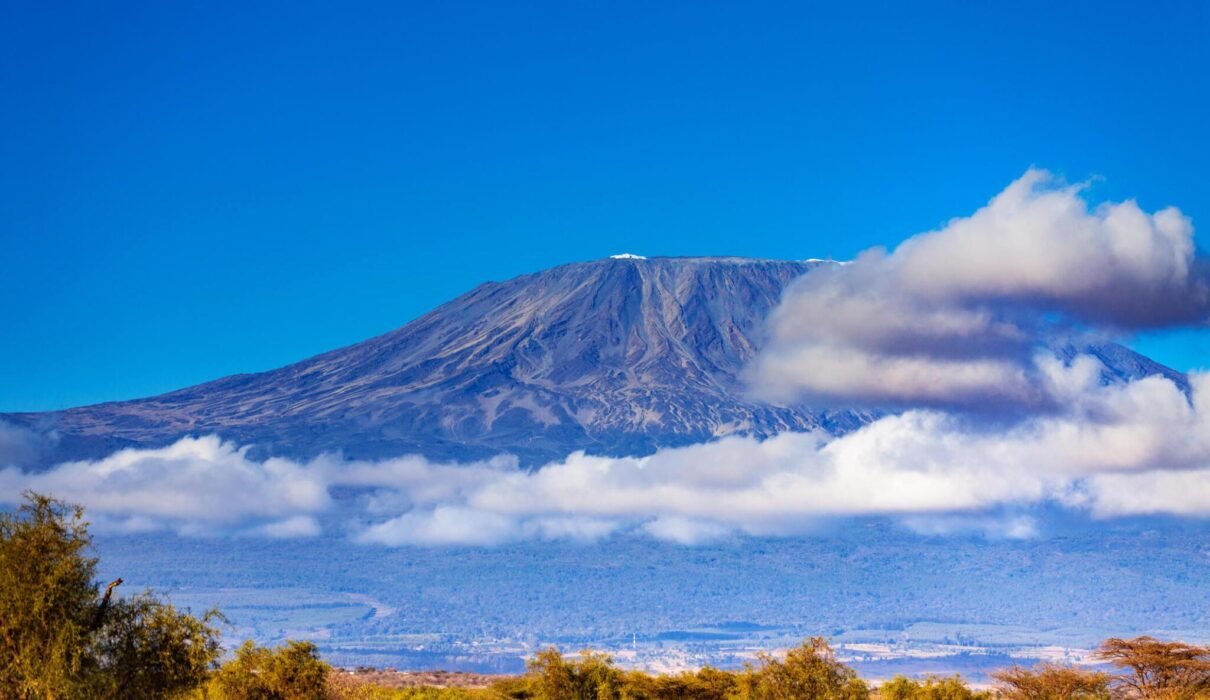
Climbing Mount Kilimanjaro is one of the most rewarding adventures in Tanzania, attracting travelers from around the world who want to stand on the highest point in Africa. Rising 5,895 meters above sea level, Kilimanjaro offers an extraordinary journey through tropical rainforest, open moorland, alpine desert, and the cold summit environment surrounding Uhuru Peak.
The 5–6 Days Kilimanjaro Hiking Joining Group via the Marangu Route is designed for travelers who want to experience this famous mountain while sharing the adventure with other climbers. Instead of booking a completely private expedition, participants join a scheduled group departure, allowing certain operational costs to be shared while enjoying the support of professional mountain guides, porters, and cooks.
The Marangu Route is particularly well known because it is the only main Kilimanjaro climbing route that uses permanent mountain huts for overnight accommodation. Rather than sleeping in camping tents, climbers stay in shared dormitory-style accommodation at Mandara Hut, Horombo Hut, and Kibo Hut. This makes Marangu attractive to hikers who prefer a roof over their heads, although the huts provide basic mountain facilities rather than hotel-style comfort.
Both the five-day and six-day itineraries follow the same general trail, beginning at Marangu Gate on the southeastern side of Kilimanjaro and continuing through Mandara, Horombo, and Kibo before the summit attempt. The main difference is that the six-day itinerary includes an additional acclimatization day at Horombo Hut, usually involving a walk toward Zebra Rocks.
Although Marangu is sometimes described as one of the easier Kilimanjaro routes because its early trails are relatively gradual, reaching the summit remains physically demanding. The rapid altitude gain, particularly on the five-day itinerary, makes proper preparation and acclimatization extremely important.
At Eddy Tours and Safaris, we help travelers plan Kilimanjaro climbing expeditions according to their preferred dates, fitness, previous hiking experience, and budget. Our Marangu joining-group arrangements are intended to provide a professionally guided mountain experience while allowing climbers to share the journey with fellow adventurers.
Whether you are planning to climb Kilimanjaro in 2027 or 2028, this guide explains both Marangu Route itineraries, the differences between five and six days, accommodation, hiking difficulty, estimated costs, equipment requirements, and everything you should consider before joining a group.
Marangu Route Joining Group Overview
| Tour details | Information |
|---|---|
| Tour name | 5–6 Days Kilimanjaro Hiking Joining Group |
| Mountain | Mount Kilimanjaro, Tanzania |
| Climbing route | Marangu Route |
| Duration | 5 or 6 days |
| Maximum altitude | Uhuru Peak – 5,895 meters |
| Starting point | Marangu Gate |
| Ending point | Marangu Gate |
| Accommodation | Shared mountain huts |
| Safari style | Guided joining-group expedition |
| Difficulty | Challenging high-altitude trekking |
| Starting elevation | Approximately 1,860 meters |
| Approximate trekking distance | 70–75 kilometers |
| Best climbing periods | January–March and June–October |
| Available travel years | 2027 and 2028 |
| Recommended option | 6-day Marangu Route |
The exact group size, departure dates, hut availability, and services are subject to confirmation when booking.
Why Choose a Kilimanjaro Joining Group?
Joining a Kilimanjaro climbing group is a practical option for solo travelers, couples, and small groups who want to share their mountain adventure with other hikers. Rather than arranging an exclusive private expedition, participants travel together under the guidance of a professional mountain team.
One of the main advantages is the opportunity to share certain operational expenses, which may make a joining-group climb more affordable than a private expedition. Group members also have the opportunity to meet travelers from different countries, exchange experiences, and encourage one another during the trek.
A joining group does not mean that everyone must walk at exactly the same speed. Responsible mountain guides monitor the condition of each climber and manage the group according to safety requirements. However, participants should understand that a group expedition normally follows a shared daily schedule, with less flexibility than a private climb.
The Marangu Route is especially suitable for organized group departures because it has established hut accommodation and a clearly defined trail. Nevertheless, hut space must be reserved, and group departures should be confirmed before travelers arrange international flights.
5 Days Marangu Route Kilimanjaro Joining Group Itinerary
The five-day Marangu itinerary follows the shortest commonly offered schedule on this route. It provides a complete ascent and descent of Kilimanjaro but allows relatively little time for acclimatization. This makes it a demanding option, particularly for climbers who have not previously experienced high altitude.
Day 1: Moshi to Marangu Gate – Hike to Mandara Hut
Starting elevation: Approximately 1,860 meters
Ending elevation: Approximately 2,720 meters
Hiking distance: 8 kilometers
Walking time: 4–5 hours
Habitat: Montane rainforest
Your Kilimanjaro adventure begins after breakfast at your hotel in Moshi. You meet your mountain guide and other group members before departing for Marangu Gate, located on the southeastern side of Mount Kilimanjaro.
The drive takes you through villages and agricultural landscapes surrounding the lower slopes of the mountain. Depending on the route, you may pass banana plantations, coffee farms, and local communities before arriving at the national park entrance.
At Marangu Gate, your guide completes the necessary registration procedures while the mountain crew organizes equipment, food, and supplies. You will receive a briefing about the trail, walking pace, safety procedures, and the importance of reporting any symptoms of altitude sickness.
Once the formalities are complete, the trek begins through Kilimanjaro’s lush rainforest. The trail is well established and gradually climbs through tall trees, thick vegetation, and moss-covered forest. The environment is often cool and humid, and rainfall is possible even during relatively dry months.
As you walk through the forest, you may hear birds calling from the trees and occasionally see monkeys or other wildlife. However, animal sightings are unpredictable and should be considered an additional pleasure rather than a guaranteed part of the trek.
Your guide will encourage the group to maintain a slow and steady pace, allowing everyone to settle into the rhythm of mountain trekking. Regular breaks provide opportunities to drink water, take photographs, and enjoy the surrounding scenery.
After approximately four to five hours, you arrive at Mandara Hut, located at about 2,720 meters. The hut complex provides shared sleeping accommodation and communal facilities.
Depending on the group’s arrival time and condition, your guide may organize a short walk toward Maundi Crater, a nearby viewpoint that can provide attractive views of the surrounding landscape when the weather is clear.
You return to Mandara Hut for dinner and your first night on Kilimanjaro.
Accommodation: Mandara Hut.
Meals: Lunch and dinner.
Day 2: Mandara Hut to Horombo Hut
Starting elevation: Approximately 2,720 meters
Ending elevation: Approximately 3,720 meters
Hiking distance: 11–12 kilometers
Walking time: 6–8 hours
Habitat: Moorland
After breakfast, you leave Mandara Hut and continue ascending toward Horombo Hut. The trail gradually emerges from the rainforest, and the landscape changes into open moorland with shrubs, grasses, and unusual high-altitude plants.
This transition is one of the most interesting parts of the Marangu Route because the vegetation becomes noticeably different as you gain elevation. Giant groundsels and other plants adapted to Kilimanjaro’s mountain environment may be seen along the way.
When the weather is clear, you may enjoy views of Mawenzi, Kilimanjaro’s rugged eastern summit, and Kibo, the main volcanic cone where Uhuru Peak is located.
The day’s walk is longer than the previous day’s, and the reduced oxygen levels may begin to affect some climbers. Maintaining a slow pace is particularly important, even if you feel physically strong.
Your mountain guide will monitor the group’s progress and encourage regular hydration and rest. You should report headaches, nausea, dizziness, or unusual fatigue promptly.
After approximately six to eight hours of trekking, you arrive at Horombo Hut, situated at about 3,720 meters above sea level.
Horombo is one of the main accommodation points on the Marangu Route and is used by both ascending and descending climbers. The surrounding landscape is open, with views of the mountain’s upper slopes.
After settling into the hut, you enjoy dinner and rest before the next day’s climb.
Accommodation: Horombo Hut.
Meals: Breakfast, lunch and dinner.
Day 3: Horombo Hut to Kibo Hut
Starting elevation: Approximately 3,720 meters
Ending elevation: Approximately 4,700 meters
Hiking distance: 9–10 kilometers
Walking time: 5–7 hours
Habitat: Alpine desert
After breakfast, the group leaves Horombo Hut and begins the ascent toward Kibo Hut, the final overnight stop before the summit attempt.
The trail continues through increasingly sparse vegetation before entering the alpine desert zone. As you gain altitude, the landscape becomes rocky and exposed, with wide views of the Saddle between Mawenzi and Kibo.
This section of the mountain can feel very different from the rainforest and moorland of the previous days. Vegetation becomes limited, the air is noticeably thinner, and the terrain is dominated by volcanic rock and open slopes.
The walk across the Saddle is particularly memorable because of the enormous scale of the landscape. On clear days, the rugged peaks of Mawenzi rise on one side while the slopes of Kibo dominate the other.
Although the trail is not technically difficult, the altitude makes walking more demanding. The guide will maintain a gradual pace, and climbers should avoid unnecessary exertion.
After reaching Kibo Hut at approximately 4,700 meters, you settle into the shared accommodation and prepare for the summit attempt.
The afternoon is dedicated to rest, hydration, equipment checks, and a briefing from your mountain guide. You will need warm clothing, gloves, a headlamp, and other essential summit equipment because the final ascent normally begins around midnight.
Dinner is served early, followed by several hours of rest before the summit departure.
Accommodation: Kibo Hut.
Meals: Breakfast, lunch and dinner.
Day 4: Kibo Hut to Uhuru Peak – Descend to Horombo Hut
Starting elevation: Approximately 4,700 meters
Summit elevation: 5,895 meters
Ending elevation: Approximately 3,720 meters
Hiking distance: 20–22 kilometers
Walking time: 12–16 hours
Habitat: Arctic summit zone and alpine desert
Summit day is the most demanding stage of the five-day Marangu Route. You normally wake around midnight and prepare for the final ascent toward Uhuru Peak.
After a light meal or warm drink, you put on your cold-weather clothing and begin climbing in darkness with the support of your mountain guides.
The trail from Kibo Hut rises steeply over volcanic scree and rocky terrain. The combination of cold temperatures, darkness, and high altitude makes progress slow and physically demanding.
Your guide will encourage a steady pace, often described by the Swahili expression pole pole, meaning slowly, slowly.
After several hours, you approach Gilman’s Point at approximately 5,685 meters on the crater rim. Reaching this point is a major achievement, but the highest summit is still farther away.
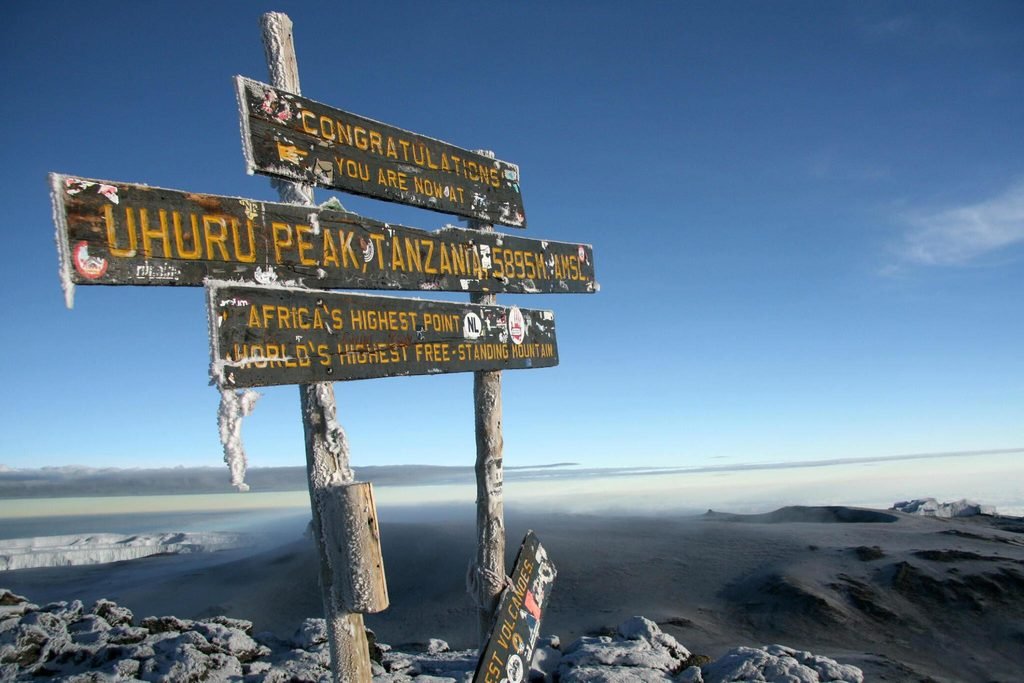
If your health and the conditions allow, you continue along the crater rim toward Stella Point and eventually Uhuru Peak, the highest point in Africa at 5,895 meters.
The summit area may be extremely cold, with strong winds and possible snow or ice. When visibility is good, the views across Kilimanjaro’s crater and remaining glaciers can be extraordinary.
After taking photographs and celebrating the achievement, you begin descending toward Kibo Hut. Following a short rest and meal, the group continues downhill to Horombo Hut.
The long descent can be tiring, particularly after the overnight summit attempt, but returning to a lower elevation is important for recovery.
You arrive at Horombo Hut for dinner and overnight rest.
Accommodation: Horombo Hut.
Meals: Breakfast, lunch and dinner.
Day 5: Horombo Hut to Marangu Gate – Return to Moshi
Starting elevation: Approximately 3,720 meters
Ending elevation: Approximately 1,860 meters
Hiking distance: 19–20 kilometers
Walking time: 5–7 hours
Habitat: Moorland and rainforest
After breakfast, you begin the final descent from Horombo Hut toward Marangu Gate.
The trail passes through the moorland before entering the rainforest, where the vegetation becomes increasingly dense and the air warmer and more humid.
You pass Mandara Hut along the way and continue descending through the forest. Although the route is generally easier than the summit ascent, the long downhill walk can be tiring because of the previous day’s physical effort.
After reaching Marangu Gate, your guide completes the park exit formalities. Eligible climbers receive the appropriate summit certificates according to the park’s procedures.
You then meet your arranged transport and return to Moshi, where you can rest and celebrate the completion of your Kilimanjaro expedition.
Meals: Breakfast and lunch.
End of 5-day Marangu Route itinerary.
6 Days Marangu Route Kilimanjaro Joining Group Itinerary
The six-day Marangu Route follows the same trail as the five-day version but includes an additional day at Horombo Hut. This extra day is important because it provides more time for altitude adjustment before continuing toward Kibo Hut and attempting the summit.
For many climbers, particularly those without previous high-altitude experience, the six-day version is a more appropriate choice than the shorter itinerary. However, it remains a demanding climb, and altitude sickness can affect anyone.
Day 1: Moshi to Marangu Gate – Trek to Mandara Hut
Starting elevation: Approximately 1,860 meters
Ending elevation: Approximately 2,720 meters
Distance: 8 kilometers
Walking time: 4–5 hours
After breakfast in Moshi, you travel with your guide and fellow climbers to Marangu Gate for registration and the start of the expedition.
The first day’s trail passes through Kilimanjaro’s tropical rainforest, where tall trees, ferns, and moss-covered vegetation create a cool and beautiful environment.
Your guide maintains a comfortable walking pace as the group gradually ascends toward Mandara Hut. Along the way, you may see forest birds and monkeys, although wildlife encounters cannot be guaranteed.
After arriving at Mandara Hut, you settle into the shared mountain accommodation and enjoy dinner.
If time and conditions allow, your guide may arrange a short walk toward Maundi Crater before returning to the hut.
Accommodation: Mandara Hut.
Meals: Lunch and dinner.
Day 2: Mandara Hut to Horombo Hut
Starting elevation: Approximately 2,720 meters
Ending elevation: Approximately 3,720 meters
Distance: 11–12 kilometers
Walking time: 6–8 hours
After breakfast, the group continues ascending through the upper forest and into the moorland zone.
The landscape gradually opens, revealing views of Kibo and Mawenzi when the weather is clear. The vegetation changes from dense forest to shrubs and distinctive mountain plants.
The day’s walk is longer and involves a substantial increase in altitude, so maintaining a slow pace is important.
After several hours, you reach Horombo Hut, where you enjoy a meal and rest.
Your guide will monitor the group’s health and explain the purpose of the following day’s acclimatization walk.
Accommodation: Horombo Hut.
Meals: Breakfast, lunch and dinner.
Day 3: Horombo Hut Acclimatization Day – Walk to Zebra Rocks
Starting elevation: Approximately 3,720 meters
Highest walking elevation: Approximately 4,000–4,100 meters
Ending elevation: Approximately 3,720 meters
Walking distance: Approximately 5–7 kilometers round trip
Walking time: 3–5 hours
The third day is the main difference between the five-day and six-day Marangu itineraries.
Instead of continuing directly to Kibo Hut, you spend an additional night at Horombo Hut to allow more time for acclimatization.
After breakfast, your guide leads the group on a walk toward Zebra Rocks, a distinctive rock formation named for its striped appearance.
The walk takes you higher into the moorland, providing an opportunity to experience the effects of altitude while returning to sleep at a lower elevation.
This approach is commonly described as climb high, sleep low and can support acclimatization, although it does not eliminate the risk of altitude sickness.
During the walk, you may enjoy views of Mawenzi and the surrounding mountain landscapes. The guide will maintain a gradual pace and monitor how everyone responds to the altitude.
After exploring the area, you descend to Horombo Hut for lunch and rest.
The afternoon provides time to relax, drink water, and prepare for the following day’s ascent toward Kibo Hut.
Accommodation: Horombo Hut.
Meals: Breakfast, lunch and dinner.
Day 4: Horombo Hut to Kibo Hut
Starting elevation: Approximately 3,720 meters
Ending elevation: Approximately 4,700 meters
Distance: 9–10 kilometers
Walking time: 5–7 hours
After breakfast, you leave Horombo Hut and continue ascending toward Kibo Hut.
The trail passes through increasingly sparse vegetation before entering the alpine desert zone.
As you cross the Saddle between Mawenzi and Kibo, the landscape becomes open and rocky, with wide mountain views when conditions are clear.
The extra acclimatization day at Horombo may help you feel better prepared for the higher altitude, but the climb to Kibo remains demanding.
After arriving at Kibo Hut, you rest and prepare your equipment for the summit attempt.
Your guide will explain the expected departure time, weather conditions, and safety procedures.
Dinner is served early, followed by rest before the overnight ascent.
Accommodation: Kibo Hut.
Meals: Breakfast, lunch and dinner.
Day 5: Kibo Hut to Uhuru Peak – Descend to Horombo Hut
Starting elevation: Approximately 4,700 meters
Summit elevation: 5,895 meters
Ending elevation: Approximately 3,720 meters
Distance: 20–22 kilometers
Walking time: 12–16 hours
The summit attempt begins late at night or around midnight.
Wearing warm clothing and headlamps, the group starts climbing the steep volcanic slopes above Kibo Hut.
The ascent is slow and physically demanding because of the altitude, cold temperatures, and loose terrain.
Your guide will monitor everyone closely and adjust the pace according to the group’s condition.
After several hours, you reach Gilman’s Point on the crater rim. If conditions and your health allow, you continue toward Uhuru Peak at 5,895 meters.
Standing at the highest point in Africa is an unforgettable achievement, but safety remains the priority. Climbers experiencing serious altitude-related symptoms must follow the guide’s instructions, including descending when necessary.
After spending a short period at the summit, you return to Kibo Hut and continue descending to Horombo Hut.
You arrive in the afternoon or evening for dinner and overnight rest.
Accommodation: Horombo Hut.
Meals: Breakfast, lunch and dinner.
Day 6: Horombo Hut to Marangu Gate – Return to Moshi
Starting elevation: Approximately 3,720 meters
Ending elevation: Approximately 1,860 meters
Distance: 19–20 kilometers
Walking time: 5–7 hours
After breakfast, you begin the final descent toward Marangu Gate.
The trail passes through moorland and rainforest, offering another opportunity to appreciate Kilimanjaro’s changing landscapes.
You pass Mandara Hut and continue through the forest until reaching the park entrance.
At Marangu Gate, your guide completes the necessary exit procedures, and eligible climbers receive their summit certificates.
After saying goodbye to the mountain crew, you travel back to Moshi, where your Kilimanjaro adventure comes to an end.
Meals: Breakfast and lunch.
End of 6-day Marangu Route itinerary.
5 Days vs 6 Days Marangu Route: Which Should You Choose?
Although both itineraries use the same trail, the additional day on the six-day Marangu Route is an important difference.
| Feature | 5-Day Marangu Route | 6-Day Marangu Route |
|---|---|---|
| Duration | 5 days | 6 days |
| Mountain nights | 4 | 5 |
| Acclimatization day | No dedicated day | Yes, at Horombo Hut |
| Summit attempt | Day 4 | Day 5 |
| Sleeping accommodation | Mountain huts | Mountain huts |
| Overall pace | Faster | More gradual |
| Altitude risk | Higher concern due to rapid ascent | Still significant, but more acclimatization time |
| Cost | Generally lower | Generally higher |
| Recommended option | For appropriately experienced climbers | Preferred for most joining-group participants |
Our recommendation: Choose the six-day Marangu Route whenever your schedule and budget allow. The additional acclimatization day provides a more sensible climbing schedule than the five-day version, although longer routes such as Lemosho or Northern Circuit may offer still more time to adjust.
Marangu Route Accommodation: What Are the Mountain Huts Like?
One of the most distinctive features of the Marangu Route is its permanent mountain hut accommodation.
Unlike the Machame, Lemosho, Rongai, and Northern Circuit routes, where climbers generally sleep in camping tents, Marangu uses shared huts at designated locations.
Mandara Hut
Mandara Hut is located in the rainforest zone at approximately 2,720 meters. It provides basic shared sleeping accommodation and communal facilities.
The surrounding forest creates a peaceful atmosphere, and the nearby Maundi Crater walk is a popular optional activity when time and conditions allow.
Horombo Hut
Horombo Hut is located at approximately 3,720 meters and is used by both ascending and descending climbers.
It is the main acclimatization stop on the six-day itinerary and offers views of Kibo and Mawenzi when the weather is clear.
Kibo Hut
Kibo Hut is located at approximately 4,700 meters in the alpine desert zone.
It is the final overnight stop before the summit attempt. Conditions are basic, and temperatures can be extremely cold.
Climbers should bring a suitable sleeping bag and warm clothing even though they are staying indoors.
How Difficult Is the Marangu Route?
The Marangu Route is sometimes described as one of the easier Kilimanjaro trails because it has an established path and does not include obstacles such as the Barranco Wall.
However, this description can be misleading.
Reaching Uhuru Peak requires climbing to almost 5,900 meters, where reduced oxygen levels make physical activity considerably more demanding.
The main challenge is altitude rather than technical terrain.
The five-day itinerary is particularly demanding because climbers ascend rapidly with limited acclimatization time. The six-day version provides an additional day but still requires careful preparation.
Travelers should be comfortable walking for several hours on consecutive days and understand that summit day may involve more than twelve hours of hiking.
Is the Marangu Route Suitable for Beginners?
Marangu can be considered by physically prepared first-time Kilimanjaro climbers, particularly on the six-day itinerary.
However, beginners should not assume that hut accommodation makes the climb easy or that reaching the summit is guaranteed.
Previous hiking experience, appropriate equipment, good physical preparation, and a responsible mountain guiding team are important.
Travelers who want a more gradual acclimatization schedule may prefer longer routes such as the eight-day Lemosho Route or nine-day Northern Circuit.
Best Time to Join a Marangu Route Kilimanjaro Group in 2027/2028
The best periods for climbing Kilimanjaro are generally January through early March and June through October.
During these months, weather conditions are often more favorable than during the main rainy seasons, although the mountain can experience rain, snow, strong winds, and freezing temperatures at any time of year.
January and February are popular because of relatively favorable conditions and opportunities for clear mountain views.
June through October is another major climbing period, with July, August, and September often attracting many visitors.
April and May are usually associated with the long rainy season, while November can bring shorter rains. These wetter periods may make trails muddy and reduce visibility.
Joining-group departures may be more frequent during popular climbing seasons, but the exact 2027 and 2028 schedules must be confirmed.
How Much Does a 5–6 Days Marangu Route Joining Group Cost in 2027/2028?
Joining-group prices depend on the departure date, group size, park fees, mountain crew arrangements, accommodation before and after the climb, and services included.
The following are broad planning estimates, not confirmed Eddy Tours and Safaris prices.
| Package | Illustrative price per person |
|---|---|
| 5-Day Marangu Route Joining Group | $1,350–$1,900 |
| 6-Day Marangu Route Joining Group | $1,550–$2,200 |
| Private 5-Day Marangu Route | Request a quotation |
| Private 6-Day Marangu Route | Request a quotation |
Actual rates for 2027 and 2028 should be confirmed before booking.
Travelers should ask whether the price includes Kilimanjaro National Park fees, hut accommodation, professional guides, porters, cooks, meals, transport, and hotel accommodation.
What Is Included in the Marangu Joining Group Package?
A professionally organized Marangu joining-group package commonly includes:
- Kilimanjaro National Park entry and hut accommodation fees.
- Professional licensed mountain guides.
- Mountain porters and cooking crew.
- Meals during the climb.
- Drinking water prepared according to the operator’s procedures.
- Shared mountain hut accommodation.
- Transport between Moshi and Marangu Gate.
- Group climbing arrangements and safety briefings.
The exact inclusions should be listed in the confirmed quotation.
What Is Not Usually Included?
International flights, visa fees, personal travel insurance, mountain equipment rental, personal clothing, tips for the mountain crew, and personal expenses are commonly excluded.
Hotel accommodation before and after the climb may also be excluded unless specifically stated.
Travelers should ensure that their insurance covers trekking to Kilimanjaro’s summit altitude and emergency evacuation.
Altitude Sickness and Safety on the Marangu Route
Altitude sickness is one of the most important risks associated with climbing Mount Kilimanjaro.
As climbers ascend, the air pressure decreases, reducing the amount of oxygen available to the body. Symptoms may include headaches, nausea, dizziness, unusual fatigue, and difficulty sleeping.
These symptoms should be reported promptly to the mountain guide.
Severe altitude illness may involve confusion, difficulty walking normally, or breathlessness at rest. Such symptoms require urgent assessment and may require immediate descent.
A responsible climbing expedition should include guides trained to recognize altitude illness, appropriate health monitoring, emergency communication arrangements, and a clear evacuation plan.
Climbers should never continue ascending with worsening symptoms simply because they want to reach Uhuru Peak.
What Should You Pack for a Marangu Route Kilimanjaro Climb?
Although the Marangu Route uses mountain huts, climbers still need proper equipment for cold weather, rain, and high-altitude trekking.
Important items include waterproof hiking boots, thermal base layers, a warm insulated jacket, waterproof outer clothing, gloves, a warm hat, trekking poles, a headlamp, sunglasses, sunscreen, and a sleeping bag suitable for freezing conditions.
A daypack is needed for drinking water, snacks, personal medication, rain protection, and other items used during the hike.
Your climbing operator should provide a complete packing list before departure, including equipment rental options and porter luggage limits.
Can You Combine a Marangu Route Climb with a Tanzania Safari?
Yes. Many travelers combine their Kilimanjaro expedition with a wildlife safari in northern Tanzania.
After completing the climb, you can visit Serengeti National Park, Ngorongoro Crater, Tarangire National Park, or Lake Manyara National Park.
A three- to five-day safari can provide opportunities to observe lions, elephants, giraffes, zebras, buffaloes, and other wildlife.
Travelers should allow sufficient time to rest after the climb before beginning a long safari journey.
Can You Visit Zanzibar After Climbing Kilimanjaro?
Yes. Zanzibar is a popular destination for travelers who want to relax after completing their Kilimanjaro expedition.
The island offers beautiful beaches, historical attractions, spice farms, snorkeling, and comfortable coastal accommodation.
A four- to seven-day Zanzibar holiday can provide a relaxing conclusion to your Tanzania adventure.
Frequently Asked Questions About the Marangu Route Joining Group
What is a Kilimanjaro joining group?
A joining group is a scheduled climbing expedition where individual travelers or small parties join other participants and share certain operational arrangements, including guides and support services.
Is the Marangu Route five or six days?
Both itineraries are commonly offered. The five-day version is shorter, while the six-day version includes an additional acclimatization day at Horombo Hut.
Which is better, the five-day or six-day Marangu Route?
The six-day itinerary is generally preferable because it provides more time for acclimatization before the summit attempt.
Is Marangu the easiest Kilimanjaro route?
Marangu has an established trail and hut accommodation, but the climb remains physically demanding because of the altitude and summit ascent.
Do you sleep in tents on the Marangu Route?
No. The standard Marangu Route uses shared mountain huts at Mandara, Horombo, and Kibo.
Can beginners join the Marangu Route?
Physically prepared beginners may consider the six-day itinerary, but they should understand the altitude risks and may benefit from a longer climbing route.
What is the highest point on the Marangu Route?
Uhuru Peak, at 5,895 meters above sea level.
Is the Marangu Route crowded?
Marangu is one of Kilimanjaro’s established popular routes. Climbers may encounter other groups on the trail and in the mountain huts, particularly during busy seasons.
How much does a Marangu joining-group climb cost?
Broad planning estimates range from approximately $1,350–$1,900 for five days and $1,550–$2,200 for six days. Confirmed prices depend on the departure and services included.
Can I join the group as a solo traveler?
Yes, joining-group departures are commonly suitable for solo travelers, subject to availability and the operator’s group arrangements.
Is the Marangu Route safe?
The route can be climbed with professional support, but high-altitude trekking carries risks, including altitude sickness, cold exposure, and physical exhaustion. Appropriate preparation and experienced guides are essential.
What is the best month to climb Marangu?
January, February, and the main dry-season months from June through October are generally popular choices.
How many people are in a joining group?
Group size varies by operator and departure. Travelers should confirm the maximum number of climbers and the guide-to-climber arrangements before booking.
Can I book a private Marangu climb instead?
Yes. Private Marangu Route expeditions can be arranged separately, subject to availability and confirmed pricing.
Final Thoughts: Is the 5–6 Days Marangu Route Joining Group Worth It?
The Marangu Route provides an established way to climb Mount Kilimanjaro while staying in permanent mountain huts rather than camping tents. Its forest trails, open moorland, views of Mawenzi and Kibo, and challenging summit ascent make it a memorable experience for travelers visiting Tanzania.
Joining a group can also make the expedition more social and may help reduce certain costs compared with a private climb.
However, choosing between five and six days is important. The shorter itinerary involves rapid altitude gain and limited acclimatization, while the six-day version provides an additional day at Horombo Hut.
For most travelers considering Marangu, the six-day itinerary is the better starting point. Those who want still more time to adjust to altitude should consider longer Kilimanjaro routes.
With suitable preparation, professional guidance, and realistic expectations, a Marangu Route climb can be a rewarding part of a Tanzania adventure.
Book Your 5–6 Days Marangu Route Joining Group with Eddy Tours and Safaris
Are you planning to climb Mount Kilimanjaro in 2027 or 2028 and want to join a group on the Marangu Route?
Eddy Tours and Safaris can help you discuss available group departures, five-day and six-day itineraries, mountain accommodation, equipment requirements, and the services included in your climbing package.
Contact our team with your preferred travel dates, number of climbers, and whether you would like the five-day or six-day itinerary.
Website: www.eddytours-safaris.com
Contact page: Plan Your Kilimanjaro Climb
Email: sales@eddytours-safaris.com
WhatsApp: +255 711 906 664