
There are places that look impressive in photographs, and then there are places whose scale changes the way you see a landscape. Serengeti National Park belongs to the second group. The road may rise over a small hill and suddenly the country opens in every direction: grassland, distant kopjes, a line of acacia trees and the tiny movement of animals on the horizon. It is a place of big wildlife moments, but it is just as powerful in the quiet spaces between them.
For travellers planning a Tanzania safari in 2026 or 2027, the Serengeti is often the main reason to come. It is home to abundant resident wildlife, famous predator populations and the annual movement of wildebeest and zebra known as the Great Migration. Yet no two Serengeti safaris are identical. Season, rainfall, the location of your camp and the patience of your guide all affect what the day brings. The best way to visit is with enough time, realistic expectations and a route matched to the months you travel.
Where is Serengeti National Park?
Serengeti National Park lies in northern Tanzania and forms part of a much wider ecosystem that reaches toward Kenya’s Maasai Mara. The name Serengeti comes from the Maasai word siringet, often translated as “endless plains.” Once you see the central and southern grasslands, the description makes sense.
Most visitors reach the Serengeti through Tanzania’s Northern Safari Circuit. A classic road route begins in Arusha and may include Tarangire National Park, Lake Manyara and the Ngorongoro Conservation Area before continuing into the Serengeti. This route is excellent for travellers who want a complete northern Tanzania safari, but it includes driving time. Flying from Arusha to one of the Serengeti airstrips is a good alternative for visitors with limited time or those who prefer to spend more hours on game drives and fewer on the road.

What makes the Serengeti such a special safari destination?
The Serengeti is not famous only because of the migration. Its strength is the depth of its wildlife year-round. Lions live across much of the park, leopards use riverine trees and thick cover, cheetahs hunt the open plains, and spotted hyenas work both day and night. Elephant, buffalo, giraffe, zebra, hippo, crocodile, jackal and a wide range of antelope species make every game drive feel different.
It is also a place where the relationship between animals becomes clear. Vultures circling in the distance may lead a guide to a predator sighting. Baboons or impalas giving an alarm call can point to a leopard. A lion pride resting in shade is not inactive in a meaningless way; it is conserving energy in the heat. Good safari guiding turns these observations into a story of how the ecosystem works.
The size of the park allows you to move away from busy areas when conditions permit. Popular sightings can attract vehicles, especially in the central Seronera area, but a good itinerary does not depend on being in one famous spot. The Serengeti rewards people who travel slowly, stay for several nights and allow the guide to work with the day rather than chase every radio message.
The Great Migration: what it is and what it is not
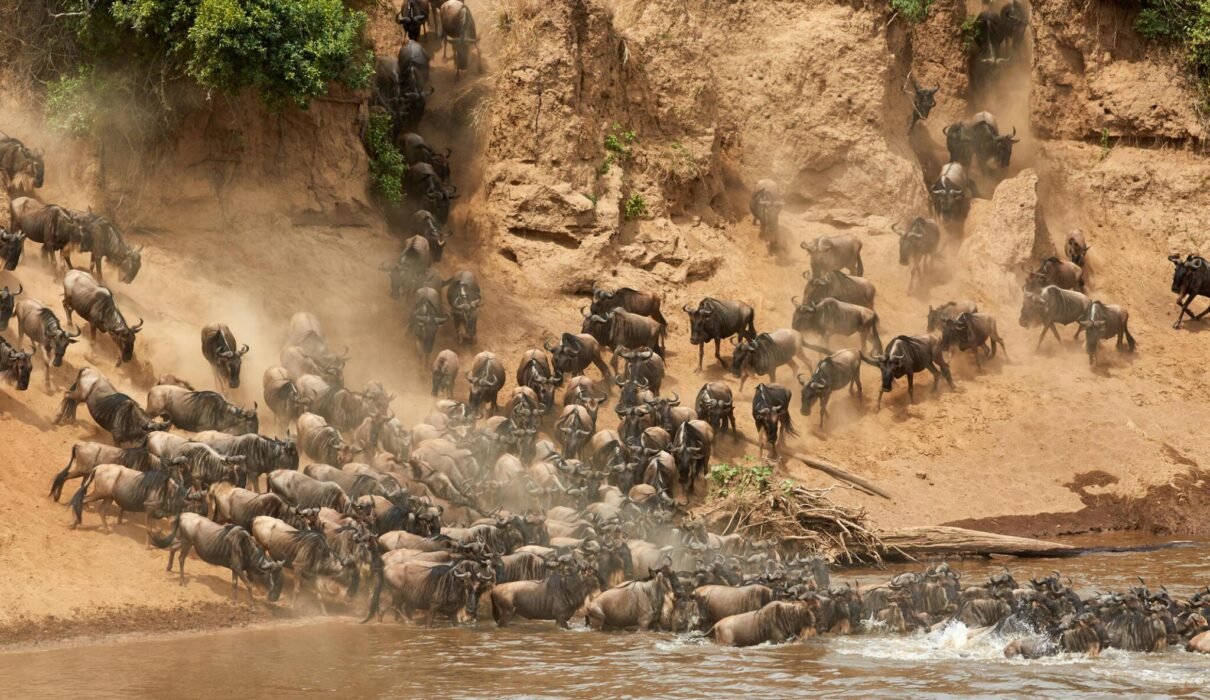
The Great Migration is the annual movement of vast herds of wildebeest, accompanied by zebra and gazelle, through the Serengeti-Mara ecosystem. It is one of the world’s greatest wildlife events, but it is not a single parade that arrives at the same place on the same date each year. The movement follows rain, fresh grass and water. That makes it exciting, but it also means a responsible safari planner must be careful with promises.
From roughly December to March, many herds are often found in the southern Serengeti and Ndutu area, where short grass and open plains provide calving grounds. The calving period is dramatic because newborn wildebeest attract predators, but it is also a time of green, wide landscapes and active birdlife. In the following months, herds generally begin moving west and north as grazing conditions change.
From around July to October, sections of the migration may be in the Northern Serengeti near the Mara River. River crossings are the scenes many visitors hope to witness. They are never guaranteed. A herd can gather on a bank for hours, turn back, cross quickly or remain elsewhere entirely. Anyone selling a “guaranteed crossing” is not being honest about nature. The better approach is to place you in the right region for your dates and give you enough nights to wait patiently.
Outside the migration, the Serengeti is still exceptional. Resident animals do not disappear, and the open plains, kopjes and river valleys continue to provide outstanding game viewing. In many ways, travellers who focus less on one event and more on the full ecosystem often enjoy a richer safari.

Serengeti regions: choosing the right area for your dates
Central Serengeti (Seronera)
Central Serengeti is the most reliable all-round area for a first visit. The Seronera Valley has permanent water and varied habitat, which supports wildlife throughout the year. It is widely known for lion, leopard and cheetah sightings, as well as giraffe, buffalo, hippo and many antelope species. It also has a broad range of camps and lodges, which makes it practical for different budgets.
If you have only two or three nights in the Serengeti and are not travelling specifically for a migration stage, Central Serengeti is usually a sensible base. It does attract more visitors than remote regions, but there is still room for excellent guiding and quieter sightings when the vehicle does not follow the crowd.
Southern Serengeti and Ndutu
The south comes into its own in the green season and calving period. It is the right area to consider if you travel from about December through March and want to be close to the migration herds when they are on the short-grass plains. Ndutu sits in the Ngorongoro Conservation Area beside the Serengeti and may allow a different game-driving experience under the regulations that apply there.
The weather can be changeable at this time of year, and rain is part of the experience. It does not mean every day is wet. In fact, showers can leave clear light, dramatic skies and fresh green grass. A flexible guide and the right camp position are more important than an overly fixed schedule.
Western Corridor
The Western Corridor follows the Grumeti River area and can be relevant as herds move westward, often from around May to June. It has riverine woodland, open plains and a different feel from the centre. Travel timing depends on rainfall, so the best camp choice should be reviewed closer to the journey rather than copied from a calendar without thought.
Northern Serengeti
Northern Serengeti is a quieter, more remote region near the Mara River. It is most sought after in the dry-season months when migration herds may be nearby, but its appeal goes beyond crossings. Rolling country, woodland, river landscapes, elephants, big cats and fewer vehicles in many areas make it a rewarding place to stay. At least two nights are recommended because reaching the region takes time.
Wildlife you can expect to see
No wildlife safari can guarantee sightings, but the Serengeti has an exceptional range of possibilities. Lions are often the most frequently encountered big cats. Leopard sightings require more patience; guides search trees, river lines and thick cover where a leopard may rest out of view. Cheetahs are easier to spot in open country, but they also range widely. Spotted hyenas are common and fascinating to watch, particularly around dens or when interacting with other predators.
Herbivores include elephant, buffalo, giraffe, hippo, zebra, wildebeest, eland, hartebeest, topi, impala, Grant’s gazelle and Thomson’s gazelle. Smaller mammals may include banded mongoose, warthog, vervet monkey, baboon, rock hyrax and bat-eared fox. Birding is excellent: martial eagles, secretary birds, kori bustards, lilac-breasted rollers, ostriches and many vultures are among the possibilities.
It helps to remember that wildlife has a life outside the visitor’s plans. Animals may be hidden by grass, travelling beyond a game-drive area or resting during midday heat. A skilled guide cannot control that, but they can give you the best chance by starting early, using their knowledge of habitat and taking time at promising sightings.
How many nights should you spend in the Serengeti?
For most visitors, three nights is a strong minimum. It provides two full days of game viewing plus arrival and departure drives. Two nights can work for a shorter itinerary, but it is easier to feel rushed, especially if you are travelling by road. Four or more nights let you explore different areas, enjoy slower mornings and adjust plans if weather or wildlife movement changes.
During a migration-focused safari, your stay should be based on the region rather than on an exact number of kilometres. For example, two or three nights in Northern Serengeti can make sense in the mid-year dry season, while travellers in the early months may be better served by spending those nights near Ndutu or the southern plains. Eddy Tours & Safaris can advise on the most practical camp locations for your specific 2026 or 2027 dates.
Best time to visit Serengeti National Park
The Serengeti is a year-round destination, so “best” depends on your priority. June to October is typically dry, with cooler mornings, lower grass and good all-round wildlife viewing. It is also a high-demand period, especially for Northern Serengeti camps. Booking early is important.
January and February are popular for the southern plains and calving season. March to May brings the long rains, lower visitor numbers and green landscapes. Some travellers enjoy this period because it feels less busy and may offer better value, while others prefer drier roads and more predictable weather. November and December often have short rains, but rainfall patterns vary from year to year.
Avoid choosing dates only because an online calendar says a certain event “must” happen. Wildlife and weather are not exact. Choose the month you can travel, then let the itinerary place you in the best area for the likely conditions.
Safari accommodation: camps, lodges and what to choose
Serengeti accommodation ranges from simple public campsites to comfortable budget tented camps, mid-range lodges and high-end mobile camps. A tented camp does not necessarily mean rough camping. Many have proper beds, en-suite bathrooms, dining tents and staff who prepare meals. The tent walls allow you to hear the natural sounds outside, which many guests value, though light sleepers may prefer a more solid lodge.
When comparing accommodation, location often matters more than a long list of facilities. A camp close to the wildlife area you want to explore saves driving time at the beginning and end of each day. Ask whether the property is inside the park, what type of bathroom it has, how electricity works, whether dietary needs can be met and how far it is from the nearest airstrip or key game-viewing areas.
For a first safari, do not be afraid to mix levels. You might choose a good mid-range camp in the Serengeti, a comfortable lodge in Karatu and a simpler overnight in Arusha. The aim is a coherent trip, not identical rooms every night.
Typical Serengeti safari day
Most days begin early. A wake-up around 5:30 or 6:00 a.m. is common, followed by tea or coffee and a game drive while animals are still active. You may return to camp for a late breakfast, take a packed breakfast into the bush or continue toward a different area. The middle of the day is often warm, so some visitors rest at camp before an afternoon drive. Others continue with a packed lunch, particularly when exploring remote parts of the park.
Evenings are for dinner, a shower and time around the campfire or on the veranda. It is not a nightlife destination in the usual sense. The pleasure comes from hearing hyenas call in the distance, seeing a sky full of stars and discussing the day with your guide or fellow travellers. Always follow camp staff instructions after dark, because animals may pass through unfenced camp areas.
Responsible wildlife viewing in the Serengeti
Respectful viewing protects both wildlife and the quality of the safari. Keep a sensible distance, allow animals room to move and avoid making loud noises for a photograph. Do not request off-road driving where it is prohibited, feed animals or leave litter. A close encounter is not automatically a better encounter; a calm animal behaving naturally is far more valuable than one that feels surrounded.
Photography requires patience. Use a long lens if you have one, but do not let the camera prevent you from looking with your own eyes. Ask before photographing people outside the park, particularly in communities and markets. Carry reusable water bottles where possible and use lodge refill stations to reduce single-use plastic.
Combining Serengeti with other Tanzania destinations
Serengeti fits well into a longer Northern Circuit journey. Tarangire adds elephants and baobabs; Lake Manyara provides forest and birdlife; Ngorongoro Crater has high wildlife density in a volcanic setting. After safari, Zanzibar offers a natural contrast with beach time and Stone Town culture. For travellers who want a mountain challenge, a guided Mount Kilimanjaro climb can be arranged separately through Kilimanjaro Climb Specialist.
The right combination depends on time. A six- or seven-day safari can include Serengeti, Ngorongoro and one additional park. With ten days or more, there is room for several Serengeti nights and a slower route. Adding every destination to a short itinerary is usually a mistake; better to see fewer places properly.
Useful packing advice
Bring neutral-coloured layers, a warm fleece for early game drives, a lightweight rain jacket in wetter months, sun protection, sunglasses, a hat and closed shoes. Binoculars are very useful, especially for birds and distant cats. A camera, spare batteries and a power bank are practical, but a phone also captures good images in the right light. Keep medication and essential documents in your hand luggage.
Soft-sided bags are generally easier than large hard suitcases, particularly if your itinerary includes small aircraft flights. Confirm baggage limits before travelling. Medical advice, vaccinations, malaria prevention, visas and passport validity should be checked with the relevant qualified sources well before departure, as requirements can change.
Plan your Serengeti safari for 2026/2027
Serengeti National Park earns its reputation because it offers more than a single famous wildlife event. It is a living ecosystem where a quiet morning can become a lion sighting, a line of vultures can reveal a story, and the plains keep changing with the weather. Give it enough time and choose a route that fits the season, and it can become the centre of a Tanzania journey.
To plan your Serengeti safari with Eddy Tours & Safaris, visit our contact page, call or WhatsApp +255 711 906 664, or email eddytoursandsafaris@gmail.com or sales@eddytours-safaris.com. Share your dates, number of travellers and preferred accommodation level, and we will prepare a clear itinerary that matches the likely wildlife conditions.