

Mount Kilimanjaro ranks fourth among the Seven Summits when ordered by elevation above sea level. Its highest point, Uhuru Peak, stands at 5,895 metres, placing it below Everest, Aconcagua, and North America’s highest mountain, commonly known as Denali, and above Elbrus, Vinson, and either mountain used for the seventh continental position.
Kilimanjaro holds this ranking on both widely recognised Seven Summits lists: the Bass list and the Messner list. The difference between them concerns Australia’s continental representative, which does not change Kilimanjaro’s position.
For travelers considering a climb, the ranking provides useful geographical context. However, height alone does not tell you how difficult a mountain is, what skills it requires, or how much preparation you need.
This guide from Eddy Tours & Safaris explains Kilimanjaro’s place among the Seven Summits, the differences between the lists, and what the comparison means for your Tanzania expedition.

What Are the Seven Summits?
The Seven Summits are the highest mountains on each of the seven traditionally recognised continents.
They are not the world’s seven highest mountains. A global list ordered purely by height would include many Himalayan and Karakoram peaks rather than one mountain from each continent.
The Seven Summits challenge is geographical: climbers aim to reach each continent’s highest point.
That means the collection includes very different environments and climbing experiences, from the tropical landscapes of Tanzania to Antarctica’s remote mountains.
The Seven Summits Ranked by Height
The table below uses the Messner version, which includes Carstensz Pyramid, also called Puncak Jaya.
Elevations are commonly published values rounded to the nearest metre. Minor differences between surveys and references do not change Kilimanjaro’s fourth-place ranking.
| Rank by elevation | Mountain | Continental position | Approximate elevation |
|---|---|---|---|
| 1 | Mount Everest | Asia | 8,849 m |
| 2 | Aconcagua | South America | 6,961 m |
| 3 | Denali / Mount McKinley | North America | 6,190 m |
| 4 | Mount Kilimanjaro | Africa | 5,895 m |
| 5 | Mount Elbrus | Europe | 5,642 m |
| 6 | Mount Vinson | Antarctica | 4,892 m |
| 7 | Carstensz Pyramid / Puncak Jaya | Australia–Oceania continental interpretation | 4,884 m |
The mountains above Kilimanjaro are Everest, Aconcagua, and Denali. Those below it are Elbrus, Vinson, and Carstensz Pyramid. The same ordering is reflected in Seven Summits climbing references.
Why Are There Two Seven Summits Lists?
The main disagreement concerns how the Australian continent is interpreted.
The Bass List
The Bass list uses Mount Kosciuszko, the highest mountain on mainland Australia, at approximately 2,228 metres.
Under this version, Kosciuszko occupies the seventh position when the mountains are ordered by elevation.
The Messner List
The Messner list uses Carstensz Pyramid, approximately 4,884 metres, on the island of New Guinea in Indonesia.
This version considers the broader continental landmass rather than mainland Australia alone.
Does the Difference Affect Kilimanjaro?
No. Both Carstensz Pyramid and Kosciuszko are lower than Kilimanjaro.
Kilimanjaro remains fourth under either definition. Climbers discussing a completed Seven Summits challenge should specify which list they followed.
Why Kilimanjaro Represents Africa
Kilimanjaro is Africa’s highest mountain.
Its highest point is Uhuru Peak, located on Kibo, the highest of Kilimanjaro’s principal volcanic features.
For Seven Summits purposes, reaching another viewpoint or crater-rim point is not equivalent to reaching Uhuru Peak.
On some routes, climbers first reach Stella Point or Gillman’s Point before continuing toward the highest summit. These are important milestones, but the final destination matters when recording a Seven Summits ascent.
If your guide recommends turning around before Uhuru Peak, follow that advice. The geographical goal must remain secondary to your condition and the mountain circumstances.
Is Kilimanjaro the Fourth-Highest Mountain in the World?
No.
Kilimanjaro is fourth within the Seven Summits collection. Many mountains outside that collection are higher.
The distinction is simple:
| Question | Answer |
|---|---|
| Is Kilimanjaro Africa’s highest mountain? | Yes |
| Is it fourth among the Seven Summits by elevation? | Yes |
| Is it the fourth-highest mountain worldwide? | No |
| Does its height establish its difficulty ranking? | No |
Confusing these categories can lead to misleading travel descriptions. A continental ranking should not be presented as a worldwide height ranking.
Does Fourth Place Mean Fourth Most Difficult?
No. There is no universal difficulty ranking that follows directly from the height table.
A mountain’s demands depend on the route, terrain, weather, remoteness, expedition length, and skills required.
Some climbs involve glacier travel, ropes, crampons, or technical rock climbing. Others are primarily trekking expeditions but still expose climbers to serious altitude and weather challenges.
Even on one mountain, routes can differ substantially.
For Kilimanjaro, the usual trekking routes do not generally require technical mountaineering skills in normal conditions. However, they require sustained walking, suitable equipment, careful altitude planning, and the ability to manage a demanding summit day.
“Nontechnical” describes the type of climbing. It does not mean easy or risk-free.
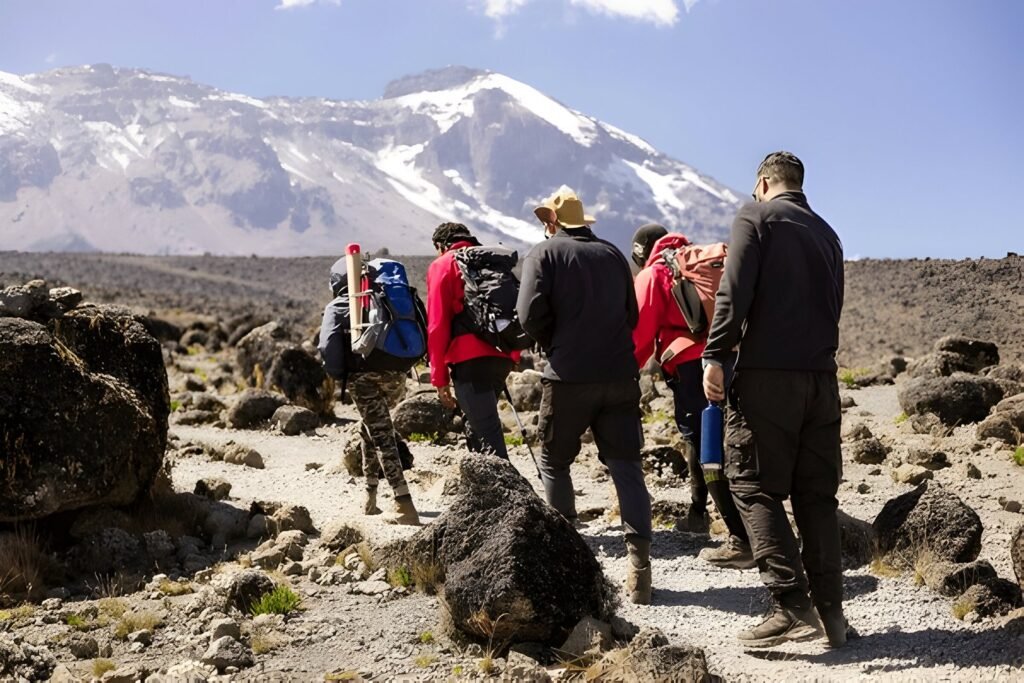
Why Kilimanjaro Appeals to First-Time High-Altitude Trekkers
Kilimanjaro offers established trekking routes and organised expedition support.
Travelers can experience a major continental summit without first undertaking an advanced technical climbing programme. That makes it appealing to people with hiking experience who want a more demanding goal.
The scenery also changes throughout the journey. Forest trails give way to heath and moorland, followed by sparse alpine terrain and the high summit environment.
But accessibility should not be confused with suitability for every traveler.
Your preparation, health, route duration, and expectations all matter. Someone with strong fitness can still respond poorly to altitude, while previous experience does not guarantee the same response on a new itinerary.
Height Versus Altitude Exposure
The summit elevation tells you the highest point. The itinerary tells you how you reach it.
Two climbs ending at 5,895 metres may have different overnight elevations, walking demands, and opportunities to adjust.
This is why comparing routes requires more than choosing the most attractive photographs or the lowest price.
The CDC explains that ascent rate and individual susceptibility affect altitude-illness risk, and that physical fitness does not protect against it.
Discuss personal health questions with a qualified clinician and review the actual daily ascent profile with your operator.
How Kilimanjaro Compares With Everest
Everest is almost 3,000 metres higher than Kilimanjaro.
However, that numerical difference does not fully describe the difference between their standard expeditions.
An Everest summit expedition involves specialised high-altitude mountaineering, technical equipment, and a much longer commitment than a typical Kilimanjaro trek.
Kilimanjaro should not be described as a small version of Everest. It is a distinct trekking objective with its own terrain, weather, and altitude demands.
Also distinguish Everest Base Camp trekking from climbing Everest. Reaching base camp does not count as reaching Asia’s Seven Summits peak.
Is Kilimanjaro Taller Than Elbrus?
Yes.
Using the commonly cited elevations of 5,895 metres for Kilimanjaro and 5,642 metres for Elbrus, Kilimanjaro is 253 metres higher.
That does not establish which expedition is harder for a particular climber. Elbrus involves different terrain and equipment requirements, while Kilimanjaro’s trekking routes present their own challenges.
Use height comparisons for geography, then assess each climb through its specific itinerary.
Which Kilimanjaro Route Should You Choose?
The ranking does not identify the best route for you.
Consider the mountain days, overnight elevations, terrain, accommodation, and supporting arrangements.
| Route | Planning consideration |
|---|---|
| Lemosho | Compare seven- and eight-day schedules; confirm current access |
| Machame | Consider daily demands, duration, and the Barranco Wall |
| Rongai | Northern approach with itinerary variations and Marangu descent |
| Marangu | Hut accommodation; compare five- and six-day schedules |
| Northern Circuit | Longer journey with additional time on the mountain |
| Umbwe | Steep opening ascent requiring careful assessment |
A longer advertised package may include hotel nights rather than extra trekking days. Always request the mountain itinerary separately.
Route availability also needs checking before booking, particularly when planning far ahead.
Preparing for Your First Continental Summit
Start with regular walking and progressively longer hill days.
Practise using your trekking boots and daypack so you can identify comfort problems before travel. Include descents in your training: the walk down after a summit attempt can be demanding.
Prepare equipment for rain, cold, wind, and changing conditions. Your operator should provide a detailed packing list and explain any rental options.
Learn the daily routine before departure, including meals, drinking-water arrangements, luggage, and communication with guides.
The aim is to arrive prepared for the full expedition rather than only the summit photograph.
Planning Your Budget
Kilimanjaro’s place among the Seven Summits does not determine its price.
Costs depend on route duration, group size, equipment, accommodation, crew support, park charges, and transfers.
Ask for a complete quotation and identify flights, insurance, personal equipment, gratuities, and hotel nights separately.
A lower price should be assessed through its service scope. A higher price should also be supported by clear explanations.
No price guarantees reaching Uhuru Peak.
Frequently Asked Questions
What number is Kilimanjaro among the Seven Summits?
Fourth when ranked by elevation above sea level.
Does Kilimanjaro’s ranking change between the Bass and Messner lists?
No. It ranks fourth on both.
What is Kilimanjaro’s summit height?
Uhuru Peak is commonly listed at 5,895 metres.
Is Kilimanjaro the easiest Seven Summit?
There is no universal answer. Standard routes are generally nontechnical, but altitude and physical demands remain significant.
Does reaching Stella Point count as summiting Kilimanjaro?
For the Seven Summits objective, the highest point is Uhuru Peak. Stella Point is a separate crater-rim milestone.
Must I climb all Seven Summits to appreciate Kilimanjaro?
No. Kilimanjaro is a worthwhile expedition on its own.
Plan Your Kilimanjaro Expedition
Kilimanjaro’s fourth-place ranking highlights its stature, but a well-planned climb begins with an itinerary that suits your circumstances.
Contact Eddy Tours & Safaris with your dates, group size, trekking experience, and available mountain days.
Request the full route, equipment information, crew arrangements, and price before choosing your expedition.
For official mountain guidance, visit Kilimanjaro National Park. For altitude preparation, review the CDC’s high-altitude travel guidance.
Website: eddytours-safaris.com
Email: sales@eddytours-safaris.com
Alternative email: eddytoursandsafaris@gmail.com
Phone and WhatsApp: +255 711 906 664