
Climbing Kilimanjaro is expensive because you are paying for a supported mountain expedition lasting several days. The price covers far more than permission to walk a trail: park charges, guides, porters, meals, accommodation, equipment, transport, and the organisation required to deliver those services.
Your full holiday also includes costs that may sit outside the advertised climbing package, such as international flights, insurance, personal equipment, gratuities, and additional hotel nights.
That does not mean every expensive quotation offers good value or every affordable operator provides poor service. The useful question is what the Kilimanjaro climbing cost includes—and whether those arrangements suit your expedition.
This guide from Eddy Tours & Safaris explains the main expenses, shows how to build a realistic budget, and identifies sensible ways to save.
How Much Does Climbing Kilimanjaro Cost?
There is no single price that applies to every Kilimanjaro climb.
The route, number of mountain days, group size, accommodation, equipment, and supporting services all affect the quotation. A five-day trek and an eight-day trek are different products, even before comparing operators.
Published prices provide useful reference points, but they must be read alongside inclusions. For example, Ultimate Kilimanjaro’s published 2027 schedule lists an eight-day Lemosho group departure at US$3,299 per person and a nine-day Northern Circuit departure at US$3,649 per person. These are examples from one operator, not Tanzania-wide averages or Eddy Tours & Safaris prices.
For your own trip, request a quotation based on your dates, group size, route, and actual trekking duration.
The advertised package price is only one part of your total travel budget.

What Makes Kilimanjaro Expensive?
1. Park Charges Form a Substantial Part of the Cost
Kilimanjaro is a protected national park, and climbing involves applicable conservation, camping or hut, and rescue charges.
TANAPA’s visitor guidance identifies these fee categories and advises travelers to confirm the current schedule before departure.
Some charges depend on the number of days or nights, while others apply differently. Your nationality, residency, age, and chosen arrangements may also affect the calculation.
An operator cannot simply negotiate away compulsory park charges because you want a lower price.
Ask whether all applicable fees and taxes are included. Do not add VAT automatically to a quotation that already includes it.
For a future departure, confirm whether the quoted amount is fixed and what happens if official charges change before travel.
2. Your Expedition Requires a Mountain Crew
A Kilimanjaro climb relies on people working throughout the journey.
Guides manage the trekking schedule and help assess concerns. Cooks prepare meals. Porters carry the equipment and supplies needed to support the group.
You are paying for their work over multiple days, together with their food, shelter, transport, and equipment.
Crew size varies with group size and the services offered. Additional dining equipment, toilet facilities, or comfort items can increase the load and staffing requirements.
A quotation that includes “guides and porters” should still explain the practical arrangements. Ask how the team supports different walking speeds and what happens when a climber needs to descend.
3. Food and Supplies Must Reach the Camps
Meals on the mountain require purchasing, packing, carrying, preparation, fuel, and cooking equipment.
Supplies need to serve the climbers and crew throughout the expedition. Dietary requirements also need advance planning.
Even a simple meal involves logistical work when it is prepared several thousand metres above sea level.
When comparing packages, check which meals are included and how drinking water is treated and supplied.
A vague reference to “full board” should be supported by a clear description of the mountain arrangements.
4. Accommodation and Equipment Have Real Costs
Camping routes require tents, sleeping mats, cooking equipment, and other group supplies. Equipment needs cleaning, maintenance, repair, and replacement.
Marangu uses mountain huts, but hut accommodation also carries charges. Sleeping in a hut does not make the whole expedition inexpensive.
Service levels differ. A larger tent, thicker mattress, private toilet tent, or additional dining equipment may improve comfort, but also affects the quotation.
Check whether sleeping bags and personal equipment are included or rented separately.
5. Transport Extends Beyond the Trailhead
The expedition includes moving people, equipment, and supplies to the mountain, then collecting them after descent.
The cost depends partly on the route and departure base. Some trailheads require longer transfers than others.
Airport transfers are separate from mountain transfers unless included expressly.
Also check your hotel location. A package based in Moshi may require different arrangements if you stay in Arusha.
6. Emergency Preparation Requires Organisation
Emergency arrangements involve more than carrying a piece of equipment.
The operator needs appropriate communication, trained personnel, and a practical plan for accompanying someone down while supporting the remaining group.
Ask what equipment is provided, who uses it, and how evacuation arrangements work.
A park rescue charge is not a substitute for insurance. It should not be interpreted as a promise that every medical bill, helicopter evacuation, or onward travel expense is covered.
7. The Operator Has Business Costs
Booking support, staff administration, equipment storage, vehicles, maintenance, and other operating expenses also contribute to the selling price.
Profit is part of running a sustainable business. Its presence does not automatically mean you are being overcharged.
The important issue is whether the total price corresponds to clear, appropriate services and understandable booking terms.
Why Longer Routes Usually Cost More
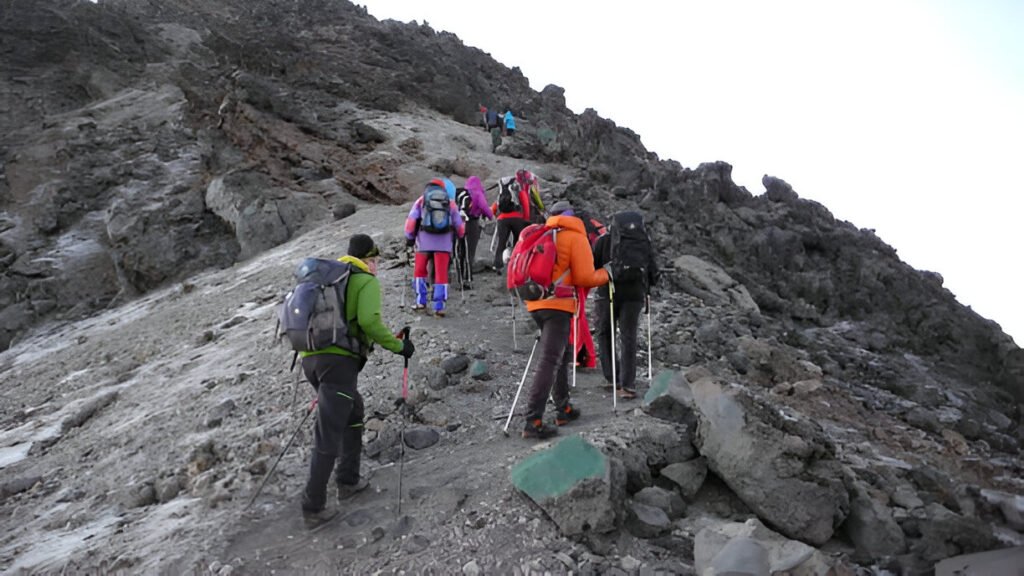
An additional mountain day can mean another day of crew work, meals, park charges, and equipment use.
This is why shortening a route can reduce the quotation. However, choosing fewer days solely to save money changes the ascent schedule as well as the price.
More time can support acclimatisation planning, but the actual itinerary matters. An extra transfer or hotel day is not an extra acclimatisation day on the mountain.
Physical fitness does not protect against altitude illness. Review the ascent profile separately from your training, using the CDC’s high-altitude travel guidance and advice from a qualified clinician.
Group Climbs Versus Private Climbs
Joining a scheduled group can reduce your share of certain operational costs.
A private expedition reserves the arrangements for your party. For a solo traveler or couple, that can produce a higher per-person cost because fewer people share services.
However, a private climb for a larger party may compare differently. Ask for a quotation rather than assuming one format is always cheaper.
Consider practical preferences too:
| Arrangement | What to compare |
|---|---|
| Scheduled group | Departure date, group size, pace management, and room arrangements |
| Private climb | Total party price, itinerary flexibility, and guide coverage |
| Solo private climb | Single-room costs and services that cannot be shared |
| Larger private party | Vehicle, equipment, and staffing capacity |
Group travel should still provide appropriate support if someone becomes ill or walks more slowly.
Costs Often Missing From the Headline Price
Build your budget around the whole trip.
| Expense | What to confirm |
|---|---|
| International flights | Fare, baggage, and change conditions |
| Visa | Requirements and applicable cost for your passport |
| Hotel nights | Number of nights, meals, and room supplements |
| Airport transfers | Arrival and departure airports |
| Equipment | Included items, rentals, and purchases |
| Gratuities | Crew size, recommended budget, and distribution |
| Insurance | Trekking altitude and evacuation cover |
| Personal spending | Drinks, laundry, souvenirs, and extra meals |
| Payment costs | Bank, card, and currency-conversion charges |
| Extensions | Safari, Zanzibar, or other activities |
A lower package quotation can become more expensive once missing services are added.
An Illustrative Kilimanjaro Budget
The following is a made-up budgeting example, not an Eddy Tours & Safaris quotation or a market-price estimate. Replace each figure with your actual costs.
| Budget item | Illustrative amount |
|---|---|
| Climbing package | US$3,000 |
| International flights | US$900 |
| Equipment purchases or rentals | US$250 |
| Crew gratuities | US$350 |
| Suitable travel insurance | US$150 |
| Additional hotels, transfers, and meals | US$200 |
| Visa allowance | US$100 |
| Contingency allowance | US$250 |
| Illustrative total | US$5,200 |
The visa allowance is a placeholder, not a statement of the fee for every traveler. Gratuities also depend on actual crew arrangements and guidance.
If your climbing package already includes hotel nights or airport transfers, avoid counting them twice.
Nine Practical Ways to Save
1. Compare Complete Quotations
Send the same request to two or three operators.
Specify route, mountain days, dates, group size, hotel requirements, and any equipment needs.
Then compare equivalent services rather than whichever headline number is lowest.
2. Consider a Scheduled Group
A joining departure may reduce your share of some costs.
Check the departure is available and understand what happens if it does not meet the operator’s required booking level.
Also confirm group size and how different walking speeds are supported.
3. Choose Standard Accommodation
A comfortable standard hotel may meet your needs before and after the trek.
Premium rooms and extra amenities can be enjoyable, but are not essential to the mountain itinerary.
4. Rent Selected Equipment
Renting suitable items can be economical if you are unlikely to use them again.
Confirm condition, size, specifications, and availability. Essential equipment should fit properly and be dependable.
5. Buy Personal Items Gradually
Prepare early enough to compare equipment prices and test what you buy.
Boots deserve particular attention because you need time to check fit and break them in.
6. Compare Flight Dates
A small change in arrival or departure date may affect airfare.
Balance savings against connection quality, baggage charges, and the need to arrive rested.
7. Remove Optional Comfort Extras
Ask which upgrades can be removed without changing core support.
A simpler hotel or fewer nonessential extras may reduce cost more sensibly than shortening the mountain schedule.
8. Plan Extensions Separately
If the combined climb, safari, and beach holiday exceeds your budget, price each part clearly.
You may choose a shorter extension or postpone it while retaining an appropriate trekking itinerary.
9. Keep a Contingency Allowance
A budget with no spare capacity can become difficult if flights change or you need an additional hotel night.
Keep funds available for reasonable unexpected expenses rather than spending everything on upgrades.
Where Cutting Costs Can Cause Problems
Ask careful questions if savings involve inadequate equipment, unclear guide coverage, insufficient food, or poor crew conditions.
Porter welfare includes wages, workloads, food, and accommodation. KRTO’s programme information identifies these as areas addressed through its responsible-travel work.
Tips should not be used as an excuse to avoid the operator’s responsibility for wages.
A low price alone does not prove mistreatment, and a high price does not prove good practice. Look for specific answers and independently verify any partnership claims.
How to Recognise Good Value
Good value begins with a proposal you can understand.
Look for clear mountain days, overnight camps, inclusions, equipment arrangements, crew support, and booking terms.
Read cancellation conditions and ask about costs if you leave the mountain early. Do not assume unused days are automatically refundable.
Reviews can help identify communication and service patterns, but they do not replace checking the arrangements for your own departure.
Apply the same questions to every operator, including Eddy Tours & Safaris.
Frequently Asked Questions
Is the cheapest route always the best budget choice?
No. Compare the ascent schedule and complete cost. A shorter itinerary may reduce expenses while providing less time on the mountain.
Is Marangu automatically cheaper because it uses huts?
No. Duration, hut charges, staffing, and package inclusions still affect the price.
Are tips included?
Sometimes, but often they are separate. Confirm the arrangement before booking.
Does paying more guarantee the summit?
No. Weather, health, and altitude response remain uncertain.
Does “all-inclusive” include flights and insurance?
Not necessarily. Request an itemised description.
Can I get an exact price for 2027?
Yes, through a quotation for your dates and party. Confirm whether official fee changes can affect it before departure.
Request a Clear Kilimanjaro Quotation
A realistic budget lets you prepare for the whole journey.
Contact Eddy Tours & Safaris with your preferred route, dates, number of climbers, and available trekking days.
Ask for the full itinerary, inclusions, exclusions, equipment information, crew arrangements, and payment terms.
For official charges, refer to TANAPA’s tariff information. For crew-welfare guidance, visit KRTO–KPAP.
Website: eddytours-safaris.com
Email: sales@eddytours-safaris.com
Alternative email: eddytoursandsafaris@gmail.com
Phone and WhatsApp: +255 711 906 664