
Climbing Mount Kilimanjaro is one of those adventures that sounds simple when you describe it in one sentence:
“You walk up Africa’s highest mountain and reach the summit.”
But anyone who has actually climbed Kilimanjaro will tell you that the experience is much more complicated—and much more rewarding than that.
One of the first questions almost every prospective climber asks is:
How long does it take to reach the summit of Kilimanjaro?
The honest answer is that it depends on the route, the itinerary, your acclimatization, your walking pace, weather conditions, and how your body responds to altitude.
In general, the actual summit push from the final high camp can take many hours, while the complete Kilimanjaro expedition usually takes approximately 5 to 9 days on the mountain, depending on the route and itinerary.
For example, Eddy Tour and Safaris currently offers a 5-day Marangu itinerary, 6- and 7-day Machame options, and longer Lemosho itineraries, among other Kilimanjaro routes.
But there is an important distinction:
The time it takes to reach Uhuru Peak is not the same as the total length of your Kilimanjaro trek.
You need several days of walking before summit night because your body needs time to adjust to increasing altitude.
For travelers planning to climb Kilimanjaro in 2026, 2027 or 2028, understanding this difference is one of the most important parts of preparation.
At Eddy Tour and Safaris, we encourage climbers to think about Kilimanjaro as a journey rather than a race. The goal is not simply to reach the summit as quickly as possible.
The goal is to reach the summit safely, responsibly and with enough energy to appreciate the experience.
So, How Long Does It Actually Take to Reach the Summit:How Long Does It Take to Reach the Summit of Kilimanjaro? Understanding the Trekking Challenge
There are two different answers to this question.
1. The complete trek
Depending on your route, you may spend approximately 5 to 9 days trekking on Kilimanjaro, although longer itineraries can also be arranged.
2. The final summit ascent
The final ascent usually begins during the night from a high camp.
On several popular routes, climbers leave camp around midnight or in the early hours of the morning and walk toward the crater rim before continuing to Uhuru Peak.
The summit push can take roughly 6 to 8 hours of climbing, although the actual time varies considerably between climbers and conditions.
And remember: reaching Uhuru Peak is only part of summit day.
After standing at the Roof of Africa, you still have to descend.
That means summit day can become a 12-hour or longer physical effort, depending on the route and itinerary.
For example, Eddy Tour and Safaris’ current 5-day Marangu itinerary describes a summit day from Kibo Hut to Uhuru Peak and back down to Horombo as approximately 12–16 hours, covering about 21 km.
That gives you a much better idea of what “reaching the summit” really means.
Why Can’t You Simply Climb Kilimanjaro in One or Two Days?
Technically, the mountain is not a technical climb requiring ropes and advanced mountaineering skills on the standard trekking routes.
But that doesn’t mean you should try to rush to the summit.
The biggest reason is altitude.
Uhuru Peak stands at approximately 5,895 meters (19,341 feet) above sea level.
At that elevation, the air pressure is significantly lower than at sea level, meaning less oxygen is available with each breath.
Your body needs time to adapt.
That process is called acclimatization.
If you ascend too quickly, you increase your risk of altitude-related problems.
This is why a five-day itinerary and a seven- or eight-day itinerary should not be viewed simply as “short trip versus long trip.”
They provide different opportunities for your body to adapt to altitude.
Kilimanjaro Is a Trek, Not a Race
This is perhaps the most important thing we tell climbers at Eddy Tour and Safaris:
Don’t race the mountain.
You may meet another group on the trail moving faster than you.
You may see a very fit climber walking ahead.
You may feel strong during the first two days and think you should increase your pace.
Don’t.
Kilimanjaro is not about who reaches camp first.
Your body may feel completely different at 4,000 or 5,000 meters than it does at 2,000 meters.
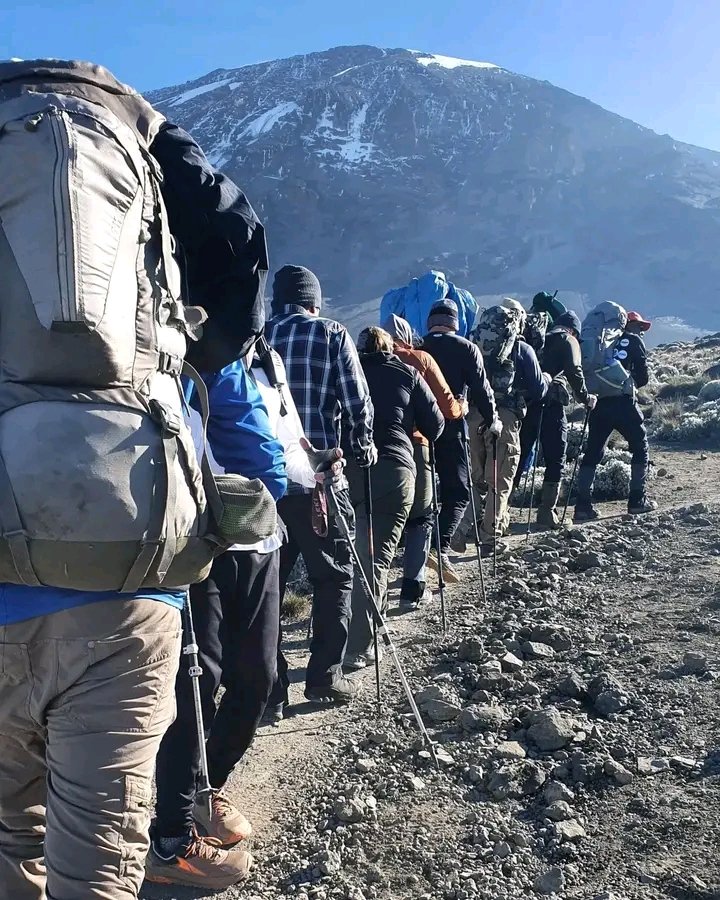
A slow and controlled pace gives you the opportunity to conserve energy and adapt.
This is why you will hear your guides use the famous Swahili expression:
Pole pole.
It means:
Slowly, slowly.
It is one of the most useful phrases you will learn before climbing Kilimanjaro.
How Long Does the Final Summit Push Take?
The exact timing varies by route.
But the basic pattern is similar.
You spend the night at a high camp, usually after reaching the camp during the previous afternoon.
You have an early dinner.
You organize your summit clothing and equipment.
You try to rest.
Then, during the night, you wake up and begin the summit attempt.
The reason for starting at night is to allow climbers to reach the summit around sunrise or in the early morning.
This can provide spectacular views and also helps organize the ascent before conditions become warmer later in the day.
However, starting at night creates another challenge:
You are climbing when your body wants to sleep.
Why Summit Night Feels So Long
Imagine waking up around midnight after several days of trekking.
You are tired.
It is dark outside.
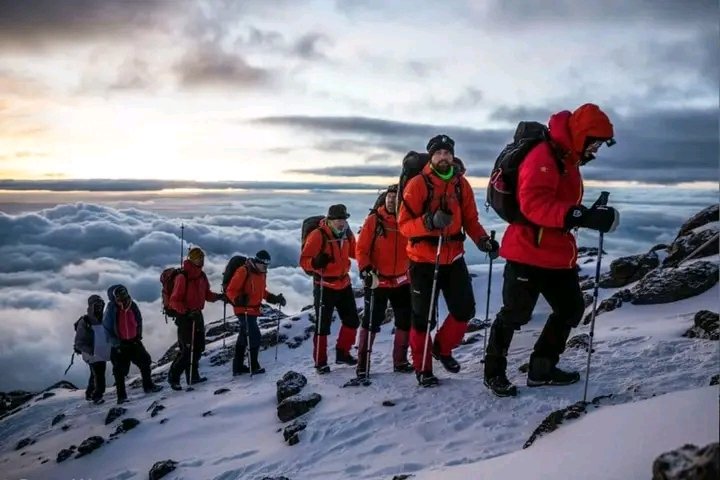
The temperature is extremely cold.
You put on your warmest clothes, switch on your headlamp and begin walking.
At first, you may feel fine.
But gradually, the altitude begins to make itself known.
Your breathing becomes heavier.
Your steps become slower.
The trail becomes steeper.
You take more frequent breaks.
The summit seems very far away.
This is why summit night is often considered the hardest part of a Kilimanjaro trek.
The difficulty isn’t just physical.
It is also psychological.
You know that you have several more hours to go, but you cannot see the summit clearly in the darkness.
The best approach is to stop thinking about the entire mountain.
Think about the next step.
Then the next.
Then the next.
A Realistic Example: The Marangu Route
Eddy Tour and Safaris currently publishes a 5-day Marangu Route itinerary for 2026, 2027 and 2028.
The itinerary includes:
- Day 1: Marangu Gate to Mandara Hut
- Day 2: Mandara Hut to Horombo Hut
- Day 3: Horombo Hut to Kibo Hut
- Day 4: Kibo Hut to Uhuru Peak and back toward Horombo
- Day 5: Horombo Hut to Marangu Gate
The summit day is listed at approximately 12–16 hours, including the ascent to Uhuru Peak and descent.
This demonstrates an important point.
You don’t spend five days simply walking toward the summit at the same speed.
The final day is dramatically longer and more demanding because you are climbing to the highest point and then descending a substantial distance.
The 5-day itinerary is also relatively compressed, providing less time for acclimatization than longer options. Eddy itself notes that the shorter Marangu itinerary has limited acclimatization compared with longer climbs.
For climbers whose primary concern is altitude, a longer itinerary may be worth considering.
What About the Machame Route?
Machame is one of Kilimanjaro’s best-known routes and is often called the Whiskey Route.
Eddy Tour and Safaris currently offers 6- and 7-day Machame itineraries, with the 7-day option allowing more time on the mountain.
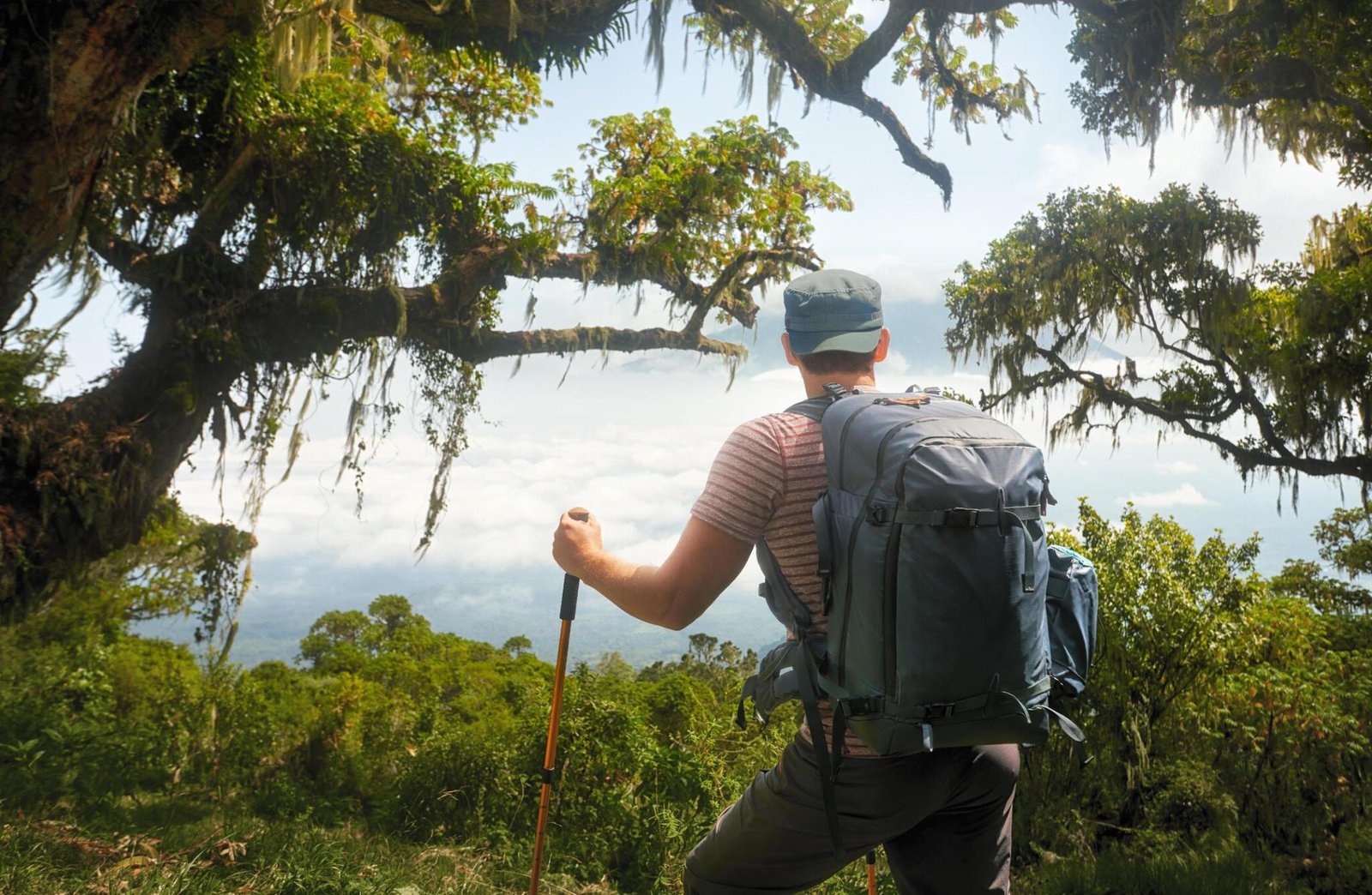
A typical Machame itinerary takes climbers through several different ecological zones before approaching the summit from the southern side.
One of the most valuable features of the route is the opportunity to gain altitude during the day and then descend to a lower sleeping elevation on certain sections.
For example, Eddy’s 7-day Machame itinerary includes a trek from Shira Camp toward Barranco via Lava Tower, reaching approximately 4,630 meters before descending to Barranco Camp at around 3,960 meters.
This is an excellent illustration of the principle:
Climb high, sleep low.
It gives your body exposure to higher altitude while allowing you to sleep at a lower elevation.
How Long Does the Lemosho Route Take?
Lemosho is another popular option for climbers looking for a longer and more gradual approach.
Eddy Tour and Safaris currently offers a 7-day Lemosho itinerary, as well as other Lemosho options.
The route begins on the western side of Kilimanjaro and passes through rainforest, moorland and the Shira Plateau before connecting with the southern circuit.
One of the advantages of a longer Lemosho itinerary is that it gives climbers more time to experience the mountain and adapt gradually.
Eddy’s published 7-day Lemosho itinerary includes a summit attempt starting around midnight, followed by a climb to Stella Point and then Uhuru Peak. The summit day is listed at approximately 12–16 hours, depending on the stage and conditions.
For many travelers, the extra time is worth considering because Kilimanjaro is not an adventure where you necessarily want to take shortcuts.
Which Route Gets You to the Summit Fastest?
If your only objective is to reach the summit in the fewest possible days, shorter itineraries exist.
The 5-day Marangu route is one example.
But there is a major difference between:
“How quickly can I physically reach Uhuru Peak?”
and:
“What itinerary gives me a sensible opportunity to acclimatize and enjoy the climb?”
These are not the same question.
A shorter trek may save time and money, but it can also mean a more compressed acclimatization schedule.
At Eddy Tour and Safaris, we encourage travelers to look beyond the number of days and consider the entire elevation profile.
Why More Days Can Be Better
Many first-time climbers initially think:
The answer is acclimatization.
More days can allow your body to adjust gradually.
It can also mean shorter daily trekking stages before the summit.
You get more time to rest.
You get more time to appreciate the landscape.
And you don’t have to feel as though you are constantly rushing toward the next camp.
For a mountain reaching 5,895 meters, that extra time can be valuable.
Longer does not automatically guarantee success, but it can provide a more gradual experience.
How Long Is Each Day on Kilimanjaro?
Trekking times vary considerably.
Some days may involve only four or five hours of walking.
Other days can require six to eight hours.
Summit day is the major exception.
For example, Eddy’s current 5-day Marangu itinerary lists:
- Day 1: approximately 4–6 hours
- Day 2: approximately 6–8 hours
- Day 3: approximately 5–7 hours
- Summit day: approximately 12–16 hours
- Final descent: approximately 5–7 hours
These are itinerary estimates, not guarantees. Weather, trail conditions, group pace, altitude response and individual fitness can change actual trekking times.
This is why you should avoid thinking of Kilimanjaro as simply a certain number of kilometers per day.
At high altitude, distance alone does not tell the whole story.
Distance Isn’t the Same as Difficulty
A five-kilometer walk at home might take you an hour.
Five kilometers on Kilimanjaro can feel completely different.
Why?
Because you may be:
- At 4,000+ meters
- Walking on rocky terrain
- Carrying a backpack
- Dealing with cold
- Already fatigued
- Sleeping at altitude
- Moving slowly to acclimatize
This is why experienced Kilimanjaro guides don’t simply say:
It’s only five kilometers.
They consider elevation gain, terrain, altitude and the overall condition of the group.
What Happens on Summit Day?
A typical summit day follows a pattern similar to this:
Midnight: Wake Up
You get up, dress warmly and have a light meal.
Around Midnight to Early Morning: Start Walking
Your guide leads the group into the darkness.
Early Morning: Continue the Steep Ascent
The pace remains slow.
Around Sunrise: Approach the Crater Rim
Depending on your route and pace, you may reach a major point on the crater rim around sunrise.
Morning: Continue Toward Uhuru Peak
You continue around the crater rim toward Africa’s highest point.
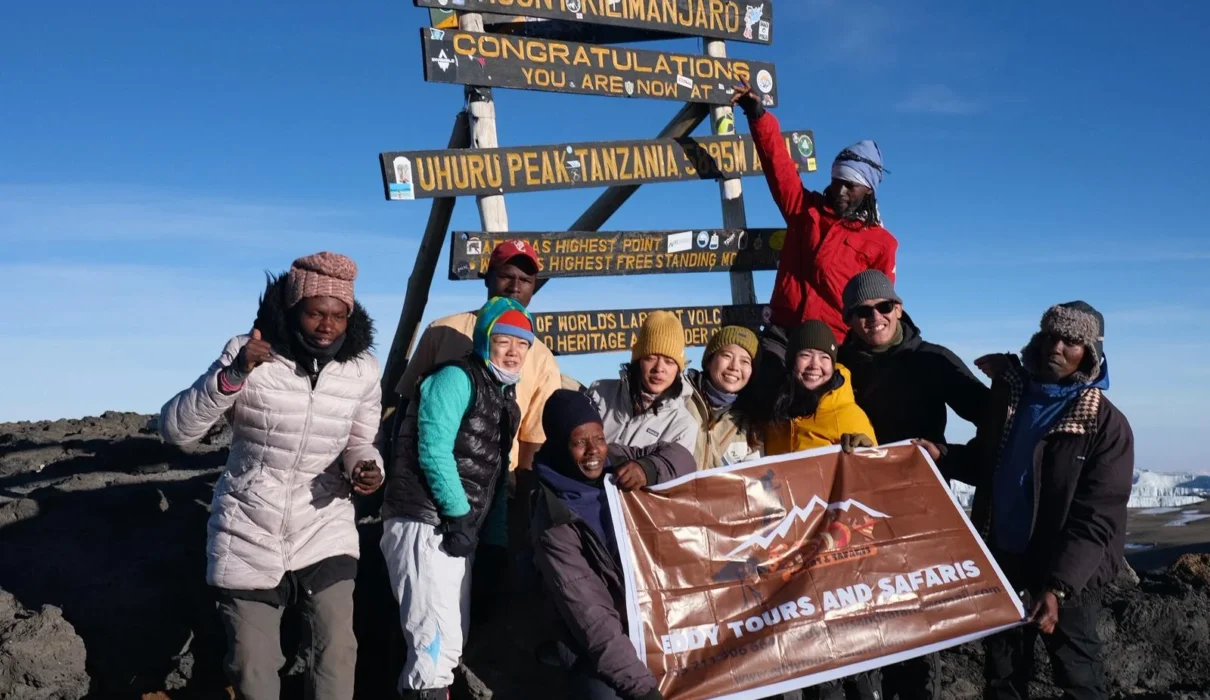
Summit: Uhuru Peak
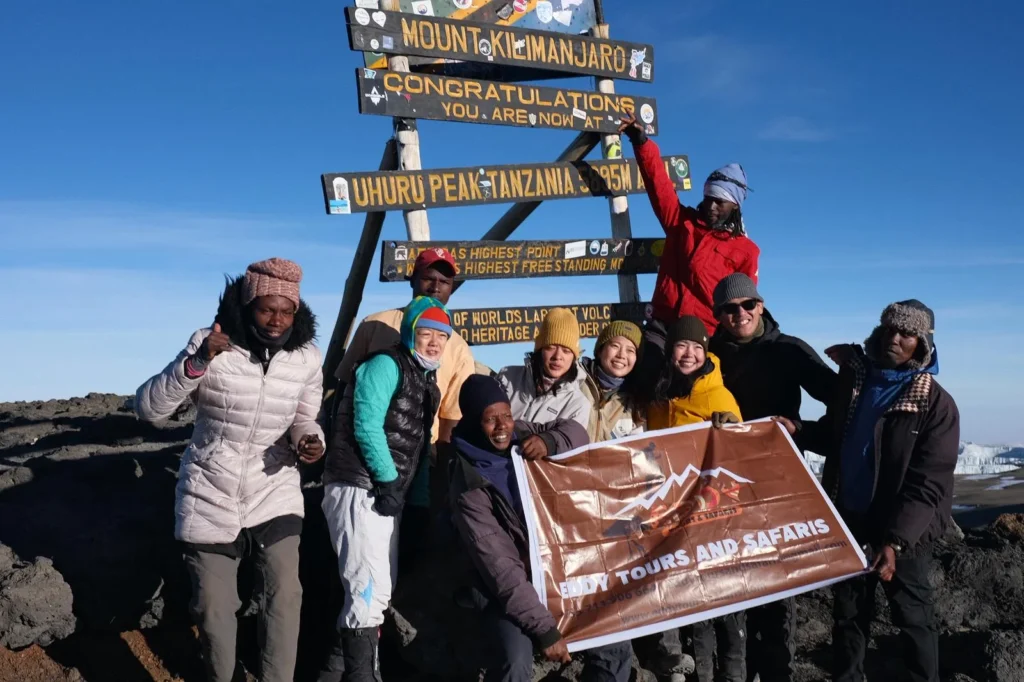
You finally reach the famous summit sign.
You take photographs, celebrate and enjoy the achievement—but you don’t stay unnecessarily long because of the altitude and cold.
Descent
You begin the journey back down.
This is why summit day can become one of the longest and most exhausting days of the entire expedition.
Why Altitude Makes the Summit So Slow
At sea level, your body has access to relatively abundant oxygen.
At nearly 5,900 meters, the environment is dramatically different.
You may feel as though you are working much harder for each step.
This is why the guide’s pace can seem almost unbelievably slow.
You might take a step.
Pause.
Breathe.
Take another step.
Pause.
Breathe.
That is not wasted time.
That is altitude management.
Trying to walk quickly can increase fatigue and make the experience unnecessarily difficult.
What If I Am Extremely Fit?
Being fit is a major advantage.
It can help you:
- Walk for several consecutive days
- Handle steep terrain
- Carry your daypack
- Recover between trekking days
- Manage the physical demands of descent
But fitness doesn’t eliminate altitude risk.
Someone can be extremely athletic and still experience altitude-related symptoms.
This is why preparation should have two parts:
Physical preparation + altitude awareness.
You need both.
How Should You Train for Kilimanjaro?
If you’re planning to climb in 2026, 2027 or 2028, don’t wait until the week before your trip.
Build your endurance gradually.
Walking
Long walks are one of the simplest ways to prepare.
Hiking
If possible, train on hills and uneven terrain.
Stair Training
Stairs can be useful when you don’t have access to mountains.
Leg Strength
Include exercises such as:
- Squats
- Lunges
- Step-ups
- Calf raises
Cardiovascular Training
Running, cycling, swimming and other aerobic activities can help develop endurance.
Consecutive-Day Training
One of the most useful preparations is walking on consecutive days.
Kilimanjaro isn’t just one long hike.
It is several days of hiking followed by an extremely demanding summit day.
The Importance of Choosing the Right Itinerary
If you are booking with Eddy Tour and Safaris for 2026, 2027 or 2028, one of the first questions to discuss is:
Which itinerary is appropriate for me?
Eddy currently presents multiple route options, including Machame, Marangu, Lemosho, Rongai, Umbwe, Northern Circuit and Shira.
The best choice depends on:
- Your available time
- Your hiking experience
- Your budget
- Your physical preparation
- Your preferred scenery
- Your comfort with camping
- Your altitude concerns
Don’t choose solely based on the lowest price.
Instead, compare the number of days, elevation profile, accommodation style and overall experience.
Planning Your Kilimanjaro Adventure
If you are climbing in 2026, you should already be thinking carefully about your itinerary and preparation.
Your priority should be making sure that your selected route fits your available time and physical preparation.
Eddy Tour and Safaris currently promotes Kilimanjaro packages specifically covering 2026, including different routes and itinerary lengths.
If you’re booking for a particular season or date, it is wise to confirm current availability, pricing and itinerary details directly with the operator because these can change.
More Time to Prepare
For climbers planning 2027, there is a major advantage:
You have time.
Use it.
Rather than simply deciding to climb and waiting until the final months, create a structured preparation plan.
You can gradually increase your hiking distance.
You can test equipment.
You can choose between Machame, Lemosho, Marangu and other routes.
You can compare different itinerary lengths.
Eddy currently publishes 2026–2027 Machame options, including a 7-day itinerary designed around a more gradual trekking experience.
That gives prospective climbers a useful starting point when comparing options for 2027.
Plan the Experience, Not Just the Summit
For travelers thinking about 2028, you have even more opportunity to plan carefully.
This is particularly useful if you are traveling with:
- Family
- Friends
- A private group
- A charity team
- A corporate group
- A photography group
You can choose your preferred season, route and itinerary well in advance.
You can also build a long-term fitness program instead of rushing your preparation.
The best Kilimanjaro experience is rarely the one that is thrown together at the last minute.
Does the Full Moon Affect Summit Timing?
Some climbers deliberately plan their summit attempt around a full moon.
The bright moon can illuminate parts of the trail during the nighttime ascent and create a spectacular atmosphere.
Eddy Tour and Safaris publishes full-moon climbing information for 2026, 2027 and 2028, including dates that travelers can use when planning their summit attempt.
However, a full moon should be treated as an optional experience rather than a substitute for a headlamp or proper preparation.
Weather and mountain conditions remain more important than moonlight.
What Should You Expect Emotionally?
One thing people sometimes underestimate is the emotional side of Kilimanjaro.
You may experience excitement on Day One.
Confidence on Day Two.
Fatigue around the middle of the trek.
Doubt before summit night.
And then an incredible sense of achievement when you reach Uhuru Peak.
The summit may not look or feel exactly the way you imagined.
You may be exhausted.
You may have a headache.
You may be too tired to celebrate loudly.
You may simply stand there quietly and take it all in.
That’s okay.
Everyone experiences the mountain differently.
What Does Success Really Mean?
Many people define success as reaching Uhuru Peak.
That’s understandable.
But at Eddy Tour and Safaris, we believe success also means completing the journey responsibly.
That means:
Arriving prepared.
Respecting altitude.
Listening to your guide.
Taking care of yourself.
Respecting the mountain environment.
Returning safely.
The summit is the goal.
Safety is the priority.
If a climber develops serious altitude-related symptoms, turning around can be the correct decision.
No summit is worth risking your life.
10 Tips for Reaching Uhuru Peak Successfully
1. Choose Enough Days
Don’t automatically choose the shortest itinerary.
2. Train Beforehand
Build endurance rather than relying on last-minute fitness.
3. Walk Pole Pole
Slow and steady is the Kilimanjaro philosophy.
4. Listen to Your Guide
Your guide understands the mountain and monitors the group’s progress.
5. Stay Hydrated
Drink regularly according to your needs and your guide’s advice.
6. Eat Even When Your Appetite Drops
Your body still needs energy at altitude.
7. Sleep Whenever You Can
Rest is part of the climb.
8. Dress Properly for Summit Night
Cold can make an already difficult ascent significantly harder.
9. Don’t Compare Yourself With Other Climbers
Altitude affects individuals differently.
10. Break the Summit Into Small Goals
Think about the next section instead of the entire mountain.
The Biggest Question Isn’t How Fast?
When planning your Kilimanjaro climb, you may initially ask:
“How quickly can I reach the summit?”
We recommend asking a different question:
“How can I give myself the best opportunity to reach the summit safely?”
That change in perspective can completely transform the experience.
Kilimanjaro isn’t a sprint.
It is a gradual journey toward one of the highest points on the African continent.
The people who enjoy the experience most are often those who accept the mountain’s rhythm.
They walk slowly.
They rest.
They eat.
They drink.
They listen.
They keep moving.
And they allow the mountain to reveal itself one day at a time.
Final Thoughts: How Long Does It Take to Reach the Summit of Kilimanjaro?
So, how long does it take?
The answer depends on your route.
A typical Kilimanjaro expedition can take around 5 to 9 days or more, while the final summit ascent itself can take approximately 6 up 8 hours of climbing, followed by a long descent.
On some itineraries, the entire summit day can last 12 up 16 hours or even longer, depending on the route, pace, conditions and individual circumstances.
Eddy Tour and Safaris’ published itineraries illustrate this difference clearly. Its 5-day Marangu route lists a 12–16-hour summit day, while its longer Machame and Lemosho programs spread the journey across additional days to provide a more gradual experience.
For climbers planning their adventure in 2026, 2027 or 2028, the most important lesson is this:
Don’t measure Kilimanjaro only in hours.
Measure it in preparation.
Measure it in acclimatization.
Measure it in patience.
Measure it in the number of careful steps you take toward the summit.
Because when you finally stand at Uhuru Peak, 5,895 meters above sea level, you won’t remember whether you reached the summit ten minutes earlier or later than another climber.
You’ll remember that you made it.
You’ll remember the sunrise.
You’ll remember the people who walked beside you.
You’ll remember your guide encouraging you with:
Pole pole.
And you’ll understand why Kilimanjaro is about much more than simply reaching the top.
It is about the journey.
Frequently Asked Questions
How many days does it take to climb Mount Kilimanjaro?
Most trekking itineraries take approximately 5–9 days on the mountain, depending on the route and itinerary. Longer options are also available. Eddy Tour and Safaris currently offers several route and itinerary choices, including Marangu, Machame and Lemosho.
How many hours does it take to reach Uhuru Peak?
The final ascent commonly takes several hours, often around 6–8 hours, although individual times vary. The summit day can be much longer because it includes the descent.
How long is summit day?
It varies by route. Eddy Tour and Safaris’ current 5-day Marangu itinerary estimates approximately 12–16 hours for the summit day.
What time do climbers start the summit?
Most summit attempts begin around midnight or during the early morning hours. The exact time depends on the route, camp location, group pace and guide’s plan.
Is a shorter Kilimanjaro route better?
Not necessarily. A shorter itinerary may suit travelers with limited time, but additional days can provide more opportunities for acclimatization and a less rushed experience.
Which route should I choose for 2026, 2027 or 2028?
There is no single best route for everyone. Machame and Lemosho are popular choices for climbers looking for scenic and more gradual itineraries, while Marangu offers hut accommodation and a shorter itinerary. Eddy Tour and Safaris also offers Rongai, Umbwe, Northern Circuit and Shira options.
Can a beginner climb Kilimanjaro?
Yes. Technical mountaineering experience is generally not required for the standard trekking routes, but beginners should prepare physically and take altitude seriously.
Is Kilimanjaro difficult?
Yes. The main challenges include altitude, long trekking days, cold conditions, steep sections and the demanding summit night.
What does “pole pole” mean?
“Pole pole” is Swahili for “slowly, slowly.” It is a common phrase used by Kilimanjaro guides to encourage climbers to maintain a controlled pace.
Is reaching Uhuru Peak guaranteed?
No. No responsible operator should guarantee that every climber will summit. Individual responses to altitude vary, and safety decisions may require a climber to stop ascending or descend.
Plan Your Kilimanjaro Climb With Eddy Tour and Safaris
Whether you are considering 2026, 2027 or 2028, planning early gives you time to select an itinerary that fits your goals.
Eddy Tour and Safaris currently offers Kilimanjaro routes including Machame, Marangu, Lemosho, Rongai, Umbwe, Northern Circuit and Shira, with different itinerary lengths and trekking styles.
The right trip is not necessarily the shortest one.
It is the one that gives you a realistic opportunity to enjoy the mountain, acclimatize properly and make informed decisions throughout the trek.
Take your time. Train properly. Choose your route carefully. Walk pole pole.
And when the summit finally comes into view, take a moment to appreciate how far you have come.
Uhuru Peak is not reached in one step.
It is reached through thousands of small ones.