
Antelopes and Gazelles of Africa Explained is a practical guide for safari travellers who want to recognise more than lions, elephants and giraffes. On the plains of Tanzania, antelopes and gazelles are often the animals you see most often. They are also the animals that make the whole ecosystem work. Predators follow them, birds feed near them, and their movements help tell a guide what is happening across the landscape.
At first, they can all look similar: brown coats, horns and quick legs. After a few game drives, the differences become clear. A gazelle flicks its tail and springs away. An impala gathers under acacias. A waterbuck stays close to water. A shy kudu disappears into thick bush. A wildebeest has the build of a heavy antelope but looks like nothing else. This article helps you notice those details on your next Tanzania safari with Eddy Tours & Safaris.
What is the difference between an antelope and a gazelle?
Gazelles are antelopes, but not all antelopes are gazelles. “Antelope” is a broad everyday term used for many hoofed, ruminant mammals in the family Bovidae. This large group includes impala, eland, kudu, waterbuck, reedbuck, hartebeest, wildebeest, dik-dik and many other African animals. Gazelles are a smaller group of light, graceful antelopes, usually associated with open plains and known for speed, alertness and slender horns.
Safari guides often use common names because they are easier for guests. Scientific classification can be more complicated, and names sometimes change as research develops. For the traveller, the useful point is behaviour and habitat. Ask: is the animal grazing or browsing? Is it alone, in a family group or a large herd? Does it favour open grass, river edges or dense woodland? Those questions make identification easier than trying to memorise every Latin name.
Why antelopes matter so much on an African safari
Antelopes and gazelles are central to African ecosystems. They turn grass, leaves, shoots and seeds into food for lions, leopards, cheetahs, wild dogs, hyenas and crocodiles. Their different feeding habits allow many species to live in the same area. A giraffe reaches high leaves, an impala browses lower vegetation and grazes when conditions allow, a zebra crops grass differently from a wildebeest, and a gazelle can select tender shoots from open ground.
They are also excellent early-warning systems. Watch a herd closely and you may notice every head suddenly facing the same direction. Ears turn, tails stiffen and the group becomes silent. Your guide may then look for a lion, leopard or hyena before it is visible to anyone else. The prey animals usually see or smell danger first. On a slow game drive, their behaviour can lead to some of the best wildlife sightings.
The main antelopes and gazelles you may see in Tanzania
Wildebeest: the famous migration antelope
Wildebeest are perhaps the best-known antelope of East Africa, especially because of the Great Migration in Serengeti and the Ndutu area. They have a heavy front end, narrow hindquarters, curved horns, a beard and an almost puzzled expression. Their calls carry across the plains, particularly when large herds are moving or gathering.
Blue wildebeest dominate Tanzania’s northern safari circuit. They are grazers and depend on seasonal grass. Their yearly movement with zebra and gazelles is driven by rainfall and grazing conditions, not a fixed calendar. In the calving season, many young are born on the southern plains; later, the herds move through central, western and northern Serengeti. Exact positions vary every year, so a good migration safari is planned around current conditions rather than promised as one guaranteed river-crossing event.
Zebra are not antelopes—but often travel with them
Zebra are horses, not antelopes, but they deserve a mention because they are usually alongside wildebeest and gazelles. Their different grazing style complements the herd. On migration drives, look at the mixture rather than only the number of wildebeest. A line of zebra can signal movement across the horizon, while young wildebeest and alert Thomson’s gazelles add movement at ground level.
Thomson’s gazelle: the small, fast plains specialist
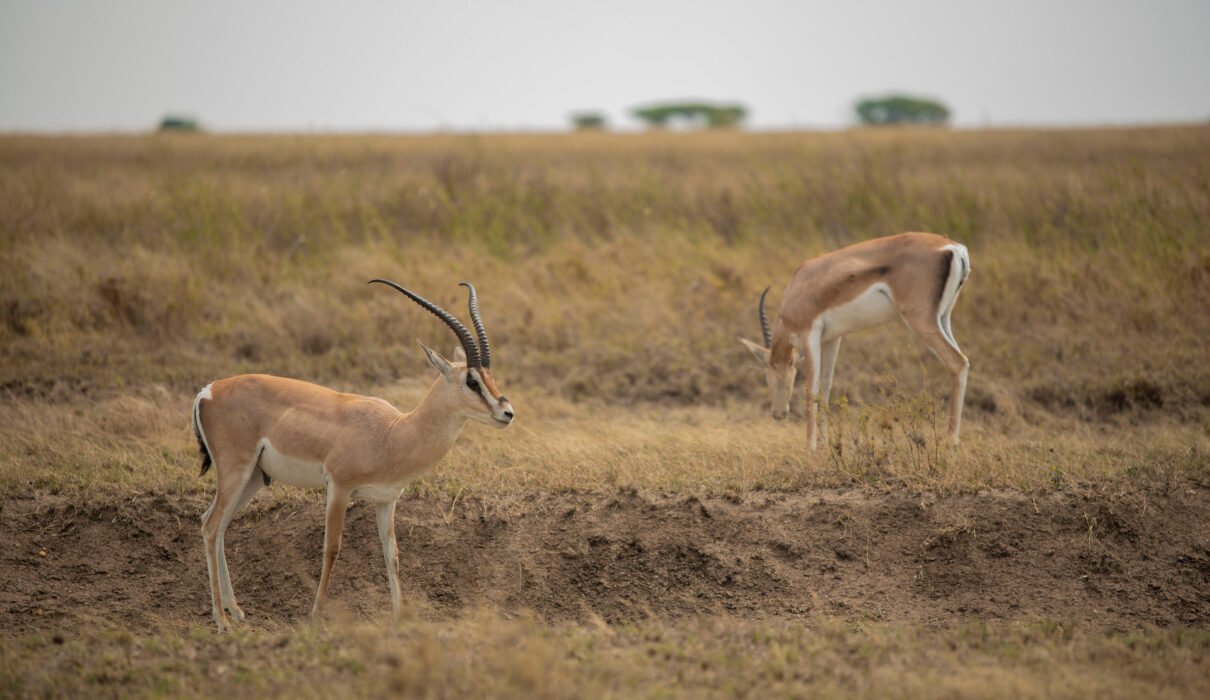
Thomson’s gazelle, often called a “Tommie,” is one of the most common small gazelles in open grassland. It has a warm brown back, white belly and bold black stripe along the side. Both males and females can carry horns, though males usually have thicker, longer ones. Tommies often keep their heads down feeding, then snap upright together at the smallest sign of danger.
They are well known for stotting or pronking: a high, springing leap with all four feet leaving the ground. It can look playful, but it may signal fitness to a predator or help the animal see over grass. Cheetahs hunt Thomson’s gazelles in some areas, so watching a scattered group can be a clue that the open plain is worth scanning carefully.
Grant’s gazelle: larger, paler and more independent
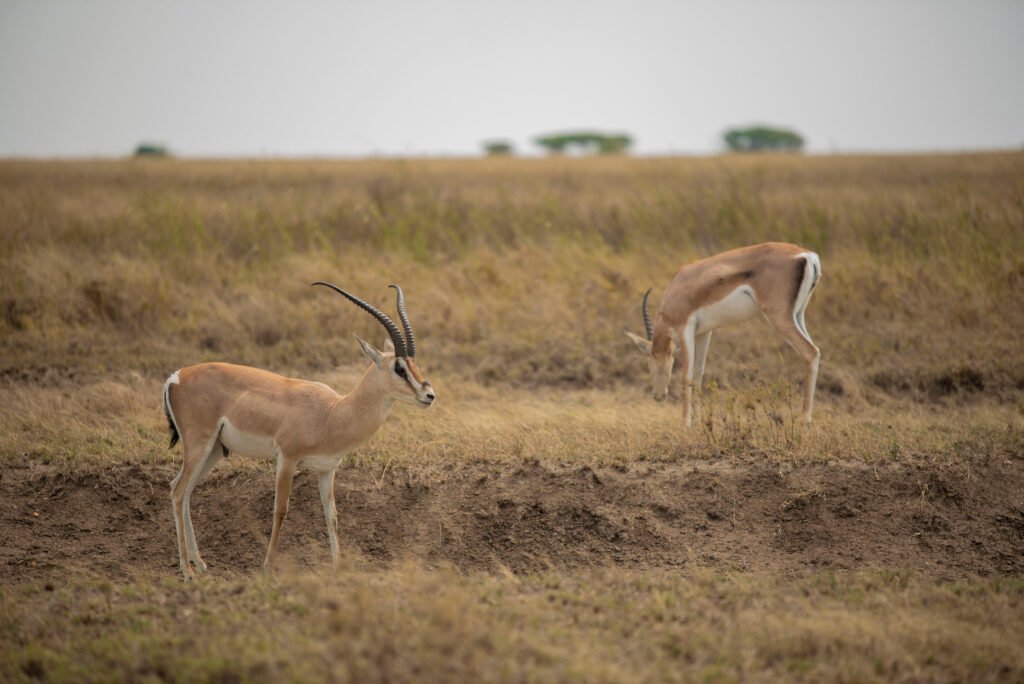
Grant’s gazelle is larger than Thomson’s gazelle and often looks paler, with a white rump patch and long, elegant horns. It is commonly seen in drier, more open country and may occur where water is scarce. Unlike many animals, it can obtain much of its moisture from the plants it eats, which helps it use dry habitats effectively.
A simple field mark is the side stripe: Thomson’s gazelle has a strong black band down the flank, while Grant’s generally lacks that obvious stripe. Do not worry if you cannot identify every gazelle on the first day. Ask your guide to point out one clear individual, study it for a minute, then the difference starts to stay in your mind.
Impala: the animal with the reddish coat and black tail marks
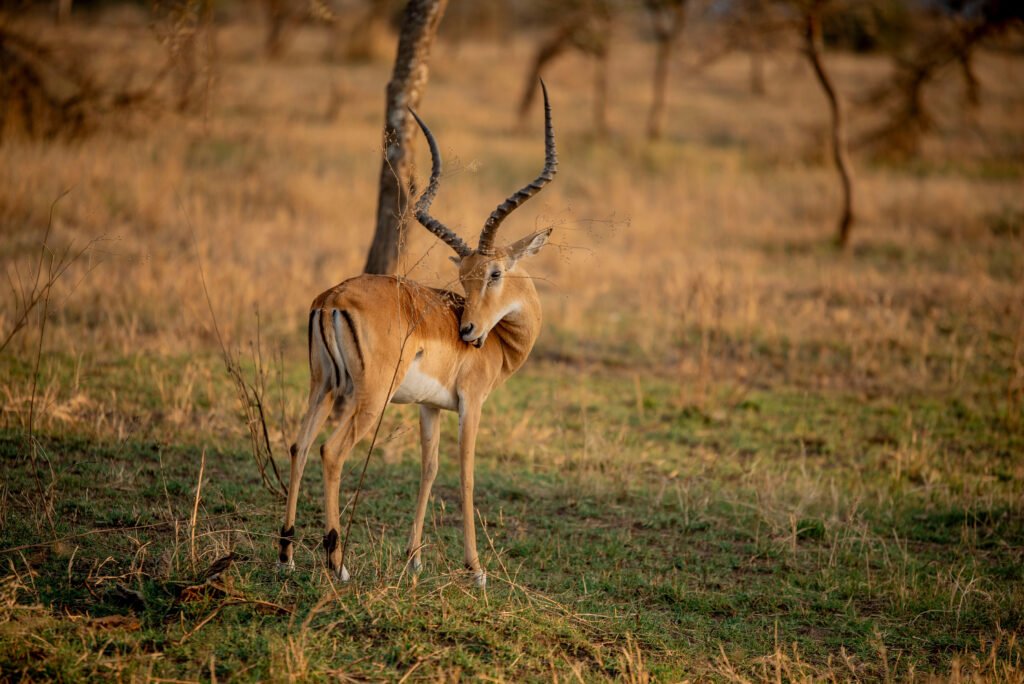
Impala are among the easiest antelopes to recognise once you know their markings. They are medium-sized, reddish-brown and have black lines on the back of the thighs and tail. Males have graceful lyre-shaped horns; females do not. You often see impala in groups under acacias, along rivers or on the edge of woodland, where they can browse leaves and also graze fresh grass.
Impala are athletic jumpers. In a sudden alarm, they may leap high and bound through the bush in a way that makes them appear almost weightless. During the rut, males defend small territories and gather females, while rival males posture and clash horns. Their social life is active and entertaining, so even guests who have seen many impala usually stop to watch when a bachelor group starts sparring.
Waterbuck: the antelope with the white ring
Waterbuck are larger and shaggier than impala, with a grey-brown coat and a distinctive white ring around the rump. Males carry long, ridged horns that sweep upward and forward; females do not. As their name suggests, they are often found close to rivers, lakeshores and wet grassland. Tarangire, Lake Manyara and the wetter parts of Serengeti are good places to look for them.
They are not elegant sprinters in the same way as a gazelle, but water is an important refuge. A waterbuck may enter it to escape a predator, although water itself can contain danger from crocodiles. Their coarse coat and strong scent are commonly noted by guides. Look for them near vegetation, not on the barest open plains.
Common eland: Africa’s largest antelope
The common eland is Africa’s largest antelope, and it can surprise people because of its size. An adult bull is massive, with a heavy neck, dewlap and spiral horns. Females are lighter but still large. Despite this, eland can move quietly and jump far better than their size suggests. They are usually seen in small herds in woodland, bushland or open grass country.
In northern Tanzania, eland are possible in Serengeti, Ngorongoro and Tarangire, though they are not always as obvious as impala or wildebeest. Their pale vertical body stripes can be visible in good light. Listen closely when they walk: the tendons in their legs can make a clicking sound, a small detail that your guide may point out when the herd is nearby.
Greater kudu: the master of camouflage
Greater kudu is one of Africa’s most handsome antelopes. The body is grey-brown with thin white stripes, the ears are large, and adult males carry spectacular long spiral horns. The horns can look impossible in thick bush, yet kudu move quietly through cover and are often noticed only when they turn their head.
Kudu prefer thicker woodland and bush, so they are more likely in Tarangire and other wooded safari areas than on the middle of the Serengeti plains. Females and young may form small groups, while mature males are often solitary or loosely associated. If you see what looks like a striped shadow beside a thicket, keep looking. It may be a kudu standing still and relying on camouflage.
Hartebeest and topi: built for the open country
Hartebeest have long faces, high shoulders and a sloping back that gives them an unusual outline. Their horns are short and curved, and their build is made for steady travel over open ground. They are social grazers and are often seen in groups, scanning from a distance. Coke’s hartebeest is a familiar species in northern Tanzania.
Topi are close relatives with a striking darker blue-purple sheen on the legs and upper body. They favour open plains and often stand on termite mounds, using the slight height to watch for danger or display to rivals. During breeding periods, males may defend territories vigorously. When a guide points at an animal on a mound, it is very often a topi.
Reedbuck, oribi and steenbok: small antelopes worth slowing down for
Not every important antelope is large. Reedbuck are usually found near tall grass and wetter ground. Males have short, hooked horns and may stand still before giving a whistling alarm and bounding away. Oribi are smaller and delicate, usually seen in open grassland; only males have short straight horns. Steenbok are tiny, reddish antelopes that often occur alone or in pairs in bushy, dry country.
These smaller species are easy to miss from a moving vehicle. Tell your guide you enjoy learning the smaller wildlife, not only the Big Five. A slower drive on the way to camp may reveal a steenbok lifting its head from the grass or a reedbuck disappearing through a wetland edge. Those sightings often become the ones serious wildlife lovers remember.
Dik-dik: small size, large personality
Dik-diks are among the smallest antelopes in East Africa. They have large dark eyes, a pointed nose and a compact body, usually seen in pairs in dry bush. Males have short horns that are partly hidden by a tuft of hair. They are named for their alarm call, which sounds like a sharp “dik-dik.”
Because they are small and secretive, dik-diks do not need large herds for protection. They rely on cover, alert senses and quick movement. A pair may live in a small territory and use familiar paths through the brush. Seeing one cleanly is a treat, particularly for children or photographers who enjoy detail rather than only dramatic predator action.
How horns help you identify African antelopes
Horns are useful, but use them with care. In most antelope species, horns are permanent structures made around a bony core. They are not shed each year like deer antlers. Their shape differs by species: impala horns curve in a lyre shape, kudu horns twist in a spiral, eland horns also spiral but are heavier, and gazelle horns are slender and ridged.
Sex also matters. In some species both males and females have horns, while in others only males do. Horn size varies with age, so a young male may not look like the textbook picture. Look at the whole animal—body size, coat pattern, habitat and group behaviour—not only the horns. Your guide may identify an animal in seconds because they are combining all those clues.
Grazers, browsers and mixed feeders
A grazer mainly eats grass. Wildebeest, zebra, hartebeest and many gazelles are strongly associated with grazing, though diets can shift with season. A browser takes leaves, shoots and shrubs; kudu and dik-dik are good examples. Impala are flexible mixed feeders, able to browse or graze depending on what is available. This flexibility helps them live in varied habitat.
These feeding differences reduce direct competition. One piece of land can support many animals because they are using different parts of the vegetation. It also explains why a safari can change dramatically in a short drive. Open grassland may hold wildebeest, zebra and gazelles; a nearby acacia thicket may hide impala and kudu; a wet channel may attract waterbuck and reedbuck.
Predators, survival and the importance of the herd
Antelopes live with constant risk. Lions depend heavily on medium and large herbivores. Cheetahs target smaller, fast prey in open areas. Leopards may ambush from cover, and African wild dogs and hyenas can hunt cooperatively. Young animals are especially vulnerable, which is one reason calving seasons attract so much predator activity.
Herds provide safety through many eyes and ears. One animal watches while others feed. An alarm can spread through a group in seconds. Some species share space with other herbivores, gaining more warning signals. Being alert does not always save an animal, but it improves the chance of detecting a threat early enough to run, hide or group together.
Best parks in Tanzania for antelope and gazelle watching
Serengeti National Park is the top choice for wildebeest, zebra, Thomson’s gazelle, Grant’s gazelle, topi, hartebeest and a vast range of predator-prey interactions. The season changes what you see, so ask us to place your Serengeti nights in the right area for your dates.
Tarangire National Park is excellent for impala, waterbuck, kudu, eland, dik-dik and bush-loving species, as well as elephants and baobabs. Its mixture of river, woodland and dry-country vegetation makes it one of the best parks for seeing different antelope habitats in a single day.
Ngorongoro Crater offers a compact wildlife day with wildebeest, zebra, gazelles, buffalo, waterbuck and predators. It should be viewed as a complete ecosystem rather than a guarantee of a checklist. A full early descent gives more time to notice the smaller animals as well as the famous ones.
Simple tips for photographing and observing antelopes
- Look for the eye and ear position before taking a photograph; alert animals create stronger images.
- Ask your guide to stop at a respectful distance and never request off-road driving.
- Use binoculars before moving closer; identification is often easier than expected.
- Photograph the habitat as well as the animal—grassland, acacia, riverbank or kopje tells part of the story.
- Watch the herd for five minutes before leaving; behaviour often changes after the first look.
Respect matters. Do not call out, throw food or pressure a guide to push closer to wildlife. Calm, natural animal behaviour is both safer and more valuable than a forced close view. On a private safari, we can allow extra time for your favourite species without disturbing them.
Frequently asked questions
Are gazelles deer?
No. Gazelles are antelopes in the bovine family, while deer belong to a different family. Antelope horns are usually permanent; deer grow and shed antlers.
What is the biggest antelope in Africa?
The common eland is Africa’s largest antelope. Adult males can be very heavy, but they remain surprisingly agile.
Which antelope takes part in the Great Migration?
Blue wildebeest are the main migrating antelope in Tanzania, travelling with large numbers of zebra and other grazing animals. The timing and location depend on seasonal conditions.
Can I see antelopes on a short Tanzania safari?
Yes. Even a two- or three-day route through Tarangire and Ngorongoro can show several species. A longer safari to Serengeti provides more habitat and a greater variety.
Plan your Tanzania wildlife safari with Eddy Tours & Safaris
Knowing the antelopes and gazelles of Africa changes the way you see a safari. The plains are no longer just a background for predators; they are a living map of different animals, feeding styles, family groups and survival strategies. Let us know if wildlife identification, photography or the Great Migration is important to you, and we will build more time into the right parks.
Start with Eddy Tours & Safaris or send your request through our contact page. You can email eddytoursandsafaris@gmail.com or sales@eddytours-safaris.com, or call and WhatsApp +255 711 906 664. If you are also planning a mountain climb, explore ideas at Kilimanjaro Climb Specialist. For current personal health guidance before travel, use Google to find a qualified travel-health clinic near you.