
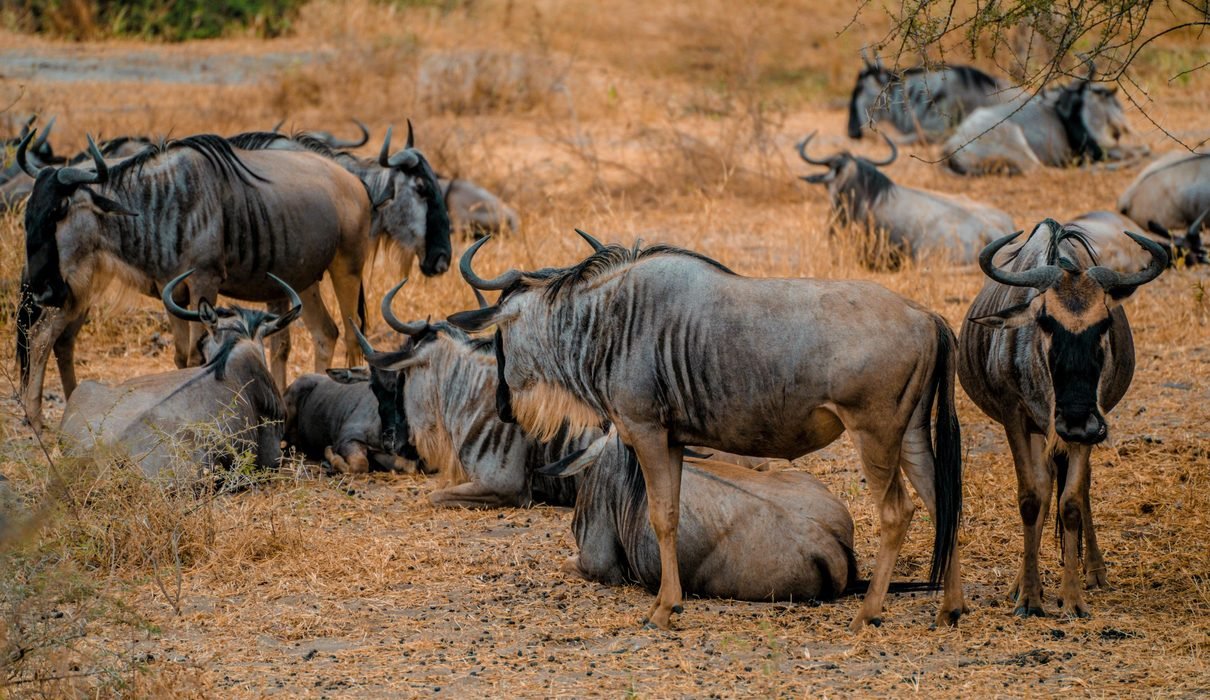
Facts About the Blue Wildebeest help explain why this animal deserves more than a passing look on safari. The enormous herds are impressive, but individual animals are interesting too. Watch for a while and you may notice calves following their mothers, males standing apart from the group and animals repeatedly lifting their heads between mouthfuls of grass.
The blue wildebeest is closely associated with the Great Migration in Tanzania and Kenya. Yet its life involves more than travelling across the plains. Finding enough food, reaching water and raising a calf are daily challenges.
Understanding these details can change how you watch a herd. A quiet grazing scene becomes part of a much larger story about survival.
If you are planning a Tanzania safari, allow time to observe wildebeest behaviour rather than looking only for a dramatic river crossing.
1. The Blue Wildebeest Is an Antelope
Its broad face and heavy shoulders may remind you of cattle, but the blue wildebeest is an antelope. Its scientific name is Connochaetes taurinus, and it is also known as the common wildebeest or gnu.
There are two wildebeest species: the blue wildebeest and the black wildebeest. They should not be confused simply because both can have dark coats.
The wildebeest associated with the Serengeti–Mara migration is the western white-bearded form of the blue wildebeest. The Convention on Migratory Species identifies it as Connochaetes taurinus mearnsi.
On safari, ask your guide to explain the features you are seeing. Looking carefully at the beard, horns and body shape is more useful than judging the animal by colour alone.
2. “Blue” Does Not Mean a Bright Blue Coat
The name can create a misleading picture.
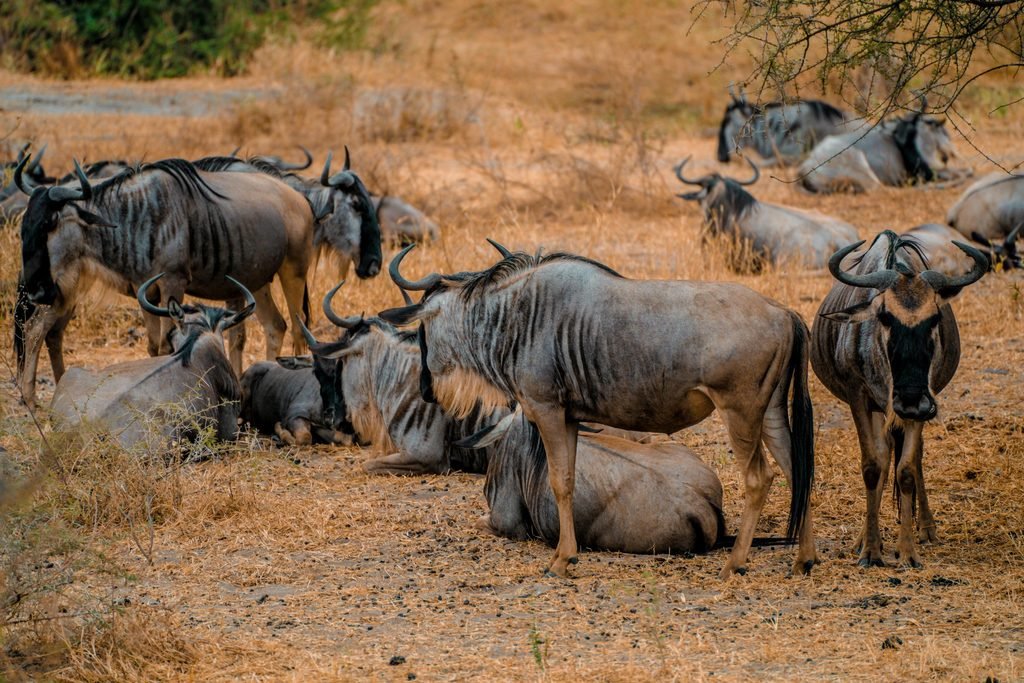
Blue wildebeest have grey or brownish coats, sometimes with a silvery appearance. They also have darker markings, a mane and a long-haired tail. Colour varies with age and the form of wildebeest you are watching.
Both males and females have horns. Males are generally larger, while calves look noticeably different from mature animals. SANParks describes these differences in its blue wildebeest species account.
Light and distance can make identification difficult. Binoculars help you see details without asking the driver to move closer.
Take time to compare several animals within the same herd. The differences become easier to recognise when you look beyond the first photograph.
3. Grass and Water Shape Their Movements
Blue wildebeest are herbivores. Grass forms the main part of their diet, and suitable grazing is central to where they spend their time.
They also need access to drinking water. SANParks explains that the animals move in search of suitable grass and water.
This helps explain why a landscape full of grass is not necessarily useful throughout the year. Its value changes as vegetation grows, dries and is grazed.
When watching a herd, ask your guide about the condition of the grass and nearby water sources. Those details can explain the animals’ movements better than a calendar alone.
4. Migration Is a Response to Changing Conditions
The Great Migration follows seasonal changes in rainfall, grazing and water availability.
The herds use different parts of the Serengeti–Mara ecosystem as conditions change. The southern short-grass plains provide important wet-season grazing, while northern areas and the Mara River become important during the dry season.
The movement is not a fixed procession with every animal travelling together.
For visitors, this means choosing accommodation around the likely location of the herds during the travel period. Even then, the daily programme needs some flexibility.
Read Eddy’s explanation of the Great Migration before deciding where to stay.
5. Not Every Blue Wildebeest Joins the Great Migration
The famous Serengeti–Mara movement is one population’s migration. It does not describe the behaviour of every blue wildebeest.
Some populations are resident or have ceased migrating. The Convention on Migratory Species notes this distinction within the wider Greater Serengeti–Mara ecosystem.
Seeing wildebeest therefore does not automatically mean you have found the main migratory herds.
Ask your guide whether the animals belong to a resident population or are part of the seasonal movement. It is a small distinction that makes the sighting easier to understand.
You can enjoy watching wildebeest outside the main migration areas. A smaller group can provide a better opportunity to study individual behaviour.
6. Calves Can Move Soon After Birth
A newborn wildebeest needs to become mobile quickly.
Calves can stand and walk soon after birth, helping them remain with their mothers in an open landscape. This early mobility is an important feature of their survival.
During a calving-season safari, watch how closely a young calf stays beside its mother. Allow the guide to choose a respectful viewing distance.
Avoid pressing for a closer position near a birth or a very young animal. Patience and binoculars are better choices than disturbing the pair.
A birth cannot be scheduled for a game drive. Plan to enjoy the wider scene, including mothers, older calves and grazing herds.
7. Many Females Give Birth Within a Similar Period
Wildebeest births are concentrated into a seasonal period rather than spread evenly throughout the year.
Many calves arriving around the same time can reduce the chance that any one calf is taken by predators. It does not make individual calves safe, but it is part of the species’ reproductive strategy.
Animal Diversity Web describes the relationship between synchronized births, close mother–calf association and protection from predation.
For travellers, the calving season offers more than a chance to see newborn animals. It is an opportunity to spend time watching family groups and the ordinary work of feeding and staying together.
Discuss southern Serengeti and Ndutu travel when comparing migration safari programmes. Confirm the camp location and the area covered by the proposed game drives.
8. Mothers and Calves Recognise Each Other
A large herd may look confusing to a visitor, but a calf’s relationship with its mother is specific.
Young calves remain close to their mothers, and scent helps the pair recognise each other after they have formed that bond.
This is worth watching during a calm sighting. Notice how a calf follows when its mother moves and how the pair settles when the herd pauses.
You do not need an action-filled scene to see something interesting. Tell your guide if you would like more time observing these smaller details.
9. Predators Are Only One Part of the Survival Story
Lions, hyenas and other predators receive much of the attention on safari. Wildebeest are an important food source for several carnivores.
However, access to food and water is also essential. Drought, loss of grazing areas and blocked movement can affect survival on a much wider scale.
The Convention on Migratory Species highlights the importance of the Mara River and the threats created when animals lose access to suitable grazing and water.
A predator encounter is only one moment in an animal’s life. The effort to find enough grass and water continues every day.
10. Wildebeest Help Shape the Ecosystem
Large herds affect the places where they feed and move.
Their grazing influences vegetation, their dung returns nutrients to the ground, and they provide food for predators and scavengers. IFAW describes their importance to nutrient cycling and the wider ecosystem.
This is one reason wildebeest matter beyond their appeal to visitors.
Protecting them involves more than protecting individual animals. It also requires space, functioning water systems and access between the areas they use.
Facts About the Blue Wildebeest: Why River Crossings Are Unpredictable
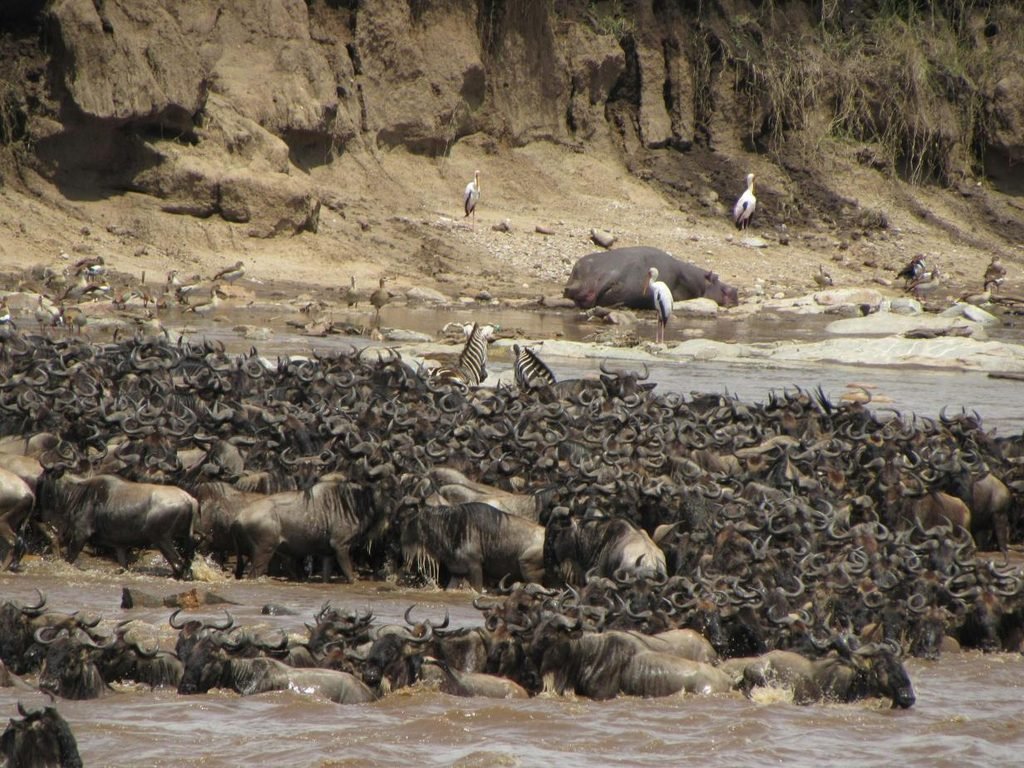
A river crossing is one of the best-known migration scenes, but it is only a small part of the yearly movement.
Animals may gather near the water and wait. They may move away, approach another section or cross when visitors are elsewhere. Being beside a river does not guarantee that you will see a crossing.
If crossings are your main interest, allow several nights in an appropriately located camp. More time provides more opportunities, although it still cannot produce a promise.
Ask the operator to explain:
- Why the proposed camp suits your dates.
- How much driving is needed to reach the viewing area.
- How many full game-drive days are included.
- What other wildlife experiences fit the programme.
- How the guide handles busy sightings.
A good safari remains enjoyable even when the crossing does not happen.
When Should You Plan a Wildebeest Safari?
Choose your dates around the behaviour you most want to observe.
If young calves interest you, discuss the early-year calving period and southern areas. If northern migration viewing is your priority, discuss the months when the herds commonly use that part of the ecosystem.
Treat seasonal guidance as a planning tool. It cannot predict the exact position of the animals on your arrival date.
The Tanzania Tourism guide to travel seasons is useful background when comparing months.
For general wildlife viewing, you may prefer an itinerary that includes several habitats rather than depending entirely on the migration.
How to Watch Wildebeest Without Disturbing Them
Give the animals room to move.
Do not ask your driver to block a herd, chase animals or move too close to a mother and calf. Follow park rules and the guide’s instructions.
At a busy sighting, accepting a more distant view can be the right choice. A longer lens or binoculars lets you observe details without demanding a closer position.
Useful items to bring include:
- Binoculars.
- A camera with a suitable zoom, if photography interests you.
- Spare batteries.
- Protection for equipment against dust.
- A small notebook for observations.
Keep watching after taking the photograph. You may notice more when you put the camera down.
Official visitor information is available from Tanzania National Parks.
Planning Your Trip Around Wildlife Interests
Tell the operator what you want to spend time watching.
“Seeing the migration” can mean different things. You might want broad views of large herds, calf behaviour, river activity or photography with time to wait.
Those preferences affect the route, camp choices and number of nights.
A private Tanzania safari can provide more scope to arrange the programme around your party’s interests. If you prefer shared travel, check the schedule and expectations of a joining safari.
For a shorter holiday, compare a four-day safari and ask whether its destinations suit your priorities. A short general safari is not automatically a migration-focused trip.
Why Conservation of Movement Matters
Wildebeest need access to the resources they use.
Fences, habitat loss and other barriers can prevent populations from reaching grazing and water. SANParks identifies these as concerns for blue wildebeest populations.
You can learn more from the Convention on Migratory Species wildebeest fact sheet and the African Wildlife Foundation’s wildebeest information.
When supporting conservation, check the organisation, the purpose of the contribution and how funds are used. During your safari, following wildlife-viewing rules is a practical contribution you can make yourself.
Frequently Asked Questions
Is a blue wildebeest the same as a gnu?
Yes. Gnu is another name used for wildebeest.
Are both males and females horned?
Yes. Horns alone do not distinguish males from females.
Do all blue wildebeest migrate?
No. Migration varies between populations, and some are resident.
Can newborn calves walk?
They can stand and walk soon after birth, allowing them to follow their mothers.
Can a safari company guarantee a river crossing?
No. Wild animals determine when and where they move.
Is the migration worth seeing without a crossing?
Yes. Large grazing herds, calves and daily behaviour can all make a rewarding wildlife experience.
Plan a Safari with Time to Watch
Wildebeest become more interesting when you give them time. The migration’s scale is impressive, but a mother and calf or a slowly moving herd can tell you just as much about their lives.
Share your dates, group size and wildlife interests with Eddy Tours & Safaris. Ask for an itinerary with suitable camp locations and enough time to observe the animals.
Contact the team to plan your wildebeest safari.
Email: sales@eddytours-safaris.com
Alternative email: eddytoursandsafaris@gmail.com
WhatsApp: +255 711 906 664